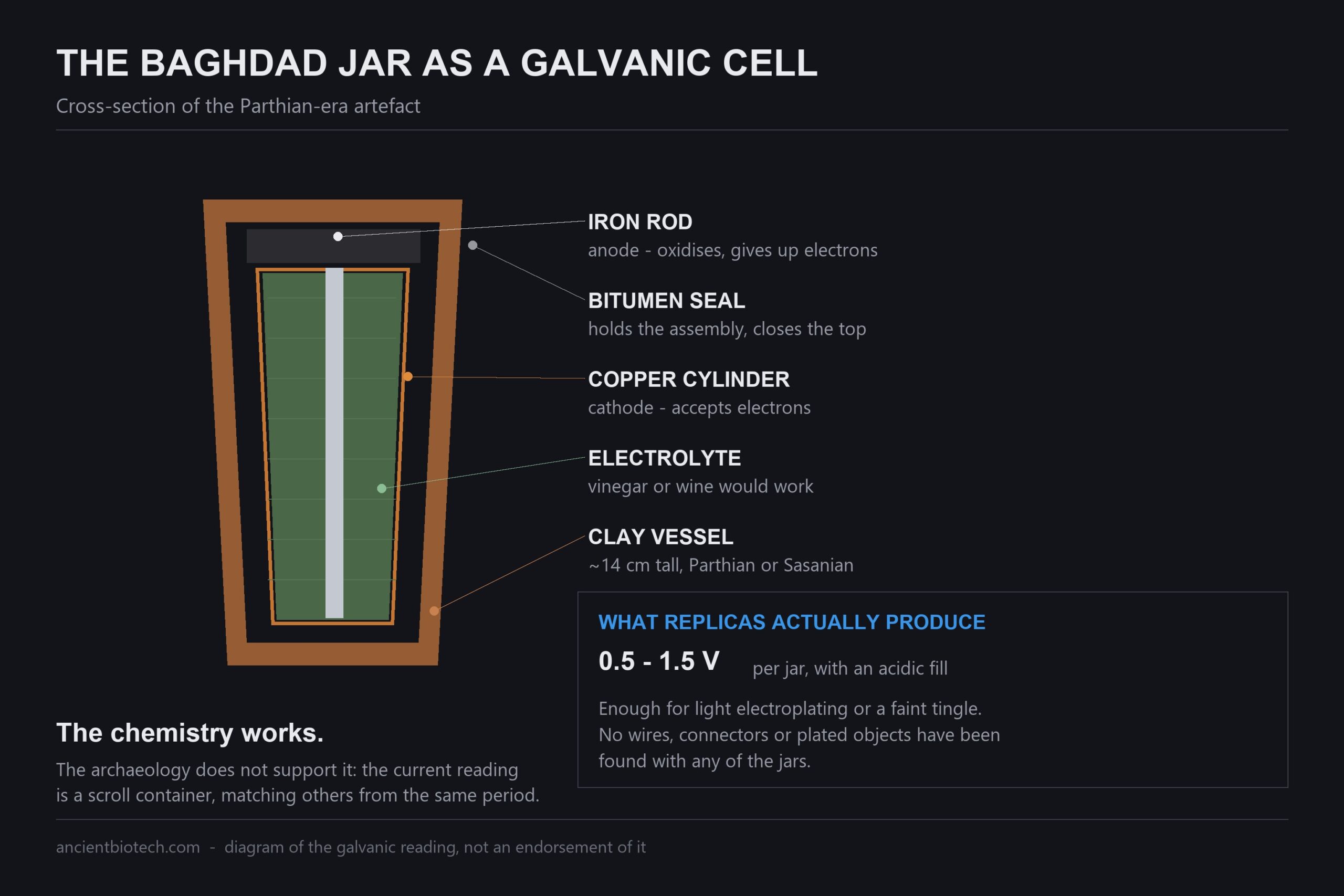
In 1938, the German director of the National Museum of Iraq, Wilhelm König, published a paper about a clay jar in the collection. It was about 14 cm (5.5 in) tall, and inside it were a copper cylinder and an iron rod, held in place with bitumen.
König suggested it was a battery, and the Baghdad Battery has been argued over ever since.
He was not being fanciful. The arrangement — two dissimilar metals, separated, in a sealed vessel — is the arrangement of a galvanic cell. Fill it with something acidic and it will generate a current. That is not a theory; it is chemistry, and it has been demonstrated repeatedly since.
The difficulty is that being able to produce electricity and having been built to produce electricity are different claims, and almost everything written about this object blurs them.
What Is the Baghdad Battery?
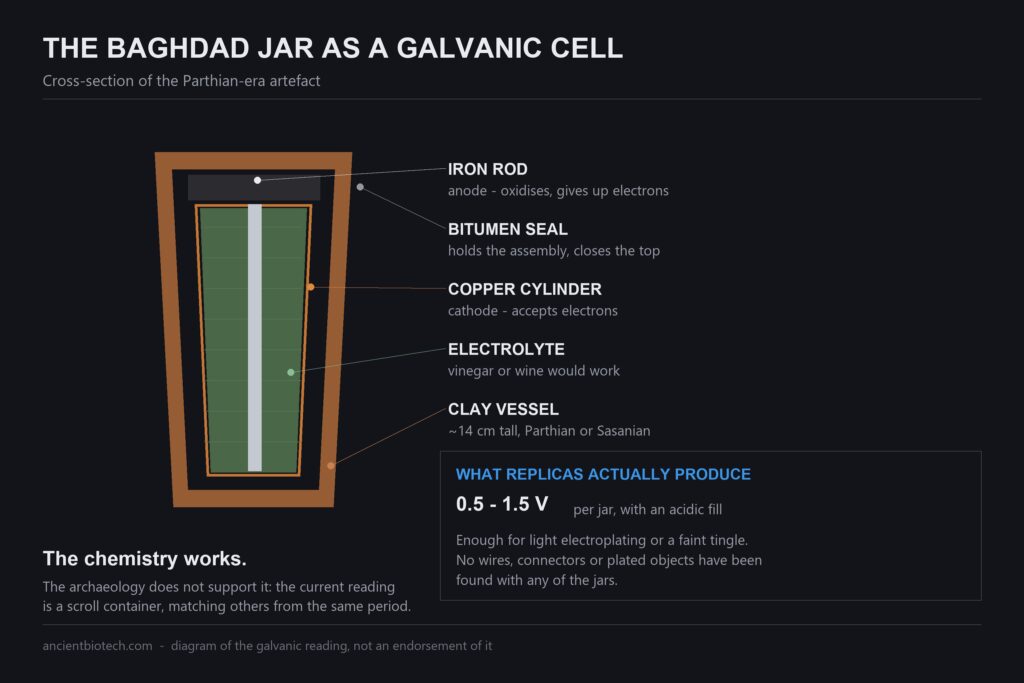
The “Baghdad Battery” is a set of artefacts, the best known found near Khujut Rabu outside Baghdad, consisting of a terracotta jar roughly 14 cm (5.5 in) tall, a copper cylinder inside it, and an iron rod suspended within the cylinder, sealed with bitumen and isolated from it by an asphalt plug. They date to the Parthian (c. 250 BC – AD 224) or Sasanian (AD 224-650) period.
Filled with an acidic liquid — vinegar, wine, grape juice — replicas generate roughly 0.5 to 1.5 volts.
The Chemistry Genuinely Works
This part is not in dispute, and it is worth being precise about it.
A galvanic cell needs three things: two metals with different electrode potentials, an electrolyte, and a path for current. Iron and copper have different standard potentials. Vinegar or wine is an adequate electrolyte. The jar holds it all together.
MythBusters built replicas in 2005 and measured around 4 volts with ten jars wired in series — enough to run small tasks. Other replications, including academic ones, have landed in the 0.5 to 2 V per-jar range depending on the electrolyte.
So if you handed this object to a modern chemist with a bottle of vinegar, they could light an LED with a stack of them. That is real.
Why Archaeologists Do Not Accept It
The professional reading has shifted decisively toward scroll containers, and the reasons are specific rather than dismissive.
The form matches known scroll jars. Comparable vessels from the same period and region, with similar copper cylinders, have been found containing rolled papyrus or parchment. A metal cylinder sealed with bitumen is a good way to protect a document from damp and insects. When the organic contents decay, you are left with exactly what the Baghdad jars contain: a cylinder, a corroded rod, and nothing else.
Nothing else in the assembly is electrical. No wires. No conductors. No connectors. No terminals designed for attachment. To get a useful voltage you need jars linked in series, and no linking hardware has ever been found with any of them.
The seal is in the wrong place. The bitumen seals the cylinder completely, including the top. A cell you intend to use needs access — to refill electrolyte, and to connect a circuit. A fully sealed assembly is what you build to keep something out, not to draw power.
No electroplated objects exist. The most-cited proposed use is gilding by electroplating. If the technique existed, plated artefacts should turn up. Analysis of Mesopotamian gilded objects consistently shows fire-gilding and leaf application, not electrodeposition.
No text mentions it. Mesopotamian and Persian written records are extensive on crafts and materials. Nothing describes anything resembling electricity, current, or a process that would require it.
And the corrosion points the other way. Some examples show corrosion consistent with an acidic agent having been present — which is often cited in favour of the battery reading. But it is equally consistent with an organic content decaying, or with groundwater over two millennia.
The Honest Position
Here is how the evidence actually stacks up.
| Claim | Status |
|---|---|
| The configuration can generate current | True — demonstrated repeatedly |
| It produces about 0.5-1.5 V per jar | True |
| It was designed as a battery | Not supported |
| It was used for electroplating | No evidence — no plated objects, no apparatus |
| Similar jars held scrolls | Documented for comparable vessels |
| Ancient texts describe electricity | No |
The current consensus favours the scroll-container reading, chiefly because it requires no undocumented knowledge tradition and matches comparable finds from the same period. A minority of historians of technology continue to defend the galvanic reading, arguing that the written record for the region is fragmentary and that absence of evidence carries less weight than usual.
That is a real argument, and it is the strongest one the battery reading has. It is also, on its own terms, an argument about what has not survived rather than about what has.
Why the Battery Reading Still Has Defenders
The consensus has not made this claim go away, and the reasons are worth setting out properly, because they are not stupidity.
The claim is demonstrable in one direction only, and that direction is the vivid one. You can build a replica and watch the needle move. That produces a powerful impression of confirmation — but what has been confirmed is that the shape works, not that the shape was chosen for that function. A ceramic bowl will hold water; it does not follow that every ceramic bowl was a drinking vessel.
It also benefits from a real adjacent phenomenon: electricity genuinely does appear in the ancient world, just not as a technology. The Greeks knew about static charge from amber — our word “electricity” comes from elektron, Greek for amber. Egyptian texts describe the electric catfish. Observing an effect is not the same as engineering with it.
This is exactly the distinction that makes the Ark of the Covenant a stronger case than this one. There, the text itself specifies the layer order — gold, wood, gold — and then supplies handling rules with a body count attached. The claim comes from the document rather than from a modern observer noticing that an object could, in principle, do something.
With the Baghdad jar, nothing in antiquity says what it was for. The battery reading originates entirely with König in 1938.
What It Does Tell Us
The object remains genuinely interesting, just not for the reason usually given.
It shows that the physical preconditions for electrochemistry were available in antiquity. Copper, iron, bitumen and vinegar were ordinary materials. The gap between the ancient world and a working cell was not materials or manufacturing capability. It was the concept — nobody had a reason to look for a current, because nobody had a framework in which a current was a thing that could exist.
That is a more interesting conclusion than “the ancients had batteries.” It means the ratelimiting step in technology is often not capability but the question you think to ask. Volta built his pile in 1800 from materials any Roman metalworker could have assembled — copper, zinc, brine-soaked cloth. What Volta had that they did not was two centuries of argument about Galvani’s twitching frog legs, and a reason to care.
The same pattern shows up in the Antikythera mechanism, where sophisticated gearing appears and then vanishes from the record for 1,400 years, and in Roman concrete, where a superior material was in use for centuries before anyone understood why it worked.
Frequently Asked Questions
What is the Baghdad Battery?
A set of Parthian or Sasanian artefacts, the best known found near Khujut Rabu outside Baghdad: a terracotta jar about 14 cm (5.5 in) tall containing a copper cylinder and an iron rod sealed with bitumen. Wilhelm König proposed in 1938 that it was a galvanic cell.
Does the Baghdad Battery actually work?
The configuration does generate electricity. Replicas filled with vinegar, wine or grape juice produce roughly 0.5 to 1.5 volts each, and MythBusters measured about 4 volts from ten jars in series in 2005.
Was the Baghdad Battery really a battery?
The archaeological consensus says no. The current reading is that these were scroll containers, since comparable vessels from the same period have been found holding rolled papyrus or parchment, and no wires, connectors or electroplated objects have ever been found with them.
How old is the Baghdad Battery?
It dates to the Parthian period (c. 250 BC – AD 224) or the Sasanian period (AD 224-650), making it roughly 1,400 to 2,200 years old.
Was it used for electroplating?
No plated object has ever turned up to show it. Analysis of Mesopotamian gilded objects consistently shows fire-gilding and gold leaf rather than electrodeposition, and no plating apparatus has been found. Those who defend the galvanic reading answer that small metal fittings from the region mostly corroded away, so the absence is weaker than it looks. One plated object at a thickness fire-gilding cannot produce would end the argument.
Why is the jar sealed with bitumen?
The bitumen seals the copper cylinder completely, including the top. This is consistent with protecting contents from moisture and insects, and inconsistent with a cell intended to be refilled or connected to a circuit.
Did ancient people know about electricity?
They knew certain effects. The Greeks observed static charge from rubbed amber — the word electricity derives from elektron, Greek for amber — and Egyptian sources describe the electric catfish. Observing the effect is not the same as engineering with it.
What Would Settle It
Strip the case back and the Baghdad Battery reduces to one question: does an object’s capability tell you its purpose?
On its own, both sides agree it does not. The jar can hold a charge — copper and iron in vinegar will always do that, whether anyone intends it or not. Where they part company is over the second thing, the one that has never been found: a wire, a connection, a plated object, a line of text, any component that only makes sense if the first one is a power source.
To most archaeologists that absence is the answer, and the sealed cylinder is the kind that turns up elsewhere with a scroll inside it. To the minority defending the galvanic reading, it is what you would expect from a region whose written record is fragmentary and whose small metal fittings mostly corroded away — and they point out that Antikythera was filed under impossible too, until someone put it in a scanner.
One find would end this in a day. A plated object from the same period and place, at a plating thickness no fire-gilding process produces. Or a second cylinder excavated with its bitumen stopper intact and something still rolled up inside it. Neither has appeared in eighty years, and both are the kind of thing that could appear tomorrow.
The chemistry works. That was never the question. The question is what the people who made it thought they were making, and the object has not said.
Continue Reading
- The Viking Sunstone: How It Works, and What Has Been Found — The physics is settled: a calcite crystal really can locate the sun through cloud. Everything else is argued — the one…
- The Sumerian King List: 241,200 Years Before the Flood — Eight kings, 241,200 years, then a flood. Almost every retelling adds the numbers up — and what that shape means is the…
- Derinkuyu: The Doors Only Close From Inside — Eighty-five metres down, eight levels open of an estimated eighteen, and a half-tonne stone wheel with a spear-hole…