In 1901, sponge divers sheltering from a storm off the Greek island of Antikythera found a wreck. They brought up bronze statues, marble, glassware, coins — a first-century BC cargo ship’s worth of Greek luxury goods, probably bound for Rome.
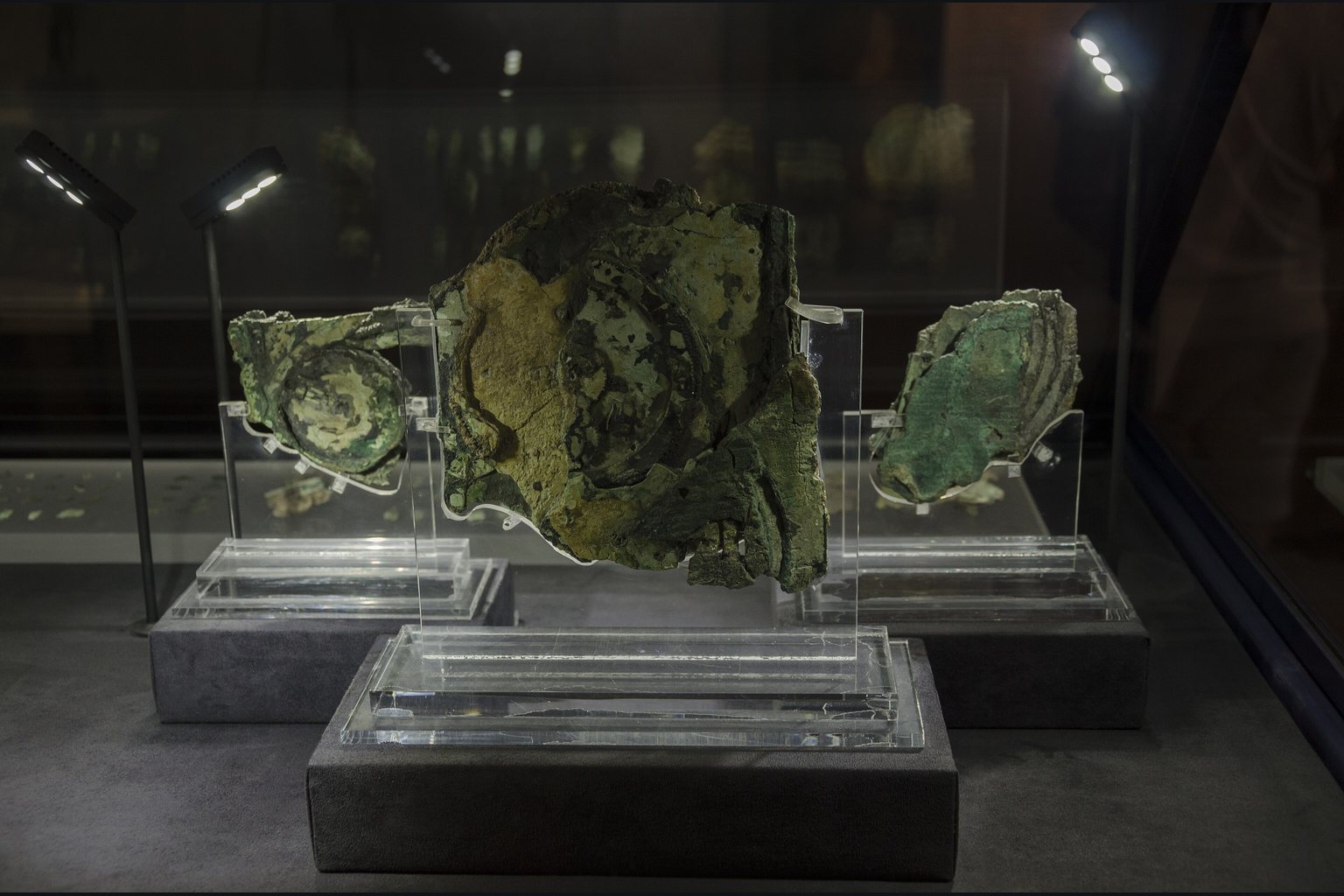
Among it was a shoe-box-sized lump of corroded bronze and rotted wood. It sat in the National Archaeological Museum in Athens, largely ignored, until it split open and someone noticed something inside it.
Gear teeth. Cut into bronze. In an object more than two thousand years old.
Nothing else remotely like it survives from antiquity. Nothing of comparable mechanical complexity appears again in the archaeological record for more than a thousand years.
What Is the Antikythera Mechanism?
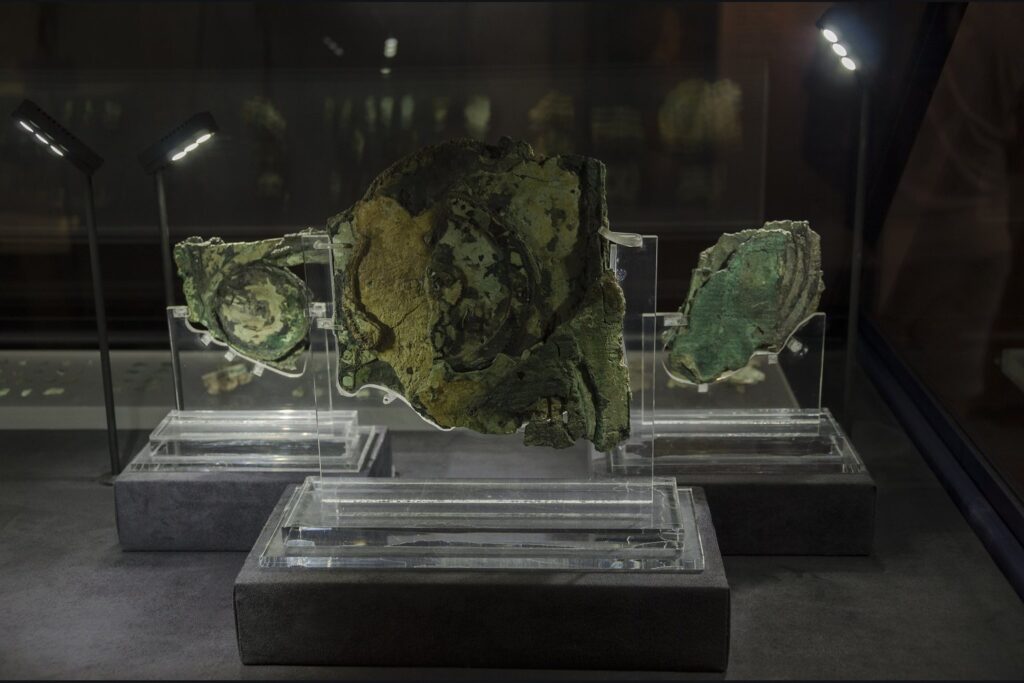
The Antikythera mechanism is a geared bronze device recovered from a shipwreck off Antikythera in 1901, dated to roughly 150-100 BC. It is an astronomical calculator: a hand-cranked analogue computer that modelled the movements of the sun and moon, tracked multiple calendar cycles, and predicted eclipses.
It survives in 82 fragments. Thirty gears have been identified physically, and reconstructions based on the surviving tooth counts and inscriptions suggest the complete device had somewhere in the region of 69 or more.
What It Actually Did
This is the part that is hard to absorb. The mechanism was not a clock or a simple orrery. It performed several distinct astronomical functions simultaneously from a single crank input.
| Function | What it tracked |
|---|---|
| Solar position | The sun through the zodiac and the Egyptian calendar |
| Lunar position | The moon’s position, with its variable speed modelled |
| Moon phase | Displayed by a small rotating silver-and-black ball |
| Metonic cycle | 19 years ≈ 235 lunar months, reconciling solar and lunar calendars |
| Saros cycle | 223 lunar months, used to predict eclipses |
| Exeligmos | 3 × Saros, correcting for the one-third-day offset |
| Callippic cycle | 4 × Metonic, a further refinement |
| Games dial | A four-year cycle naming athletic festivals, including the Olympics |
The eclipse predictions were not merely dates. Inscribed glyphs indicate whether an eclipse would be solar or lunar, give a predicted hour, and in some cases note the expected colour of the eclipsed moon.
The Pin-and-Slot Mechanism
The single most impressive component is a solution to a real astronomical problem.
The moon does not move at a constant rate. Its orbit is elliptical, so it runs faster at perigee and slower at apogee. Hipparchus described this variation in the 2nd century BC.
The mechanism models it mechanically. Two gears are mounted on slightly offset axes, with a pin on one riding in a slot on the other. As they turn, the offset causes the output gear to speed up and slow down across each revolution — reproducing the moon’s variable motion.
That is an elegant engineering answer to a specific astronomical observation, and it is executed in bronze, by hand, in the second century BC.
The device also incorporates differential gearing to compute the difference between solar and lunar positions — which is how it derives the moon’s phase.
How We Know What It Did
The reconstruction is not guesswork, and this is worth stressing because the mechanism attracts a lot of loose speculation.
Gear tooth counts are countable. Where teeth survive, they can be counted directly. Where a gear is partial, the diameter and spacing give the total.
The device is covered in writing. Roughly 3,400 characters of Greek text survive on the plates — effectively an instruction manual and a description of what the dials show. Much of it was unreadable until modern imaging.
Imaging did the rest. In 2005, a collaboration brought in an eight-tonne custom microfocus X-ray CT scanner built by X-Tek, plus polynomial texture mapping to reveal surface inscriptions. The CT data revealed gear trains and text hidden inside the corroded fragments — including the word for the Olympic games, and month names that point to a Corinthian-family calendar, possibly Syracusan.
That last detail is one of the reasons Archimedes keeps being mentioned. He worked in Syracuse and died in 212 BC, and Cicero — writing roughly a century later — describes a bronze sphere made by Archimedes that reproduced the motions of the sun, moon and planets, taken to Rome after the city fell. Cicero also mentions a similar device built by Posidonius.
So the Roman sources tell us such instruments existed and name the makers. The mechanism is the only one that survives.
What Is Still Disputed
The planets. Whether the mechanism displayed the five visible planets is the central open question. The front dial has space for it, some inscriptions describe planetary phenomena, and reconstructions by Michael Wright and by the UCL Antikythera Research Team have proposed full planetary gear trains. But the physical gearing for the planets has not been recovered. It is inference from the inscriptions and the available space.
Whether it was ever built as reconstructed. A 2021 UCL model produced a complete front-dial design consistent with the inscriptions. Whether the surviving fragments could physically accommodate it, and whether the gear train would have worked reliably, remain live questions.
Who made it, and where. The calendar evidence points toward Corinth or its colonies. Rhodes, home to Hipparchus and Posidonius, is the other main candidate. No maker’s name survives.
The Real Mystery Is Not the Machine
The mechanism can be explained. Greek astronomy was mathematically sophisticated — Hipparchus produced a star catalogue and a theory of lunar motion; Babylonian records supplied centuries of eclipse observations; Greek metalworking was capable of fine bronze work. The pieces existed.
The genuinely strange thing is what happened next.
Gearing of this complexity does not reappear in the surviving record until the astronomical clocks of medieval Europe — Richard of Wallingford’s clock at St Albans in the 1330s, Giovanni de’ Dondi’s astrarium in the 1360s. That is a gap of roughly 1,400 years.
Two explanations are possible, and they are not exclusive:
Survivorship. Bronze is valuable and gets melted down. A geared instrument that stops working is scrap metal. The Antikythera mechanism survives only because it sank, and only because it was in a wreck nobody salvaged. There may have been many; we would expect zero to survive on land.
Discontinuity. The tradition may genuinely have been narrow — a handful of specialists in a few centres, whose knowledge was not widely transmitted and died with them. Cicero’s description suggests these were remarkable objects even to educated Romans, not common instruments.
The second reading has an uncomfortable implication: capability can be lost. Not forgotten slowly, but dropped — held by too few people, written down too thinly, and gone within a generation or two when the institutions supporting it fail.
That is a pattern this record keeps producing. Roman concrete outperformed modern formulations for marine work and the recipe was not reconstructed until the 21st century. Procedures preserved without the theory behind them show up repeatedly in ancient texts. Knowledge is not a ratchet. It can go backwards.
Why It Matters for Every Other “Impossible” Artefact
The Antikythera mechanism is the strongest evidence we have that the ancient world could produce things that look anachronistic — and precisely for that reason it is worth being careful about what it proves.
It does not show that ancient people had technology we lack. Everything in it is achievable with Greek mathematics, Greek astronomy and Greek bronzeworking. It is extraordinary craftsmanship applied to a well-understood theory.
What it shows is that our sample of the ancient world is thin, and that absence of evidence is genuinely weak evidence here. One storm, one wreck, one lump of corroded bronze that happened to crack open — and a whole category of ancient capability came into view that no historian had reconstructed from the texts alone.
That is a reason for humility in both directions. It does not license believing every claim about ancient electricity or lost super-civilisations. It does mean that “we have found no other examples” is a weaker argument than it sounds.
Frequently Asked Questions
What is the Antikythera mechanism?
A geared bronze astronomical calculator recovered from a shipwreck off the Greek island of Antikythera in 1901, dated to roughly 150-100 BC. It modelled solar and lunar motion, tracked calendar cycles and predicted eclipses.
How old is the Antikythera mechanism?
Roughly 2,100 years old. Dating from the shipwreck’s cargo and from the inscriptions places it in the second century BC, most commonly around 150-100 BC.
How many gears does it have?
Thirty gears survive and have been identified physically. Reconstructions based on the inscriptions and surviving tooth counts suggest the complete device had around 69 or more.
What did the Antikythera mechanism do?
It tracked the position of the sun and moon, showed the moon’s phase, followed the Metonic, Saros, Exeligmos and Callippic cycles, predicted solar and lunar eclipses with a predicted hour, and displayed a four-year cycle of athletic games including the Olympics.
Who built the Antikythera mechanism?
Unknown. The calendar month names point toward Corinth or its colonies, possibly Syracuse. Cicero describes similar devices made by Archimedes and by Posidonius, but no maker’s name survives on the mechanism itself.
How do we know what the mechanism did?
Roughly 3,400 characters of Greek text survive on its plates, effectively describing its functions. In 2005 a custom microfocus X-ray CT scanner revealed internal gearing and hidden inscriptions inside the corroded fragments.
Did the Antikythera mechanism show the planets?
It is disputed. The front dial has space, and some inscriptions describe planetary phenomena, but no planetary gearing has been recovered. Proposed reconstructions remain inference rather than direct evidence.
Is there anything else like it from the ancient world?
No. Nothing of comparable mechanical complexity survives until the astronomical clocks of 14th-century Europe, a gap of roughly 1,400 years. Bronze was routinely recycled, so survival of such objects on land would be very unlikely.
Conclusion: What a Storm Preserved
Everything we know about ancient geared computation rests on a single object, and that object reached us through a chain of accidents.
A ship sank. It sank in water deep enough that nobody salvaged it and shallow enough that sponge divers eventually reached it. A storm forced those divers to shelter in that particular bay. The corroded lump they recovered was set aside as unimportant, and only drew attention when it cracked apart on its own.
Change any link and we would have no idea this capability ever existed. The Greek texts describing such devices would still be there — Cicero would still mention Archimedes’ sphere — and historians would reasonably have read them as exaggeration.
That is the thing worth taking from Antikythera. Not that the ancients had secret technology, but that what survives is not a sample of what existed. It is a sample of what happened to be dropped in the right place.
Continue Reading
- The Viking Sunstone: How It Works, and What Has Been Found — The physics is settled: a calcite crystal really can locate the sun through cloud. Everything else is argued — the one…
- The Baghdad Battery: The Chemistry Works. That Was Never the Question. — Copper, iron, bitumen and vinegar will produce a current whether anyone intended it or not. What the Baghdad jars…
- Roman Concrete: The Material That Heals Itself — Modern marine concrete fails in 50 years. Caesarea harbour has been in the Mediterranean since 22 BC and is getting…