
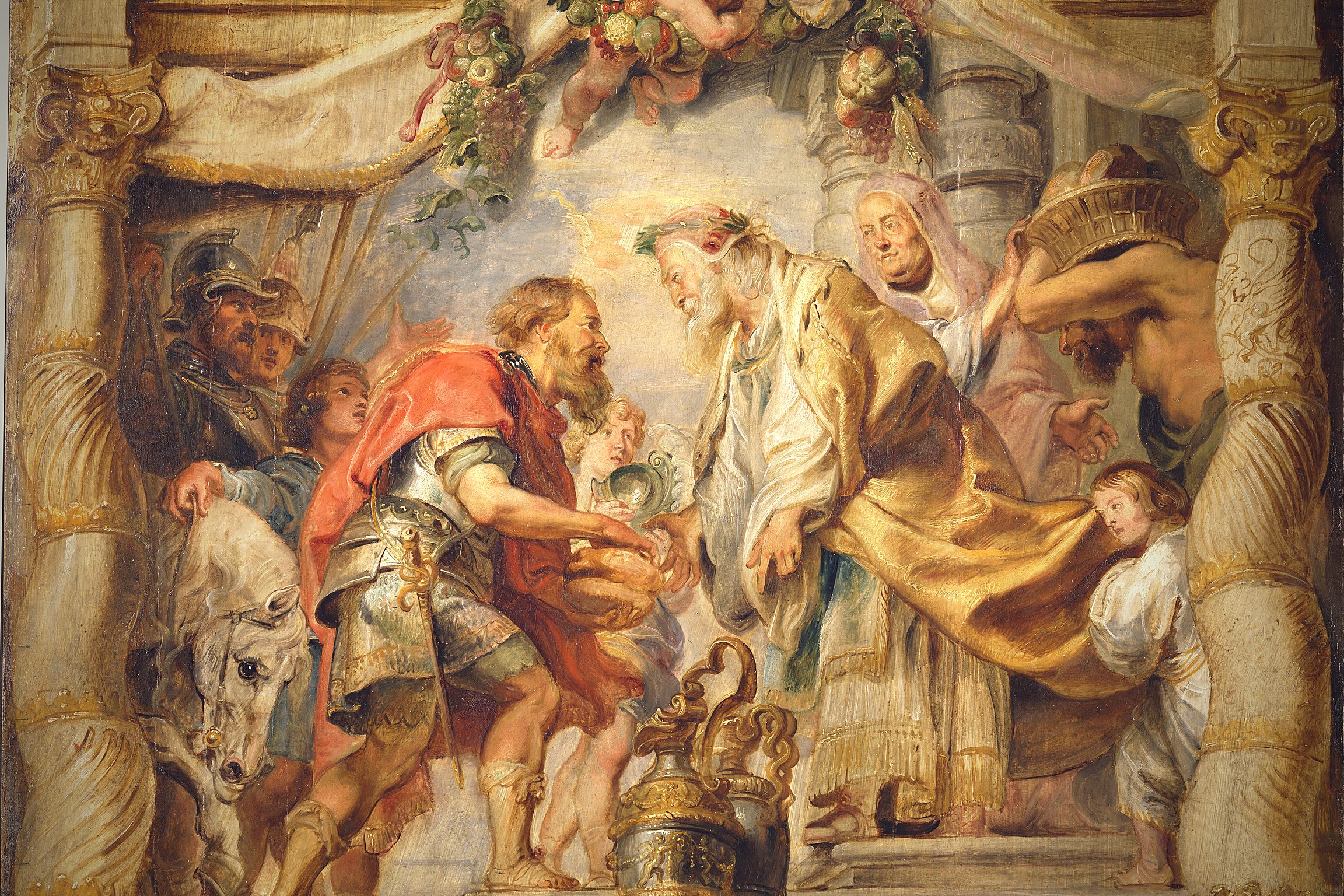
He walks in from nowhere. A priest-king blesses the father of Israel, takes a tenth of the spoils, serves bread and wine, and walks out again — four verses, and no birth, no death, no family named. A thousand years later a psalm swears a divine oath by his name. A thousand years after that, a letter in the New Testament builds an entire priesthood on him, one it says outranks the one God gave Moses.
Who was Melchizedek, and why does the Bible treat a man it barely describes as the pattern for an eternal priesthood? That gap — a few lines of text carrying an enormous theological weight — is why he has been read as everything from a Canaanite chieftain to Shem the son of Noah to the pre-incarnate Christ himself. The text does not close the question. It is worth reading slowly before deciding which answer it supports.
Who Was Melchizedek in the Bible?
Melchizedek is a priest-king named in only three parts of the Bible: a short scene in Genesis 14, a single line in Psalm 110, and an extended argument in the letter to the Hebrews. His name is usually parsed as two Hebrew elements — malki and tsedeq — giving “king of righteousness,” which is exactly how Hebrews 7:2 reads it before adding that, as king of Salem, he is also “king of peace” [1]. He is introduced as “priest of God Most High,” in Hebrew El Elyon, a title for the supreme God that was also current among Israel’s Canaanite neighbours [1].
Everything else about him is disputed, because the text supplies almost nothing to anchor him: no genealogy, no account of how he became a priest with no Israelite priesthood yet in existence, and no exit. That silence is not incidental. It is the raw material every later reading is built on.
Three Appearances, and Nothing in Between
The whole biblical record of Melchizedek fits on a single page.
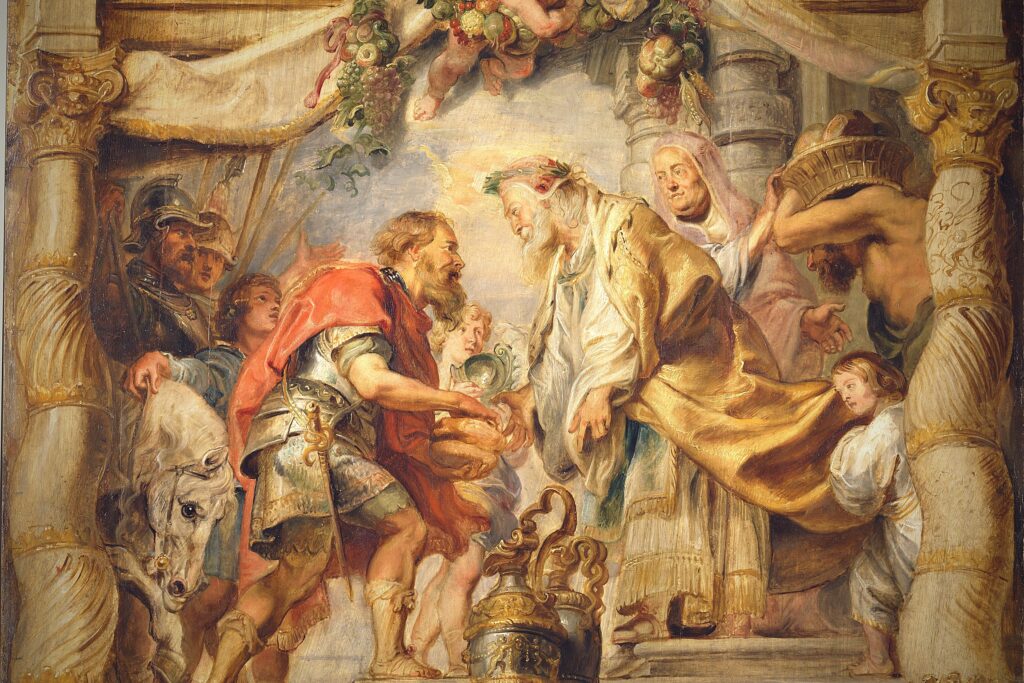
The first is the scene itself. Abram — not yet renamed Abraham — has just rescued his nephew Lot by defeating a coalition of kings, and on his way back he is met by two rulers. One is the king of Sodom. The other is Melchizedek:
“And Melchizedek king of Salem brought out bread and wine. (He was priest of God Most High.) And he blessed him and said, ‘Blessed be Abram by God Most High, Possessor of heaven and earth.’” (Genesis 14:18-19)
Abram gives him a tenth of everything — the first tithe in the Bible — and the scene ends. Melchizedek is never mentioned again in the entire Torah.
The second appearance comes roughly a millennium later, in a royal psalm ascribed to David, as a single sworn line:
“The Lord has sworn and will not change his mind, ‘You are a priest forever after the order of Melchizedek.’” (Psalm 110:4)
The third is the longest by far. The letter to the Hebrews, written in the first century AD, spends most of chapters 5 to 7 on him, and it is there that the famous description appears:
“He is without father or mother or genealogy, having neither beginning of days nor end of life, but resembling the Son of God he continues a priest forever.” (Hebrews 7:3)
Three texts, separated by centuries, each doing something different with the same shadowy figure. Any theory about Melchizedek has to account for all three at once.
Why Hebrews Needed a Priest Outside Aaron’s Line
To see why the author of Hebrews reaches back to a Bronze Age priest-king, you have to see the problem he is solving. Under the law of Moses, Israel’s priesthood ran through one family only: Aaron and his descendants in the tribe of Levi. The entire sacrificial system — the one that served the Ark of the Covenant and the tabernacle — depended on that bloodline. A priest who was not a Levite was, by that law, no priest at all.
Hebrews argues that Jesus, descended from Judah rather than Levi, is nevertheless a legitimate high priest — and the only way to make that case from scripture is to show that God had already recognised a priesthood older than Aaron’s and outside it. Psalm 110:4 is the hinge: God swears that the messianic king will be “a priest forever after the order of Melchizedek,” a line of priesthood with exactly one prior member.
The author then presses a striking argument from the Genesis scene. Abraham paid a tithe to Melchizedek, and in the ancient logic of blessing, the lesser is blessed by the greater. So Melchizedek’s priesthood outranks Abraham’s descendants — including Levi:
“One might even say that Levi himself, who receives tithes, paid tithes through Abraham, for he was still in the loins of his ancestor when Melchizedek met him.” (Hebrews 7:9-10)
Levi, unborn, pays the tithe through his great-grandfather. Whatever one makes of the reasoning, it is the load-bearing wall of the whole letter — and it is what forces every reader to ask who, or what, Melchizedek actually was.
Is Melchizedek Jesus?
This is the most common modern claim, and it splits into two very different versions that are worth keeping apart.
The stronger form says Melchizedek was a Christophany — a pre-incarnate appearance of the Son of God, centuries before Bethlehem, in the same category as the mysterious “angel of the Lord” who speaks as God in the Old Testament. On this reading the bread and wine foreshadow the Last Supper, the priesthood “forever” is literal because the priest is eternal, and Genesis gives him no death because he never died. It is a reading with a long history, and it sits naturally alongside the wider question of whether the New Testament identifies Jesus with God himself.
The difficulty is the exact wording of Hebrews 7:3. The Greek says Melchizedek was made like — “resembling” — the Son of God, and a resemblance implies two parties, not one. As several commentators note, it would be an odd way to describe the Son to say he was made to resemble himself [2]. On this ground most scholars read the passage the other way: Melchizedek is a type, a deliberate foreshadowing. The direction of likeness runs from Melchizedek to Christ, the way a shadow resembles the thing that casts it. The 2023 study in the journal Perichoresis lays out both positions and treats the pre-incarnate reading as a case that can be argued but is not demanded by the text [2].
So the honest summary is that the grammar leans against a strict identification and toward typology, while the silence of Genesis keeps the stronger reading alive. The text does not force a verdict.
Did Melchizedek Never Die?
The claim that Melchizedek is immortal rests entirely on one clause: “having neither beginning of days nor end of life.” Read flatly, it says he was never born and never died.
The mainstream reading is that this is an argument from silence about the record, not a biography of the man. The priesthood of Aaron was obsessively genealogical — a priest had to document his descent, and Numbers and Chronicles are full of exactly those registers. Melchizedek appears in Genesis with none of it: no father, no mother, no birth, no death, no successor. The author of Hebrews takes that deliberate narrative blankness and uses it to build the type. A priest with no recorded beginning or end makes a fitting shadow of a priest who genuinely has neither. On this view the text is telling you what Genesis omits, not what Melchizedek was. The same interpretive move is why Enoch, whom Genesis says “walked with God, and he was not”, became the Bible’s other great figure of a life without a recorded death.
The literal reading answers that Hebrews could have said “of whom no genealogy is recorded” and instead said he has none, and that “he continues a priest forever” is stated as a present fact. If the author only meant the silence of a document, the defenders ask, why phrase it as a property of the person?
Both readings survive because the sentence genuinely does both things at once: it describes a feature of the Genesis text and ascribes it to Melchizedek in the same breath.
Was He Shem, the Son of Noah?
Long before the Christian readings, Jewish tradition gave Melchizedek a concrete identity: he was Shem, the eldest son of Noah, still alive in Abraham’s day. The arithmetic of Genesis 11 makes it possible — Shem’s recorded lifespan overlaps Abraham’s — and the Targums, the Aramaic paraphrases read in the synagogue, make the identification explicit. Targum Pseudo-Jonathan treats “Melchizedek” almost as a title and glosses the figure as Shem son of Noah, and Targum Neofiti and the fragment Targums carry the same tradition [3]. Jerome reports that the Hebrew teachers of his day held Melchizedek to be Noah’s eldest son [3].
The one passage on Melchizedek in the Babylonian Talmud (Nedarim 32b) assumes the Shem identification without arguing for it, and turns the Genesis scene into a lesson: because Melchizedek blessed Abram before he blessed God, the tradition says, the priesthood was taken from Shem’s line and given to Abraham’s [4]. The identification let Jewish readers keep the priest-king firmly inside the family of the patriarchs rather than ceding him to the Christian argument that he stood outside and above it.
Christian readers resisted exactly for that reason. If Melchizedek were Shem, he would have the most impeccable genealogy in Genesis — the opposite of the “without father or mother or genealogy” that Hebrews needs. The two traditions are reading the same silence toward opposite ends.
Or a Canaanite Priest-King of Salem?
The most historically minded reading takes Melchizedek at face value: a real Bronze Age ruler of a real city, priest of the high god El Elyon, who happened to cross Abraham’s path. Josephus, writing in the first century, read him this way — a king of Salem whose name means “righteous king,” made a priest of God because of his righteousness — and identified Salem as the city later called Jerusalem [5]. The Bible itself hints at the same equation: a psalm names “Salem” and “Zion” in parallel as the place of God’s dwelling (Psalm 76:2), and the Jebusite city Abraham approached is the one David would later capture and make his capital, the subject of the whole question of how much of the Jerusalem of Scripture the archaeology confirms.
The name itself fits a Canaanite setting. Tsedeq appears to have been a recognised element in the royal names of that region, and a later king of Jerusalem in Joshua 10:1 is called Adoni-zedek, built on the same root [1]. On this reading Melchizedek worshipped the Most High God under a title his neighbours also used, blessed Abraham as a fellow worshipper, and was then taken up by Psalm 110 and Hebrews as a type precisely because the Genesis record about him is so spare. The history and the typology are not rivals here: a real priest-king can still be read as a foreshadowing.
What this reading cannot do is explain why that particular obscure king, and not any other, was chosen to carry a messianic oath a thousand years later. The silence that makes him historically unremarkable is the same silence that made him theologically irresistible.
What the Dead Sea Scrolls and 2 Enoch Add
Outside the Bible, Melchizedek grew. These texts are not scripture, and no tradition treats them as a continuation of Genesis — but they show how early readers filled the vacuum, and two of them are worth knowing.
The first is 11Q13, a fragmentary scroll from Cave 11 at Qumran, copied in the first century BC and recovered among the Dead Sea Scrolls. In it Melchizedek is not a human king at all but a heavenly deliverer — one of the elohim, a divine being who presides over the final judgement, proclaims liberty in the last Jubilee, rescues the righteous and condemns Belial, the text’s name for the prince of darkness. Some scholars read this heavenly Melchizedek as another name for the archangel Michael [2]. It is the oldest surviving evidence that readers were already treating the priest-king as a supernatural figure.
The second is 2 Enoch, a Jewish text usually placed around the turn of the era but surviving only in later Slavonic manuscripts, and it is stranger still. Its closing chapters tell of Melchizedek’s miraculous birth: the aged, childless wife of the priest Nir conceives without a husband, dies, and the child is born from her corpse already fully formed, speaking, and marked with “the badge of priesthood” on his chest. Angels carry him to paradise to be kept safe through the Flood and installed as high priest afterward [6]. It is a legend built to give the man of “no father or mother” a birth as impossible as his silence — and, like the others, it reads the Genesis blank as an invitation rather than a full stop. These are the kinds of expansions that fill the books that never entered the canon.
Where That Leaves You
Strip the traditions away and the whole argument comes down to one sentence and how you read it. When Hebrews 7:3 says Melchizedek was “without father or mother or genealogy, having neither beginning of days nor end of life,” is that a statement about the man — someone who truly had no origin and no death — or a statement about the record, a deliberate silence in Genesis that the author has turned into a type?
Read it as a fact about the man and the supernatural answers open up: a Christophany, an immortal priest, the heavenly judge of the Qumran scroll. Read it as a fact about the text and the human answers hold: Shem under a title, or a Canaanite priest-king of Salem whom later scripture lifted into prophecy because his story was told with just enough left out.
What would settle it is the one thing the text withholds — any word about where Melchizedek came from or where he went. Genesis had every opportunity to tell us and chose not to, and every reading of Melchizedek is finally a decision about what that choice was for.
Sources
- “Melchizedek,” Encyclopedia.com (overview, name etymology, El Elyon, Adoni-zedek) — encyclopedia.com
- The question of Hebrews 7:3, type versus pre-incarnate Christ, and the heavenly Melchizedek of Qumran — Perichoresis, 2023 — sciendo.com
- Robert Hayward, “Melchizedek (Gen 14:17-20) in the Targums, in Rabbinic and Early Christian Literature,” Biblica vol. 81 (2000) — bsw.org
- “Melchizedek,” Jewish Encyclopedia (rabbinic tradition; Nedarim 32b) — jewishencyclopedia.com
- Josephus, Antiquities of the Jews 1.180 (Salem as Jerusalem; “righteous king”) — lexundria.com
- “The Heavenly Prince Melchizedek” (11Q13), Posen Library of Jewish Culture and Civilization — posenlibrary.com
- Andrei A. Orlov, “The Melchizedek Legend of 2 (Slavonic) Enoch,” Marquette University — marquette.edu
Frequently Asked Questions
Who was Melchizedek in the Bible?
Melchizedek was a priest-king of Salem who appears in Genesis 14, where he blesses Abraham, serves bread and wine, and receives a tenth of the spoils. He is named again in Psalm 110:4 and discussed at length in Hebrews 5-7. The Bible gives him no genealogy, birth, or death, which is why his identity has been debated for two thousand years.
Is Melchizedek the same as Jesus?
Some readers take Hebrews 7:3 to mean Melchizedek was a pre-incarnate appearance of Christ. Most scholars read the key phrase — that he was “made like” or “resembling” the Son of God — as describing a type or foreshadowing rather than an identity, since a resemblance implies two distinct parties. Both readings have defenders, and the text does not settle it outright.
Did Melchizedek ever die?
The Bible records no death for him, and Hebrews 7:3 says he had “neither beginning of days nor end of life.” The common reading is that this describes the deliberate silence of the Genesis record, which gives him no genealogy or death in order to make him a fitting type of an eternal priest. A minority reads it literally, as describing an immortal being.
What does the name Melchizedek mean?
It is usually parsed from two Hebrew elements meaning “king of righteousness,” which is how Hebrews 7:2 translates it. As king of Salem — a name related to shalom, peace — he is also called “king of peace.” Josephus gave the same meaning, “righteous king.”
Was Melchizedek Shem, the son of Noah?
Jewish tradition, including the Targums and the Talmud (Nedarim 32b), identifies Melchizedek with Shem, Noah’s eldest son, who by the lifespans of Genesis 11 could still have been alive in Abraham’s day. Christian readers generally reject the identification, because Shem would have a full genealogy, whereas Hebrews stresses that Melchizedek has none.
What is 11Q13?
11Q13, or 11QMelchizedek, is a fragmentary Dead Sea Scroll copied in the first century BC. It portrays Melchizedek not as a human king but as a heavenly figure, one of the elohim, who executes God’s judgement at the end of days, proclaims liberty in the final Jubilee, and condemns the forces of Belial. Some scholars connect this figure with the archangel Michael.
Why is Melchizedek important in Hebrews?
Hebrews uses Melchizedek to argue that Jesus can be a true high priest even though he descended from Judah, not from the priestly tribe of Levi. Because Psalm 110 promised a priest “after the order of Melchizedek” — a priesthood older than and outside Aaron’s line — the author can present Christ’s priesthood as legitimate and superior to the one established under Moses.
When did Melchizedek meet Abraham?
The meeting takes place in Genesis 14, immediately after Abraham defeats a coalition of kings to rescue his nephew Lot. Returning from the battle, Abraham is met by Melchizedek, king of Salem, who blesses him; Abraham then gives him a tenth of everything, the first tithe recorded in the Bible.
Continue Reading
- Adam’s First Wife: The Lilith Story Has One Source — The first wife, the refusal, the exile – all of it enters the record in a single medieval book of proverbs that half…
- Who Is Jesus According to the Bible? The Question That Split the Church — One set of passages calls Jesus God. Another says the Father is greater. Both are in the same book. Every…
- The Seventy Weeks of Daniel: The Arithmetic, Laid Out — A prophecy with a start, a unit and a count. Three decrees it could run from, two lengths of year, and the awkward fact…