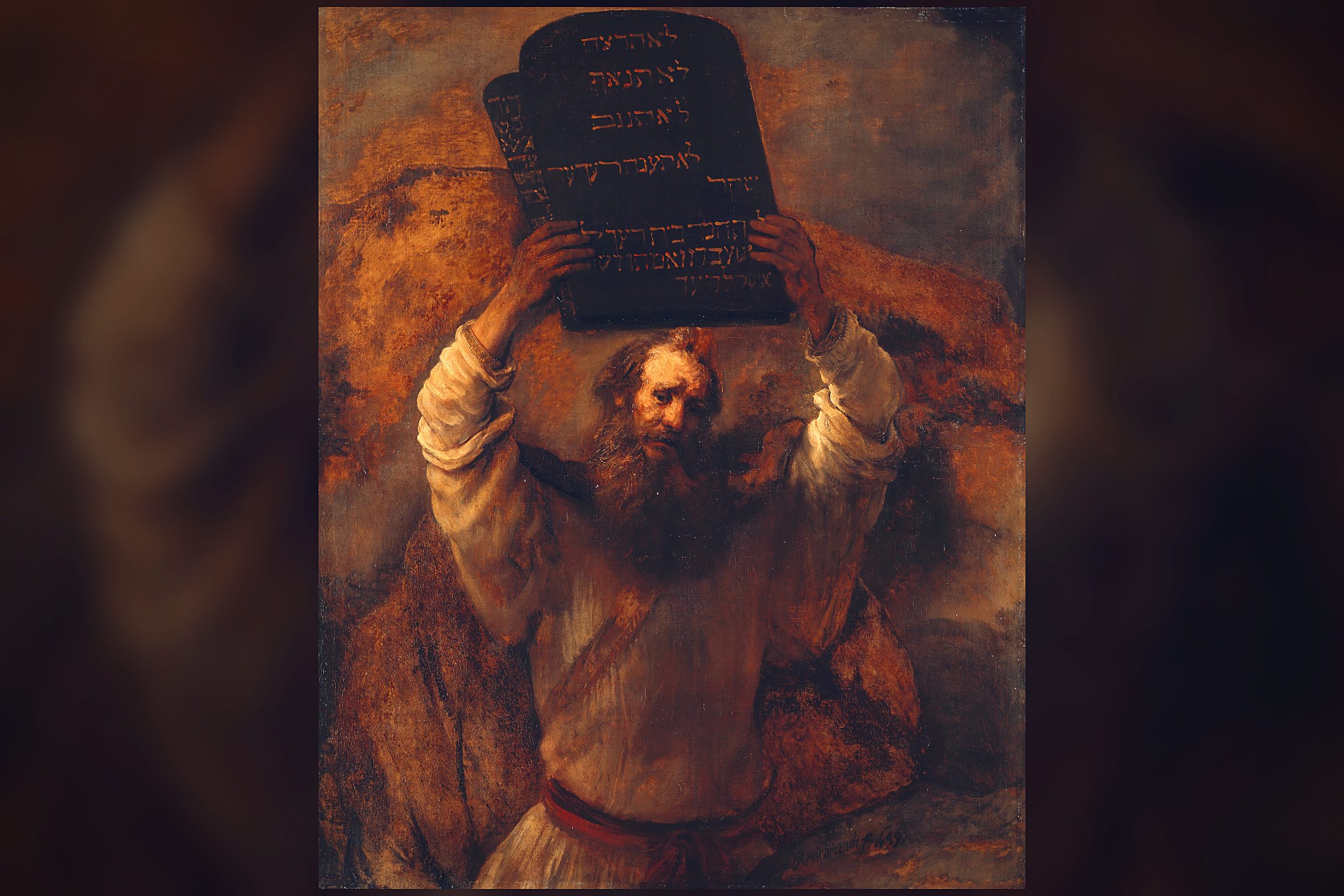
There is a town in southern California where the men live, on average, more than seven years longer than their neighbours, and almost nobody outside public-health circles can tell you why. There is a commandment longer than any of the other nine, the only one that opens with the word “Remember”, and the Christian world is split down the middle over whether it still binds. Behind both sits one of the oldest and most divisive questions in the Bible: did Jesus abolish the sabbath, or does the seventh day stand exactly where Genesis put it?
All three threads — the long-lived town, the half-forgotten commandment, and a day that three of the world’s largest religious traditions agree God set apart at the creation of the world, then disagree bitterly about which box on the calendar it occupies — run through a single subject: the Sabbath. It is one of the oldest institutions in the Bible, named before the Law, before Israel, before the Exodus. And it has divided churches for nineteen centuries.
Did Jesus Abolish the Sabbath?
No verse in the New Testament records Jesus saying the Sabbath is abolished. That is the first thing to be clear about, because the phrase “did Jesus abolish the sabbath” is searched by people on both sides expecting a yes-or-no answer, and the text does not hand one over. What the Gospels record is Jesus repeatedly healing on the Sabbath, defending his disciples for plucking grain on it, and declaring himself “Lord even of the sabbath day” (Mark 2:28) — none of which is the same as cancelling it.
From there the readings diverge, and they diverge hard. One tradition holds that the seventh-day Sabbath is part of the moral law written by the finger of God, never repealed, and still binding on Saturday. Another holds that it was a shadow pointing to Christ, fulfilled in him, and that the early church rightly moved its gathering to the first day of the week. Both cases are built from the same Bible. This article lays out the full textual record, both readings at their strongest, the historical shift from Saturday to Sunday, and — because it is the most evidence-rich and least-known part of the whole subject — what modern medicine has actually measured about people who still keep it.
What the Bible Says About the Sabbath
The Sabbath enters the Bible not as a command but as a description of God. On the seventh day of the creation week, the work stops.
“And on the seventh day God ended his work which he had made; and he rested on the seventh day from all his work which he had made. And God blessed the seventh day, and sanctified it.” (Genesis 2:2-3)
Two things are set here that every later argument returns to. The seventh day is blessed and sanctified — set apart as holy — and it is tied to creation, not to any nation. This is the ground on which those who keep the seventh day stand: it predates Israel by the whole of Genesis.
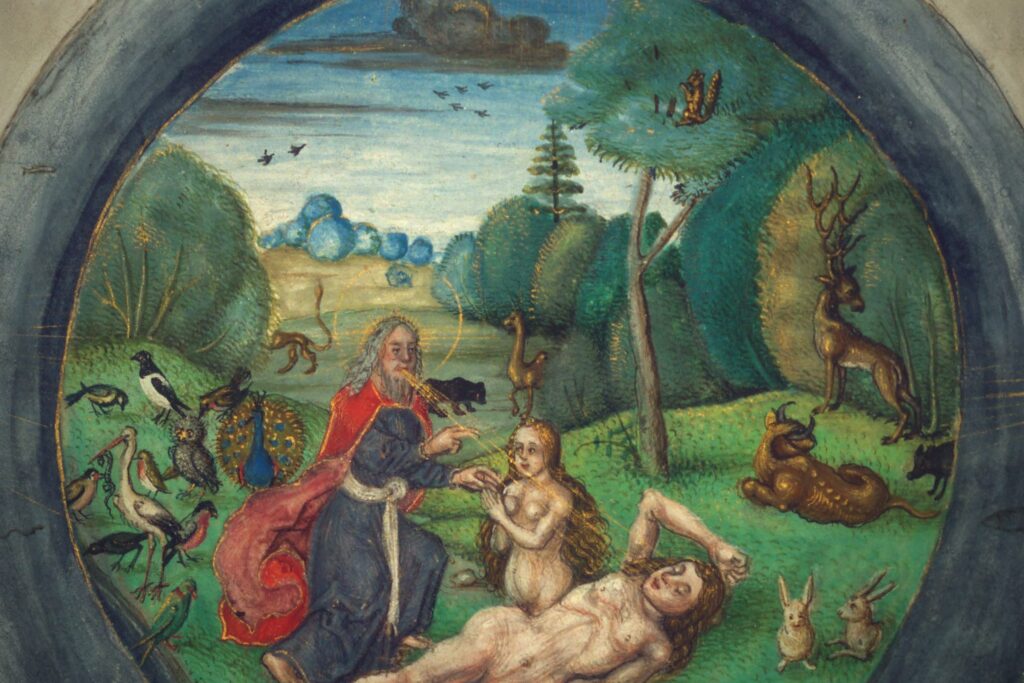
The command itself arrives at Sinai, as the fourth of the ten, and it is the longest of them [11].
“Remember the sabbath day, to keep it holy. Six days shalt thou labour, and do all thy work: but the seventh day is the sabbath of the Lord thy God… For in six days the Lord made heaven and earth, the sea, and all that in them is, and rested the seventh day: wherefore the Lord blessed the sabbath day, and hallowed it.” (Exodus 20:8-11)
When the commandment is repeated in Deuteronomy 5:12-15, the reason given changes: not creation this time, but the Exodus — “remember that thou wast a servant in the land of Egypt”. The Sabbath is both a memorial of creation and a memorial of liberation.
The pattern was taught before Sinai, in the wilderness, through the manna: a double portion fell on the sixth day and none on the seventh, and the surplus that rotted on any other day kept perfectly over the Sabbath (Exodus 16:22-30). It is the one recurring break in the entire supply, and the question of what manna actually was has never been separated from that weekly exception. Beyond the week, the principle scaled up: a sabbatical rest for the land every seventh year, and after seven sevens the Jubilee, when debts were released and land returned to its families (Leviticus 25).
Twice the text calls the Sabbath a sign. In Exodus 31:13 it is “a sign between me and you throughout your generations”; in Ezekiel 20:12 and 20:20, “a sign between me and them, that they might know that I am the Lord”. The prophets treat its neglect as a measure of covenant failure (Isaiah 58:13-14, Jeremiah 17:21-27) and its keeping as a mark of return. This is the whole Old Testament case in one line: a creation ordinance, a commandment, a covenant sign, kept on the seventh day.
Which Day Is the Sabbath? Saturday Is the Seventh Day
Here is the detail that most readers have never had spelled out, and it is the hinge of the entire Saturday-versus-Sunday dispute: the biblical Sabbath is the seventh day of the week, and in the traditional calendar the seventh day is Saturday. Sunday is the first day.
This is not an Adventist claim; it is the ordinary calendar. In the Jewish reckoning the week runs Sunday through Saturday, and the Sabbath — Shabbat — falls from Friday sunset to Saturday nightfall. The languages carry the fact fossilised inside them: Saturday is sábado in Spanish, sábado in Portuguese, sabato in Italian, samedi‘s cousin aside, and suббота (subbota) in Russian — all of them the word Sabbath [10]. Greek simply calls Saturday sábbaton. When a Spanish speaker says sábado, they are saying “Sabbath day” without noticing.
Modern standards have muddied which day is called “first”. The international standard ISO 8601 defines Monday as day 1 and Sunday as day 7, to suit business weeks [10]. But the traditional calendars used across the United States, Canada and much of the world — and the one the biblical writers used — begin the week on Sunday, which makes Saturday the seventh and final day. The disagreement is purely about where you start counting; nobody disputes that Saturday is the day the Jews have always kept as the Sabbath. The ancient concern to get the count exactly right is visible in texts like the Book of Jubilees, with its 364-day solar calendar engineered so that no festival could ever drift onto the Sabbath.
So when the question “is the sabbath Saturday or Sunday” is asked, the Sabbatarian answer is that it was never a question in the first place: the seventh day is Saturday, it always was, and Scripture never records God moving it. What moved, they argue, was human practice — and that is a separate claim with its own history, taken up below.
Jesus and the Sabbath Controversies
More of Jesus’ recorded conflicts happen over the Sabbath than over any other single issue. He is accused when his disciples pluck and eat grain walking through a field (Mark 2:23-28), and when he heals — a man with a withered hand (Mark 3:1-6), a woman bent for eighteen years by what the text calls a binding spirit (Luke 13:10-17), a man born blind (John 9), a paralytic at the pool of Bethesda (John 5).
In none of these does he break the written Sabbath of Exodus 20. What he breaks, repeatedly and deliberately, is the surrounding wall of rabbinic rules about what counted as “work”. And his defence is the line that both sides quote to this day:
“The sabbath was made for man, and not man for the sabbath: therefore the Son of man is Lord also of the sabbath.” (Mark 2:27-28)
Read one way, this is a claim about the Sabbath’s purpose — it is a gift for human benefit, not a cage, and so acts of mercy and necessity honour it rather than violate it. Read another way, the second half is the sharper claim: as the one who calls himself Lord of the Sabbath, Jesus asserts an authority over the institution that only its author could hold. What he does not do, in any of the controversies, is tell anyone to stop keeping it. He keeps it himself — “as his custom was, he went into the synagogue on the sabbath day” (Luke 4:16). The question is what that implies for those who came after him, and that is where the two cases part.
The Case That the Sabbath Still Stands
State it at its strongest, the way its advocates do. The Sabbath is one of the Ten Commandments — not the ceremonial law of sacrifices and feasts, but the moral law, written by God’s own finger on stone and placed inside the Ark. The other nine are not negotiable for Christians; no one argues that the New Testament licenses murder, theft or adultery. On what principle, the Sabbatarian asks, is the fourth commandment — and only the fourth — quietly dropped?
The institution is rooted in creation, not in the Mosaic covenant, so it cannot be dismissed as a Jewish ceremony that expired at the cross: it was blessed and sanctified in Genesis 2, more than two thousand years before Moses. Jesus kept it. He said it was “made for man” — for humanity, not merely for Israel. And the author of Hebrews, writing to Christians decades after the resurrection, uses a remarkable word:
“There remaineth therefore a rest to the people of God.” (Hebrews 4:9)
The Greek noun there is sabbatismós — “a Sabbath-keeping”. It appears nowhere else in the New Testament and may have been coined for the occasion; throughout the surrounding chapters the author uses a different word for “rest” (katápausis) and switches to this one only at the conclusion of the argument [5]. Sabbatarians, Seventh-day Adventists and some in the Reformed tradition read it as the deliberate assertion that a Sabbath observance remains for believers. On this reading, the move to Sunday was not commanded by God or by any apostle; it was a later human innovation, and the seventh day stands exactly where Genesis put it.
The Case That the Sabbath Was Fulfilled in Christ
State the other side at equal strength. The New Testament, on this reading, treats the Sabbath as one of the shadows that pointed forward to Christ and found its substance in him. Paul is explicit:
“Let no man therefore judge you in meat, or in drink, or in respect of an holyday, or of the new moon, or of the sabbath days: which are a shadow of things to come; but the body is of Christ.” (Colossians 2:16-17)
The sequence — festival, new moon, Sabbath — is the standard Old Testament trio of sacred times (yearly, monthly, weekly), and Paul groups the weekly Sabbath with the rest as “a shadow” now fulfilled. To the Romans he writes that the day is a matter of conscience, not command: “One man esteemeth one day above another: another esteemeth every day alike. Let every man be fully persuaded in his own mind” (Romans 14:5). Had the fourth commandment bound Christians as the other nine do, this liberty would be unthinkable — Paul does not write “let every man decide” about murder or idolatry.
On this reading, Hebrews 4 points the same way the other direction: the “Sabbath rest” that remains is not a weekly calendar observance but the eschatological rest believers enter through faith in Christ, of which the seventh day was always the type. The weekly shadow having met its body, the first Christians gathered on the first day of the week — the day of the resurrection. Luke records the believers at Troas gathered “upon the first day of the week… to break bread” (Acts 20:7); Paul directs the Corinthians to set aside their collection “upon the first day of the week” (1 Corinthians 16:2); and John is “in the Spirit on the Lord’s day” (Revelation 1:10), a phrase the earliest Christian writers used for Sunday. The moral principle of the fourth commandment — rest, worship, a rhythm of six and one — continues; the specific day, this side holds, does not.
From the Seventh Day to the First: How Worship Moved to Sunday
Both cases agree on one historical fact: within a few generations, the majority of Christians were gathering on Sunday rather than Saturday. They disagree only on why, and on what authority. Here the early sources themselves matter, and they are more mixed than either side’s popular version admits.
The earliest clear witness is Justin Martyr, writing in Rome around AD 155. In his First Apology he describes the weekly Christian assembly plainly: “on the day called Sunday, all who live in cities or in the country gather together”, because it is the first day, on which God made light and on which Christ rose from the dead [5]. That is unambiguous evidence of Sunday assembly by the mid-second century.
Two earlier texts are cited constantly but are both disputed. The Didache (perhaps late first or early second century) opens chapter 14 with a phrase that literally reads “on the Lord’s of the Lord” — a unique double possessive with the noun left out, which translators fill in as “day”, so “on the Lord’s day gather and break bread” [7]. Ignatius of Antioch (around AD 107), in his letter to the Magnesians, writes of those who had stopped “sabbatising” and now lived “according to the Lord’s ——”. The only surviving Greek manuscript reads kyriakén zoén — “the Lord’s life” — not “the Lord’s day”; the familiar “Lord’s day” reading is a translator’s emendation [6]. Honest history notes this: the Ignatius passage, so often quoted as proof of first-century Sunday worship, hangs on a word that the manuscript does not actually contain.
The civil and conciliar landmarks are later and firmer. On 7 March 321, the emperor Constantine issued the first civil Sunday law, ordering judges, townspeople and tradesmen to rest “on the venerable day of the Sun” (dies Solis), while exempting farm work [9]. The wording names the Sun, not the Lord — scholars have long debated whether it was a Christian measure, a solar-cult measure, or deliberately both. Four decades later the Synod of Laodicea (traditionally dated around AD 364) ruled in its canon 29 that Christians “shall not Judaize by resting on the Sabbath, but shall work on that day; rather honouring the Lord’s Day… But if any shall be found to be Judaizers, let them be anathema” [8].
That canon is the strongest single piece of evidence for both readings at once, which is why both sides quote it. To those who hold the Sabbath was fulfilled, it shows the church formally distinguishing Christian Sunday worship from Jewish Sabbath-keeping. To Sabbatarians, the very need to forbid resting on Saturday proves that a large body of Christians were still doing exactly that, three centuries on — and that the change, when it came, came by council and emperor rather than by Scripture. The phrase “if they can” attached to Sunday rest is argued over to this day.
Why Do Adventists Live Longer?
This is the part of the Sabbath story that has the hardest data behind it, and it is the part fewest people know. In 2005, the writer Dan Buettner identified five places where people reach extreme old age at unusual rates and named them “Blue Zones”. Four were old, isolated populations — Okinawa, Sardinia, Ikaria, Nicoya. The fifth was a community of Seventh-day Adventists around Loma Linda, California: not an isolated village but a modern American town, distinguished mainly by religion [4].
The numbers that anchor this come from the Adventist Health Studies run by Loma Linda University — AHS-1 (around 34,000 Californian Adventists, 1974-1988) and AHS-2 (some 96,000 across the US and Canada, from 2002) [3]. The epidemiologist Gary Fraser reports that Adventists live, on average, about 7.3 years longer for men and 4.5 years longer for women than other Californians [3]. In the landmark 2001 paper “Ten Years of Life: Is It a Matter of Choice?”, Fraser and Shavlik found that a cluster of five health behaviours together was associated with up to ten extra years of life for those who followed them all [1].
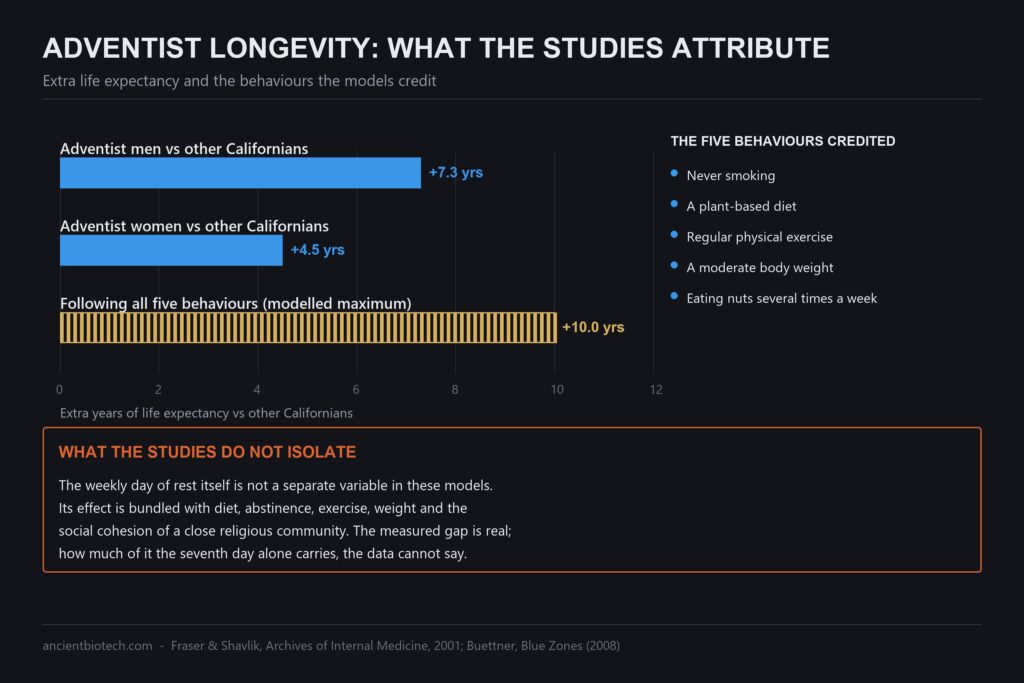
It is worth pausing on how large that is. A seven-to-ten-year gap is bigger than the life-expectancy difference that separates many wealthy countries from poor ones, and it is found inside a single nation, in a group that differs from its neighbours chiefly by belief and practice. The 2013 analysis of AHS-2 data in JAMA Internal Medicine confirmed the diet half of the picture: vegetarians in the cohort had significantly lower all-cause mortality than non-vegetarians, with vegetarian men showing the strongest advantage [2]. The interest Adventists take in careful eating has deep biblical roots of its own, closer to the plant-and-water regimen described in Daniel 1 than to any modern fad.
What the Longevity Data Can and Cannot Credit to the Sabbath
Now the checking, because this is where popular accounts overreach in both directions. It is tempting for a defender of the Sabbath to read “Adventists live ten years longer” as “the Sabbath adds ten years”. The studies do not say that, and saying so honestly weakens the case rather than strengthening it.
The five behaviours the models actually credit are not smoking, a plant-based diet, regular exercise, a moderate body weight, and eating nuts several times a week [1]. Every one of those is a measurable lifestyle variable, and every one is shared, in principle, by a non-religious vegetarian who has never heard of the fourth commandment. The weekly day of rest is not entered into these models as a separate variable at all. Its effect, if it has one, is bundled together with the diet, the abstinence from tobacco and alcohol, the exercise, the body weight and the dense social cohesion of a close religious community — itself a known predictor of longevity.
There is a further confounder specific to Loma Linda, and the honest sources raise it: the town is partly a gathering of people who chose to move there, often around the university and medical centre, rather than a native population living where it was born. Some of the advantage may reflect who self-selects into that community. So what can be said with confidence is this: the lifestyle associated with seventh-day Sabbath-keeping — plant-based, sober, active, communal, with a genuine weekly break from work — correlates with one of the largest longevity advantages ever measured in a developed country. What cannot be said, on the current evidence, is how much of that the seventh day alone is responsible for. Those who argue the rest itself matters point to the growing literature on chronic stress, sleep and the health cost of a life without a fixed stop; those who are cautious point out that the day has never been isolated from everything around it. The gap is real. Its exact cause is not settled.
Where That Leaves You
The Sabbath is one of the few subjects where the same verses have been read, carefully and in good faith, to opposite conclusions for nineteen hundred years, and nothing in this article dissolves that. What would actually settle it is not more evidence but a prior decision: whether the fourth commandment belongs with the moral law that Christ fulfilled by keeping, or with the ceremonial shadows he fulfilled by ending — and the New Testament can be read, verse for verse, either way.
What is not in dispute is smaller and stranger. The seventh day is Saturday, and half the languages of Europe still say so every weekend. A commandment that opens with “Remember” has been, for most of Christendom, quietly forgotten in its original form. And a town full of people who never forgot it are burying their men seven years later than the rest of California — for reasons that include, but cannot yet be reduced to, the day they stop.
Sources
- Fraser GE, Shavlik DJ, “Ten Years of Life: Is It a Matter of Choice?”, Archives of Internal Medicine, 2001 — pubmed.ncbi.nlm.nih.gov
- Orlich MJ et al., “Vegetarian Dietary Patterns and Mortality in Adventist Health Study 2”, JAMA Internal Medicine, 2013 — ncbi.nlm.nih.gov
- Adventist Health Study — longevity findings, Loma Linda University — adventisthealthstudy.org
- Loma Linda, California — Blue Zones — bluezones.com
- Justin Martyr, First Apology, ch. 67 (weekly Sunday assembly) — newadvent.org
- Ignatius of Antioch, Epistle to the Magnesians, ch. 9 — newadvent.org
- The Didache (Teaching of the Twelve Apostles), ch. 14 — newadvent.org
- Synod of Laodicea, Canon 29 — newadvent.org
- Imperial Sunday observance and Constantine’s edict of 321 — University of Adelaide — law.adelaide.edu.au
- Names of the days of the week — the seven-day order and ISO 8601 — en.wikipedia.org
- Bible text (KJV; Reina-Valera 1960) — Bible Gateway — biblegateway.com
Frequently Asked Questions
Did Jesus abolish the sabbath?
No recorded saying of Jesus abolishes the Sabbath. He kept it, defended acts of healing and necessity on it, and called himself “Lord even of the sabbath” (Mark 2:28). Christians divide over what that implies: one tradition holds the seventh-day Sabbath continues unchanged, another that it was a shadow fulfilled in Christ and no longer binds a specific day. The text supports a genuine argument on both sides.
Is the sabbath Saturday or Sunday?
The biblical Sabbath is the seventh day of the week, which in the traditional calendar is Saturday, running from Friday sunset to Saturday nightfall. Sunday is the first day. Many languages still call Saturday “Sabbath” — sábado in Spanish and Portuguese, sabato in Italian. Most Christians gather on Sunday, the day of the resurrection, which the New Testament calls “the Lord’s day”.
Who changed the sabbath from Saturday to Sunday?
No single person did, and that is the crux of the dispute. Christians were meeting on Sunday by the mid-second century (Justin Martyr, around AD 155). Constantine’s civil law of AD 321 made Sunday a public day of rest, and the Synod of Laodicea (around AD 364) told Christians not to rest on Saturday. Whether this reflected apostolic practice or a later human change is exactly what the two sides disagree about.
What does Colossians 2:16 say about the sabbath?
Paul writes that no one should judge believers “in respect of an holyday, or of the new moon, or of the sabbath days: which are a shadow of things to come; but the body is of Christ” (Colossians 2:16-17). First-day Christians read this as grouping the weekly Sabbath with the ceremonial times now fulfilled in Christ. Sabbatarians argue the “sabbath days” here refer to the ceremonial annual sabbaths, not the weekly seventh-day Sabbath.
Does Hebrews 4:9 teach the sabbath still applies?
Hebrews 4:9 says “there remaineth therefore a rest to the people of God”, using the rare Greek word sabbatismós, “a Sabbath-keeping”, found nowhere else in the New Testament. Sabbatarians read it as teaching that Sabbath observance remains for believers. Others read the “rest” as the eschatological rest entered through faith, which the weekly Sabbath only symbolised. The word itself supports both senses.
Why do Seventh-day Adventists live longer?
The Adventist Health Studies at Loma Linda University find Adventists live roughly 7.3 years longer (men) and 4.5 years longer (women) than other Californians, and that five behaviours — not smoking, a plant-based diet, exercise, moderate weight and eating nuts — together add up to about ten years. The weekly rest day is not measured as a separate factor, so how much the Sabbath itself contributes is not known.
Is the Sabbath part of the moral law or the ceremonial law?
This is the question the whole debate turns on. If the fourth commandment is moral law — like the prohibitions of murder and theft — it binds permanently and on the seventh day. If it is ceremonial — like sacrifices, feasts and new moons — it was fulfilled in Christ and no longer fixes a calendar day. Both sides cite Genesis 2, the Ten Commandments, the Gospels and the Epistles; the division is over how the fourth commandment is classified.
Did the early church keep Saturday or Sunday?
The evidence is mixed and both are attested. Justin Martyr clearly describes Sunday assembly by around AD 155. But the Synod of Laodicea still had to forbid Saturday rest around AD 364, which shows many Christians were keeping the seventh day well into the fourth century. Some eastern churches observed both days for centuries. There was no single, sudden switch.
Continue Reading
- What Do Angels Look Like? Men More Often Than Wings — Abraham fed three of them and took them for travellers. Daniel saw one and lost his strength. The Bible describes…
- What Did Jesus Say to Satan? Three Answers, One Book — Nobody else was there, so the account can only have come from him. The three offers in order, what forty days without…
- Who Is Jesus According to the Bible? The Question That Split the Church — One set of passages calls Jesus God. Another says the Father is greater. Both are in the same book. Every…