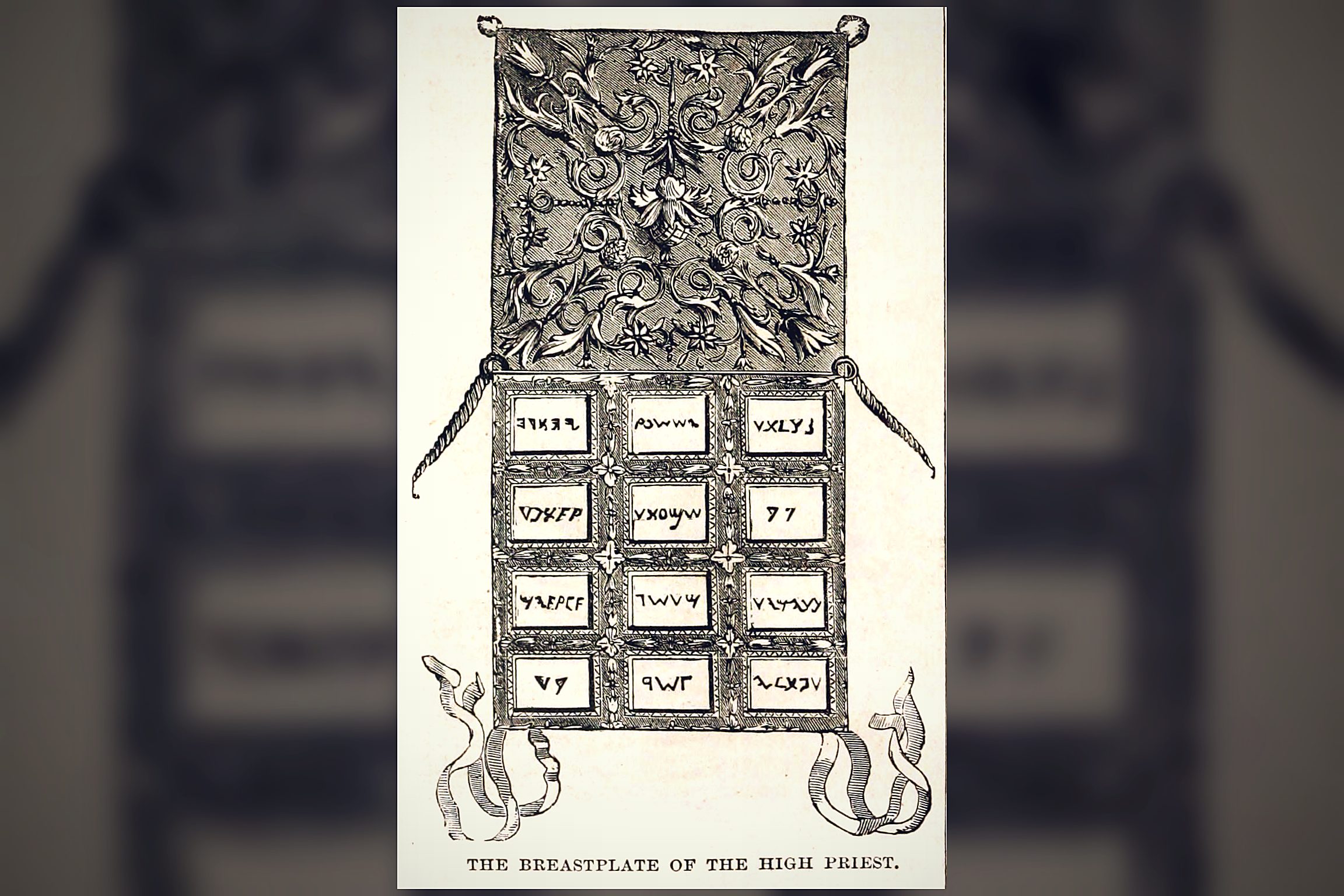
Every other piece of sacred hardware in the Bible gets a specification. The Ark of the Covenant has dimensions, materials, and handling instructions. The incense has a recipe. The tabernacle has a blueprint down to the number of sockets. But the Urim and Thummim — the device the high priest used to receive answers from God — gets almost nothing. No dimensions. No materials. No operating instructions. Just a name, a location, and a record of what happened when it was used.
That silence is the first thing worth noticing. The Bible specifies how to build an altar, how to mix anointing oil, and how many cubits wide a curtain should be. It tells you what the high priest wore down to the colour of the thread. But the one component responsible for direct communication between God and Israel is described in a single verse — and that verse says only where to put it.
What Were the Urim and Thummim?
The sole physical description appears in Exodus 28:30:
“And thou shalt put in the breastplate of judgment the Urim and the Thummim; and they shall be upon Aaron’s heart, when he goeth in before the LORD: and Aaron shall bear the judgment of the children of Israel upon his heart before the LORD continually.” (Exodus 28:30, KJV)
The Hebrew phrase is ha-urim v’et ha-tummim. The definite articles — the Urim and the Thummim — suggest objects already known to the original audience [1]. No one is being introduced to a new concept here. The verse assumes you know what they are, and tells you only where they go: into the breastplate.
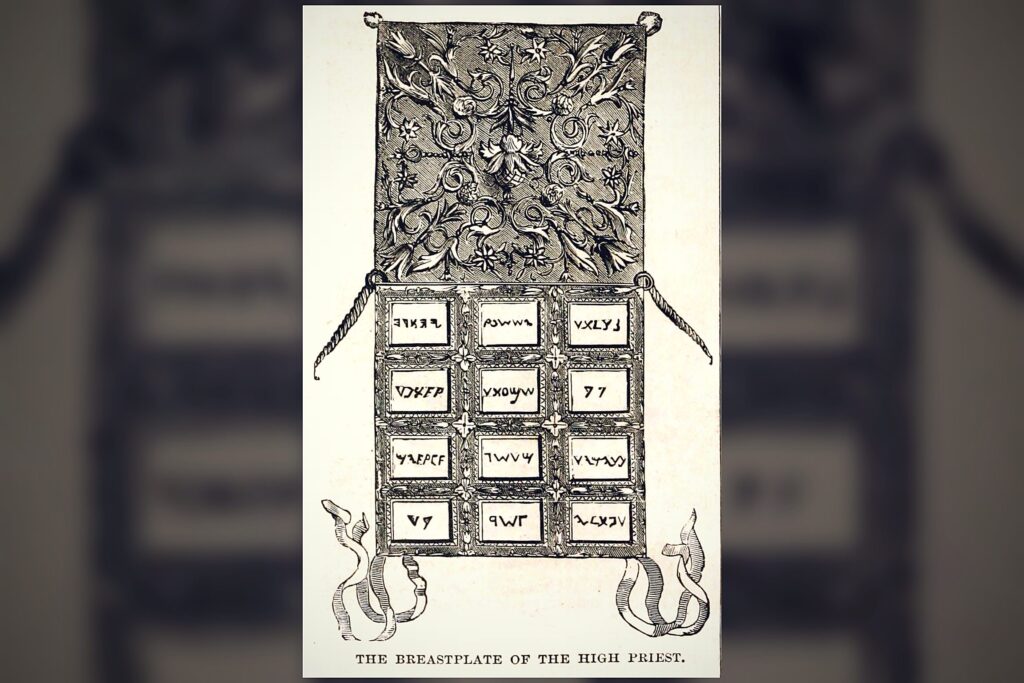
That preposition matters. The breastplate (hoshen mishpat, “breastplate of judgment”) was a square pouch — woven from gold, blue, purple, and scarlet thread, set with twelve gemstones in four rows of three, each stone engraved with the name of a tribe of Israel. The text says the Urim and Thummim were placed in it, not on it. The breastplate was folded in half to form a pocket [2], and whatever these objects were, they sat inside that pocket against the high priest’s chest.
Leviticus 8:8 records the moment they were installed: Moses placed the breastplate on Aaron and put the Urim and the Thummim in it. Two objects, placed by hand, into a textile pocket. Whatever they were, they were physical, separate from the gemstones, and small enough to carry.
Every Passage, in Order
The Urim and Thummim are named in seven passages. Each adds one fact, and none explains the mechanism.
Exodus 28:30 — the specification. Where they go: into the breastplate, on Aaron’s heart.
Leviticus 8:8 — the installation. Moses places them in the breastplate during Aaron’s consecration.
Numbers 27:21 — the operating context. When Moses is told to commission Joshua as his successor, the instruction is explicit:
“And he shall stand before Eleazar the priest, who shall ask counsel for him after the judgment of Urim before the LORD: at his word shall they go out, and at his word shall they come in.” (Numbers 27:21, KJV)
This is the most revealing passage. The leader of Israel — military commander, national authority — is subordinated to the Urim. Joshua does not decide when the army moves. The priest asks the Urim, and the Urim’s answer decides. National-level military decisions routed through a device on a priest’s chest.
Deuteronomy 33:8 — Moses’ final blessing on the tribe of Levi:
“Let thy Thummim and thy Urim be with thy holy one, whom thou didst prove at Massah.”
The order is reversed here — Thummim before Urim — the only passage where this happens. The reversal is unexplained, but both the Talmud and later scholars have noticed it [3].
1 Samuel 14:41 — the binary operation. This is the passage that reveals the most about how the device functioned, and it exists in two versions.
The Hebrew (Masoretic) text reads only: “Give a perfect lot.” But the Septuagint — the older Greek translation — preserves a longer reading:
“If this iniquity be in me or in Jonathan my son, O LORD God of Israel, give Urim; but if it be in thy people Israel, give Thummim.”
Saul is narrowing a field. The sin could be his, Jonathan’s, or the people’s. He asks the device to distinguish, and it does: Saul and Jonathan are taken by lot, and the people are cleared. Then a second inquiry isolates Jonathan. Binary elimination, two rounds.
1 Samuel 28:6 — the silence. Saul, on the eve of his final battle, asks God by every channel available:
“And when Saul enquired of the LORD, the LORD answered him not, neither by dreams, nor by Urim, nor by prophets.”
Three methods, ranked. Dreams. Urim. Prophets. All silent. The Urim is listed as a standard channel of divine communication — one of three — and all three have been shut down. The next verse records Saul turning to the witch at Endor.
Ezra 2:63 / Nehemiah 7:65 — the absence. After the Babylonian exile, certain families claim priestly descent but cannot prove it. The governor tells them:
“…that they should not eat of the most holy things, till there stood up a priest with Urim and with Thummim.”
The device is gone. Nobody has it. The ruling authority defers the question to a future that, as far as the biblical record shows, never arrived. This is the last mention of the Urim and Thummim in the Hebrew Bible.
What the Name Means
The traditional translation is straightforward: Urim from the root ‘or (“light”), Thummim from the root tamam (“be complete, be perfect”). Lights and perfections. The Septuagint translates them as dēlōsis kai alētheia — “revelation and truth” [4].
But scholarship has complicated this. Many scholars now connect Urim not to ‘or (light) but to ‘arar (curse), making the pair mean something closer to “cursed or faultless” — a binary verdict on the accused [1]. This reading fits the lot-casting scenario of 1 Samuel 14:41 precisely: one outcome condemns, the other clears.
If that etymology is correct, then the name itself is a description of what the device does. It sorts. Guilty or innocent. Yes or no. One of two outcomes, built into the name.
The competing reading — lights and perfections — fits the Josephus tradition, where the breastplate stones physically shone. The word itself may be evidence for one theory or the other, but the evidence is not decisive, and scholars have argued both directions for over a century [5].
How They Worked: Three Theories
The Lot Theory
The simplest reading: two objects, visually distinct, drawn from the breastplate pouch. One means yes, the other means no. The mechanism is casting lots — cleromancy — and the divine element is which lot appears.
The Hebrew verb used in connection with the Urim (yatsa, “come out”) is the same verb used for lots elsewhere in the Hebrew Bible [3]. The 1 Samuel 14:41 Septuagint reading directly fits this model: “Give Urim” for one outcome, “give Thummim” for the other. Two lots, two answers.
This theory accounts for the binary answers, the physical objects, and the verb. It does not account for the more complex responses David receives through the ephod — detailed sentences, not just yes or no.
The Light Theory
Josephus, writing in the first century CE, says the stones on the high priest’s breastplate shone before battle with a light so bright that the whole army could see it [6]. He identifies the Urim and Thummim with the breastplate stones themselves, rather than as separate objects inside the pouch.
The rabbinic tradition developed this further. Nachmanides (Ramban, 13th century) proposed that the Urim were divine names that caused specific letters on the breastplate’s twelve stones to light up. Each stone was engraved with a tribal name, and the lit letters spelled out the answer. But the illuminated letters could be read in multiple ways — the letters for “Judah shall go up” (Yehuda ya’aleh) could also be rearranged into “Woe unto Judah” (hey al Yehuda). The Thummim, on this reading, were a second set of divine names that gave the priest the prophetic insight to arrange the letters correctly [7].
This theory explains the name (lights and perfections = illumination and correct reading), accounts for detailed answers (any Hebrew sentence could be spelled), and makes sense of the two-part name. Its weakness is that it has no direct biblical support — the Bible never describes the breastplate glowing — and it relies entirely on a 13th-century reading of a mechanism that stopped functioning over 1,500 years earlier.
The Prophetic Inspiration Theory
Cornelis Van Dam, in the most thorough modern study of the subject, argued that the Urim and Thummim were physical objects used to initiate a process of prophetic revelation [5]. On this reading, the priest held or handled the objects, but the answer came not from the objects themselves but from direct divine communication — the priest received a word from God, triggered by the ritual act of consulting the Urim.
Van Dam’s argument is that the answers are sometimes too complex for lots. When David asks through Abiathar whether the men of Keilah will surrender him to Saul, the answer is not a single word: “They will surrender thee” (1 Samuel 23:12). When David asks whether to pursue the Amalekite raiding party, the answer is: “Pursue: for thou shalt surely overtake them, and without fail recover all” (1 Samuel 30:8). These are sentences. A binary lot cannot produce a sentence.
The weakness of this theory is that it makes the Urim and Thummim indistinguishable from prophecy — and the Bible consistently lists the Urim as a separate channel from prophets (1 Samuel 28:6). If the answer came by prophetic inspiration, why would the text distinguish the two?
The Cases That Narrow the Range
Three episodes show the device in operation, and the answers narrow the possibilities.
1 Samuel 14:41 (Septuagint): Saul receives a binary result — guilty or not guilty — in two rounds of elimination. This looks like lot-casting.
1 Samuel 23:10-12: David asks three sequential yes/no questions through the ephod, and gets three answers. Will Saul come down? He will come down. Will the men of Keilah surrender me? They will surrender thee. The structure is still binary, but the answers arrive as full statements.
1 Samuel 30:7-8: David asks whether to pursue, and gets a detailed affirmative with a promise attached: “Pursue: for thou shalt surely overtake them, and without fail recover all.” This is not a lot result. A drawn stone cannot say “without fail recover all.”
The pattern suggests that the device was not a single mechanism. Or that it began as one thing — a binary oracle — and the answers exceeded the hardware. Or that the binary question was the interface, but the answer came through a channel the device merely opened.
The same pattern appears elsewhere in the biblical record: a physical object with a described function that, in use, exceeds its own specification. The Ark kills on contact, but it also speaks from between the cherubim. The device is one thing. What comes through it is another.
When They Stopped
Three sources give three dates, and none of them agree.
The Talmud (Yoma 21b) lists the Urim and Thummim among five things present in the First Temple but absent from the Second: the Ark, the kaporet and the keruvim; the fire from heaven; the Shekinah; the spirit of prophecy; and the Urim and Thummim [8]. On this account, they were lost when Nebuchadnezzar destroyed Jerusalem in 586 BCE.
Josephus places the end much later. He says the breastplate stones “ceased to shine two hundred years before I composed this work” [6]. The Antiquities was finished around 93-94 CE, putting the cessation around 104 BCE — roughly the death of the Hasmonean king John Hyrcanus. On Josephus’s account, the device continued to function throughout the Second Temple period, well past the Babylonian exile.
Ezra 2:63, written after the return from Babylon (c. 520-450 BCE), records that certain priestly families were barred from serving until a priest with Urim and Thummim could be found. This implies the device was already missing by the early Second Temple period — supporting the Talmud and contradicting Josephus.
The disagreement between Josephus and the Talmud is unresolved [9]. What is agreed is the end state: by the time of Jesus, no priest possessed the Urim and Thummim. When the Second Temple was rebuilt, five items from the original were gone — and nobody could manufacture a replacement. The communication channel was closed. The prophets likewise had fallen silent, and Daniel’s timeline for the restoration was already running.
The Specification That Is Not There
The pattern across the Pentateuch is exhaustive specification. The tabernacle gets five chapters of instructions. The priestly garments get a chapter. The incense recipe is exact to the ingredient and carries a death penalty for private use (Exodus 30:38). The altar dimensions, the lamp oil, the colour of the ram’s skin — all specified.
And then the communication interface — the one component that connects God to the national leadership — is described in half a verse. Place it in the breastplate. That is all.
The New Jerusalem gets published dimensions. The Ark gets published dimensions. The Urim and Thummim gets nothing, and the absence looks deliberate. Every other component of the tabernacle system could, in principle, be rebuilt from the text. The incense was rebuilt. The menorah was rebuilt. The garments were rebuilt. But the Urim and Thummim cannot be rebuilt, because the text does not say what it is.
If the biblical specifications are a data set, the Urim and Thummim is the one entry marked classified. The device that hears from God is the one device whose design is not given to humans. Everything else is open-source. The interface is not.
Sources
- Urim and Thummim — en.wikipedia.org/wiki/Urim_and_Thummim
- Priestly breastplate (hoshen) — en.wikipedia.org/wiki/Hoshen
- Urim and Thummim (Jewish Encyclopedia) — jewishencyclopedia.com/articles/14609-urim-and-thummim
- Urim and Thummim (Bible Odyssey) — bibleodyssey.org/articles/urim-and-thummim
- Cornelis Van Dam, The Urim and Thummim: A Means of Revelation in Ancient Israel — fromthedesk.org/urim-and-thummim-in-the-bible-cornelis-van-dam
- Josephus, Antiquities of the Jews, 3.214-218 — lexundria.com/j_aj/3.218/wst
- The Urim and Tumim: Ramban’s reading (Ohr Somayach) — ohr.edu/2032
- Five things missing from the Second Temple (Yeshivat Har Etzion) — etzion.org.il/en/holidays/yom-yerushalayim/differences-between-first-and-second-temples-i
- Did Second Temple High Priests Possess the Urim and Thummim? (Journal of Hebrew Scriptures) — jhsonline.org/index.php/jhs/article/view/5655
Frequently Asked Questions
What are the Urim and Thummim?
The Urim and Thummim were objects placed inside the high priest’s breastplate (Exodus 28:30) used to receive answers from God on matters of national importance. Their physical form is never described. They are named seven times in the Hebrew Bible and are associated with inquiries about war, succession, and guilt. They were gone by the Second Temple period.
How did the Urim and Thummim work?
The Bible does not explain their mechanism. Three scholarly theories exist: (1) they were lots drawn from the breastplate pouch, giving binary yes/no answers; (2) they caused the breastplate’s twelve gemstones to glow, with lit letters spelling out messages; (3) they initiated prophetic revelation in the priest. The lot theory fits 1 Samuel 14:41, but the detailed answers in 1 Samuel 23 and 30 suggest something more than binary.
What does Urim and Thummim mean in Hebrew?
The traditional meaning is “lights and perfections,” from the roots ‘or (light) and tamam (be complete). The Septuagint translated them as dēlōsis kai alētheia — “revelation and truth.” An alternative scholarly theory connects Urim to ‘arar (curse), giving the pair the meaning “cursed or faultless” — a binary verdict of guilty or innocent.
What happened to the Urim and Thummim?
They were lost. The Talmud (Yoma 21b) says they disappeared when Nebuchadnezzar destroyed the First Temple in 586 BCE. Josephus says the breastplate stones ceased to shine around 104 BCE. Ezra 2:63 records that after the exile, no priest with Urim and Thummim could be found. By the time of the Second Temple, the device was gone and no replacement could be made.
Are the Urim and Thummim stones?
Possibly, but the text does not say. The Bible describes them only as objects placed inside the breastplate pouch. Josephus identified them with the twelve gemstones on the breastplate itself, but the biblical text distinguishes them — the stones are on the breastplate, while the Urim and Thummim are placed in it. Some scholars think they were two marked stones used as lots.
Where are the Urim and Thummim mentioned in the Bible?
Seven explicit references: Exodus 28:30, Leviticus 8:8, Numbers 27:21, Deuteronomy 33:8, 1 Samuel 28:6, Ezra 2:63, and Nehemiah 7:65. The Septuagint version of 1 Samuel 14:41 also names them. Additional passages describe inquiry through the ephod — the garment the breastplate was attached to — which likely involved the Urim and Thummim (1 Samuel 23:9-12, 30:7-8).
Could the Urim and Thummim be rebuilt today?
Not from the biblical text alone. The Bible specifies the breastplate in detail — its materials, dimensions, gemstones, and attachment to the ephod — but says nothing about what the Urim and Thummim were made of, what they looked like, or how they functioned. The device that everything else was built to house is the one component the text does not describe.
Conclusion: The Classified Component
The Urim and Thummim is a gap in the middle of the most detailed engineering document in the ancient world. Every other part of the tabernacle system — the structure, the furniture, the clothing, the recipes — is specified down to the material and the measurement. The communication interface is not.
That gap is either an accident of transmission — something everyone knew, never written down, and then forgotten — or it is deliberate. A device whose design is withheld from the record that preserves everything else around it.
What the text does preserve is the output. A national leader subordinated to a priest’s breastplate. Armies moved and halted on its word. A king condemned, a fugitive vindicated, a raiding party overtaken. The Urim and Thummim functioned, and the record says so plainly. It just never says how.
Continue Reading
- Biblical Prophecies That Came True — and the Test That Sorts Them — Four questions decide whether a prophecy can be checked at all. Tyre, Cyrus, the temple and one that failed outright…
- The Seventy Weeks of Daniel: The Arithmetic, Laid Out — A prophecy with a start, a unit and a count. Three decrees it could run from, two lengths of year, and the awkward fact…
- The Third Temple: What Is Actually Ready, and What Is Not — The vessels are finished, the garments are woven and the plans exist. What does not exist is a valid set of ashes, an…