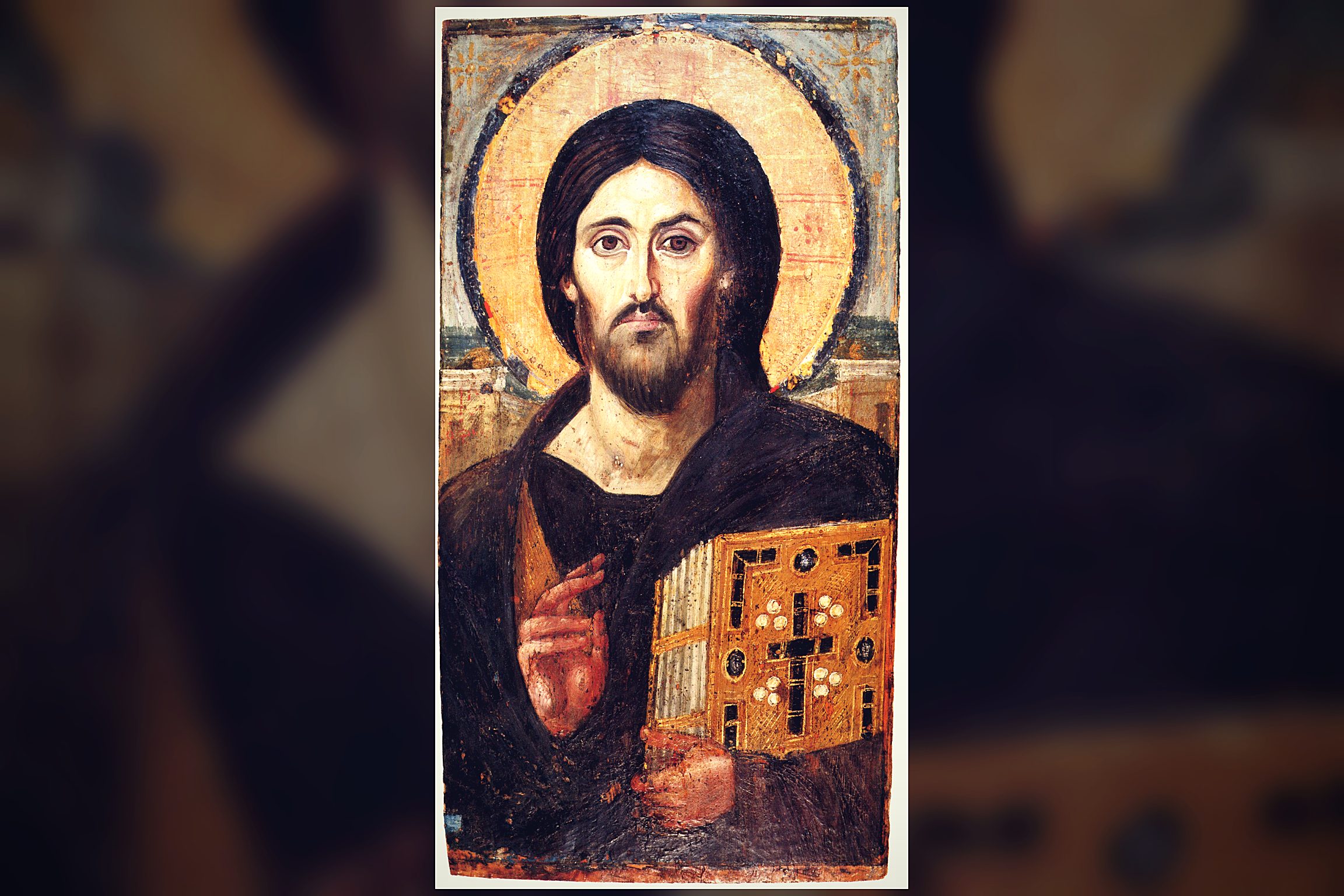
The Gospel of John opens by calling the Word God and placing it at the beginning of everything. The same Gospel records Jesus saying “the Father is greater than I.” Both sentences sit in the same book, attributed to the same author, about the same person.
The question of who is Jesus according to the Bible depends on how you hold those two claims together. For seventeen centuries, every answer that dropped one of them was condemned — and the ones that tried to keep both produced the most precise theological language any council ever wrote.
What follows is every position, with the passages behind it, the arguments for it, and what happened to it.
The Passages That Call Jesus God
These are not ambiguous. Several New Testament texts identify Jesus with God in language that leaves little room for a lesser reading.
John 1:1–14. “In the beginning was the Word, and the Word was with God, and the Word was God.” The prologue then says the Word became flesh and dwelt among us. This is Logos Christology — Jesus as the eternal Word of God, pre-existent and divine, who took on human nature. The Jehovah’s Witnesses’ New World Translation renders the last clause “the Word was a god,” arguing that the absence of the Greek definite article before theos permits an indefinite reading. Mainstream Greek scholarship regards this as grammatically unsupported — Colwell’s rule and the clause’s context both point to a qualitative reading: the Word was fully divine [1].
John 8:58. “Before Abraham was, I am.” The crowd picks up stones. The echo of Exodus 3:14 — where God gives his name as “I AM” — is the reason. Jesus is not merely claiming age. He is claiming the divine name.
John 10:30. “I and the Father are one.” Again the crowd reaches for stones, and when Jesus asks why, they answer: “For blasphemy, because you, being a man, make yourself God” (10:33). The charge tells you how the audience heard the claim.
John 20:28. Thomas, seeing the risen Jesus: “My Lord and my God.” Jesus does not correct him.
Philippians 2:5–11. The kenosis hymn: Christ existed “in the form of God” (en morphē theou), did not consider equality with God something to be grasped, but “emptied himself” (ekenōsen), took the form of a servant, was made in human likeness. After the cross, God exalted him and gave him “the name above every name, that at the name of Jesus every knee should bow.”
Colossians 1:15–20. “The firstborn of all creation; for by him all things were created.” Arians read “firstborn” as “first created.” The counter: prōtotokos means preeminent heir, not first in sequence, since the next clause says “all things were created through him and for him” — which places him outside the category of created things [2].
Colossians 2:9. “In him the whole fullness of deity dwells bodily.”
Isaiah 9:6. “Wonderful Counsellor, Mighty God, Everlasting Father, Prince of Peace.” A messianic title that includes “Mighty God” — El Gibbor, the same term used of God himself in Isaiah 10:21.
1 Corinthians 8:6. “One Lord, Jesus Christ, through whom all things exist.” Paul reworks the Shema — the central Jewish confession of one God — and places Jesus inside it [1].
Revelation 1:8, 22:13. “I am the Alpha and the Omega, the First and the Last, the Beginning and the End.” Titles the same book gives to God the Father are given to Christ.
The Passages That Set Him Apart from God
These are not ambiguous either. And they sit in the same texts.
John 14:28. “The Father is greater than I.” Said by Jesus, in John — the same Gospel that opened by calling him God.
Mark 13:32. “About that day or hour no one knows, not even the angels in heaven, nor the Son, but only the Father.” Jesus says there is something he does not know. If he is fully omniscient God, the sentence has to mean something other than what it appears to say.
1 Corinthians 15:28. “When all things are subjected to him, then the Son himself will also be subjected to the one who put all things in subjection under him, so that God may be all in all.” Paul describes the Son as ultimately subject to the Father.
Acts 2:36. “God has made him both Lord and Messiah, this Jesus whom you crucified.” Peter says God made Jesus Lord — language that sounds like elevation rather than inherent status.
Romans 1:4. Jesus was “declared to be the Son of God with power according to the spirit of holiness by resurrection from the dead.” The Greek horisthentos can be read as “declared” or “appointed.” Adoptionists read it as appointed.
Proverbs 8:22–31. Wisdom personified says: “The Lord created me at the beginning of his work.” This was Arius’s primary proof text [3]. If Wisdom is Christ (as Paul implies in 1 Corinthians 1:24), and Wisdom was created, then Christ was created. The counter-argument turns on the Hebrew verb qanah, which can mean “possessed” or “acquired” rather than “created” — and on the question of whether personified Wisdom in Proverbs is the same figure as the Logos of John 1.
Two sets of passages, in the same canon, about the same person. Every Christological position in history is an attempt to hold both sets — or to explain one away.
Nicaea, Chalcedon, and the Two Natures
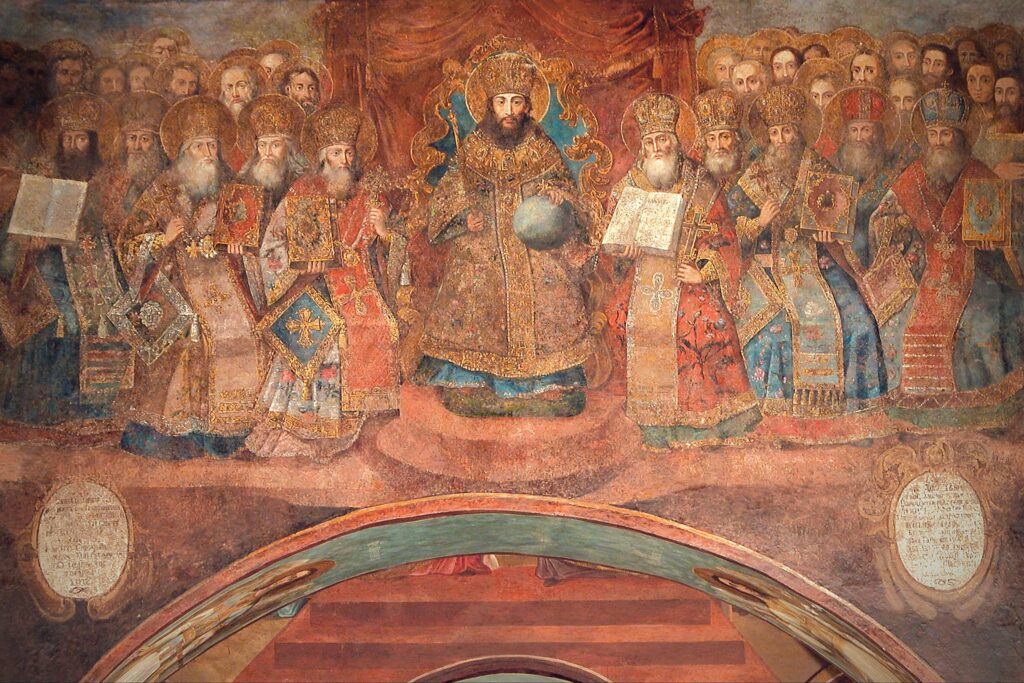
Nicaea (325). Around 318 bishops gathered, and the question on the table was Arius of Alexandria. His position, from his own letter to Bishop Alexander: the Son was brought into being before time, first and greatest of all creation, but not co-eternal with the Father. The phrase that defined the controversy: “there was when he was not” [3].
The council’s answer was a single word: homoousios — “of one substance” with the Father. The Nicene Creed declares the Son “true God from true God, begotten not made, consubstantial with the Father.” Appended anathemas condemned anyone who says “there was a time when he was not” or that the Son was “made out of nothing.” Arius and two followers were exiled. Around twenty of the roughly 318 bishops had initially supported Arius; by the final vote, almost all signed.
This site has already reported that Nicaea did not decide the biblical canon — the council addressed the nature of Christ and the date of Easter, not which books belonged in Scripture. What Nicaea settled was the Son’s relationship to the Father, and it settled it by a word — homoousios — that is not in Scripture.
Chalcedon (451). A century later the question had shifted. If the Son is fully God, and if the Word became flesh, what is the relationship between the divine and the human in Christ? Two answers had failed:
- Nestorius seemed to divide Christ into two persons — one divine, one human — inhabiting the same body. Condemned at Ephesus in 431.
- Eutyches merged the two natures into one — the human absorbed into the divine after the incarnation. Condemned at Chalcedon.
The Chalcedonian Definition answered with four Greek adverbs that remain the most precise Christological language ever written [4]:
Christ is acknowledged in two natures — without confusion (asunchutōs), without change (atreptōs), without division (adiairetōs), without separation (achōristōs) — the difference of the natures being in no way removed because of the union, but rather the properties of each nature being preserved, and both concurring into one person and one hypostasis.
Fully God and fully human. Two natures, one person. Neither swallowed by the other. Not blended. Not separated.
The Oriental Orthodox churches — Coptic, Ethiopian, Syriac, Armenian — rejected Chalcedon. They hold miaphysitism: one united nature of the incarnate Word. This is not the same as Eutyches’ monophysitism, which merged the natures by absorption. It is a distinct formula, and the division between Chalcedonian and non-Chalcedonian churches stands to this day.
Is Jesus the Archangel Michael?
This is a question with more behind it than most discussions acknowledge.
The case for. Four passages carry the argument:
- Daniel 10:13, 10:21 — Michael is called “one of the chief princes” and the guardian of Israel.
- Daniel 12:1 — “At that time Michael, the great prince who protects your people, will arise.” The role — standing up for God’s people at the end — sounds like Christ’s.
- 1 Thessalonians 4:16 — “The Lord himself will descend from heaven with a commanding call, with an archangel’s voice.” If the Lord descends with the archangel’s voice, is the voice his own?
- Revelation 12:7 — “Michael and his angels fought against the dragon.” Michael leads heaven’s army — the same role Christ fills in Revelation 19. The same passage is at the centre of the war in heaven.
Who holds this, and how:
Jehovah’s Witnesses teach this as core doctrine [5]. Jesus is Michael the Archangel in his pre-human and post-resurrection existence. The Son is not co-eternal with the Father. Their New World Translation renders John 1:1 as “the Word was a god,” placing the Son in a lesser category. This is closer to fourth-century Arianism than to any other historical position.
Seventh-day Adventists also identify Michael as Christ but with a crucial difference: they affirm full deity and eternal pre-existence. “Michael” is read as a title meaning “One Who Is Like God,” denoting command over the angelic host, not membership in it. The SDA position is not Arian — it says the one who commands the angels took the name that means “Who Is Like God,” which is a claim about rank, not nature.
The counter-argument: Hebrews 1. The entire opening chapter of Hebrews is built to demonstrate that the Son is not an angel [6]:
“To which of the angels did God ever say, ‘You are my Son, today I have begotten you’?” (1:5)
“Let all God’s angels worship him.” (1:6)
“Of the angels he says, ‘He makes his angels winds’… but of the Son he says, ‘Your throne, O God, is forever and ever.’” (1:7–8)
Hebrews proceeds through seven quotations, each drawing a line between the Son and the angels. The argument is not subtle. It concludes: “Are they not all ministering spirits sent out to serve?” (1:14). Angels serve. The Son rules. The hierarchy of angels the Bible describes places every angelic order under the authority of the one Hebrews is defending here.
The fact that Hebrews argues the point at length tells you something: the identification was live when the letter was written. You do not refute a position nobody holds.
The Angel of the Lord in the Old Testament
There is a related but distinct phenomenon that pre-dates the Michael question by centuries.
In several Old Testament passages, the “Angel of the Lord” speaks and acts as God in the first person:
- Genesis 16:7–14 — The angel speaks to Hagar, and she says “I have now seen the One who sees me.” The text identifies the speaker as the Lord.
- Exodus 3:2–6 — The angel appears in the burning bush, and then speaks as God: “I am the God of your father, the God of Abraham.”
- Judges 6:11–22 — The angel visits Gideon, and Gideon fears he will die because he has seen God face to face.
- Judges 13:3–22 — Manoah encounters the angel and says, “We shall surely die, for we have seen God.”
Justin Martyr, writing in the second century, identified this figure explicitly as the pre-incarnate Christ — the Word appearing before the incarnation in a form the text calls “angel,” which means messenger [7]. Tertullian called these episodes “preludes to the Incarnation.” The patristic reading sees the Angel of the Lord as the Son without reducing the Son to a created being — “angel” describes his function (he is sent), not his nature (he is God).
Charles Gieschen’s Angelomorphic Christology [6] documents how early Jewish-Christian communities used angelic categories to understand Christ’s identity. His argument is that angel language was a significant strand of early Christology, not a marginal aberration — but he does not argue that Christ was an angel in the created sense. The categories were applied to a divine figure because those were the available terms for a being who appeared, delivered messages, and acted with the authority of God.
Every Other Answer the Church Tried
The first four centuries produced a remarkable range of answers to the question the Bible poses. Each claimed to read the same texts. Each solved one problem by creating another.
| Position | Core claim | Key passage | Condemned | Held today |
|---|---|---|---|---|
| Arianism | The Son was created — first and greatest, but not co-eternal | Proverbs 8:22, Colossians 1:15 | Nicaea, 325 | Echoes in JW theology |
| Adoptionism | Jesus was human, elevated to divine status at baptism or resurrection | Mark 1:11, Romans 1:4, Acts 2:36 | Synods of Antioch; Nicaea | Some Unitarians |
| Docetism | Christ only appeared to have a physical body; his suffering was illusion | — | 1 John 4:2–3 written against it | No organised group |
| Modalism | Father, Son, Spirit are three modes of one God, not three distinct persons | John 10:30, John 14:9 | Constantinople, 381 | Oneness Pentecostals |
| Apollinarianism | Human body, divine mind replacing the human rational soul | John 1:14 | Constantinople, 381 | None |
| Nestorianism | Two separate persons — divine and human — in one body | Luke 2:52 | Ephesus, 431 | Assyrian Church of the East disputes the label |
| Monophysitism | After the incarnation, one nature — the human absorbed into the divine | John 1:14 | Chalcedon, 451 | None; miaphysitism is distinct |
| Socinianism | Jesus was fully human, not pre-existent; the Logos is not a person | John 17:3, John 1:1 (reinterpreted) | Not conciliar; exile and persecution | Christadelphians, Biblical Unitarians |
Every row in that table claimed the Bible. The passages are real. The disagreement was always about how to weight them — and in several cases, about a single Greek word.
Arianism deserves a longer note because it is the one most people encounter without knowing its name. Arius was not illiterate, and his reading of “firstborn of all creation” (Colossians 1:15) and “the Lord created me” (Proverbs 8:22, in the Septuagint’s ektisen) was not arbitrary. He was reading the Greek Bible as he received it, and the Septuagint did use “created” where the Hebrew is ambiguous. The counter-arguments are strong — but they are counter-arguments, not corrections of a man who could not read [3].
Modalism is the one that keeps recurring. Sabellius taught that Father, Son, and Spirit are three faces of the same person, appearing one at a time. Condemned in the fourth century, the same instinct surfaces in Oneness Pentecostalism, which baptises in the name of Jesus only and holds that the Trinity is three manifestations rather than three persons. It solves the “one God” passages at the cost of the ones where the Son prays to the Father as someone else — which is hard to explain if they are the same person wearing different masks.
Socinianism is the most radical departure. Fausto Sozzini, writing in the sixteenth century, argued that Jesus was a man and nothing more — no pre-existence, no divine nature, no incarnation. The Word of John 1 was God’s plan or purpose, not a person. This position was never condemned by a council (Socinus lived a thousand years after the last one) but was suppressed by persecution. It survives among Christadelphians and Biblical Unitarians, who insist the first Christians were monotheists in the strictest sense and that the divine Christology of the councils was a Greek philosophical overlay on a Jewish movement [8].
What the Text Does Not Settle
Stated plainly.
The Bible does not contain the word “Trinity.” The doctrine is assembled from passages, not quoted from one. The same is true of “two natures” and “hypostatic union.” These are frameworks built to hold together what the text says. They are not themselves things the text says.
The subordination passages have never been fully absorbed. “The Father is greater than I” sits alongside “I and the Father are one,” and every formula that explains one of them makes the other harder. The Chalcedonian Definition does not eliminate the tension. It names it and forbids both easy exits.
The angel question was never addressed by a council. Hebrews 1 argues against it at length, which tells you the argument was live when Hebrews was written. But no ecumenical council formally condemned the identification of Christ with Michael. The refutation is scriptural, not conciliar.
The kenosis remains open. Philippians 2:7 says Christ “emptied himself” — ekenōsen. But of what? Gottfried Thomasius proposed in the nineteenth century that the incarnation involved a voluntary surrender of certain divine attributes — omniscience, omnipotence, omnipresence — while retaining moral attributes like holiness and love [9]. That would explain Mark 13:32 directly: Jesus did not know the day because he had set that knowledge aside. The mainstream Chalcedonian answer says the divine nature was never diminished — Christ retained full deity but chose not to exercise certain powers. The paradox is not resolved. It is named and held.
The Arian reading of Proverbs 8:22 is not nonsensical. The Hebrew qanah is genuinely ambiguous, carrying both “created” and “possessed,” and the Septuagint translators chose ektisen — created. Arius was reading the Greek Old Testament as it stood. The response is strong, but it is a response, not a correction of a man who misread a word.
The question the reader asked — who is Jesus according to the Bible — has a shape that the text supplies. It is the shape of a figure who is called God, who calls the Father greater, who existed before Abraham, who does not know the hour, who empties himself, who is exalted above every name. Every Christological formula in history is an attempt to draw that shape without losing a line.
Sources
- Richard Bauckham, Jesus and the God of Israel: God Crucified and Other Studies on the New Testament’s Christology of Divine Identity (Grand Rapids: Eerdmans, 2008) — eerdmans.com
- Larry W. Hurtado, Lord Jesus Christ: Devotion to Jesus in Earliest Christianity (Grand Rapids: Eerdmans, 2003) — eerdmans.com
- J. N. D. Kelly, Early Christian Doctrines, 5th ed. (London: A&C Black, 1977); ch. 9 on Arianism and Nicaea, ch. 13 on Chalcedon
- Definition of Chalcedon (451), full text — earlychurchtexts.com
- “Is Jesus the Archangel Michael?”, Watch Tower Bible and Tract Society — jw.org
- Charles A. Gieschen, Angelomorphic Christology: Antecedents and Early Evidence, AGAJU 42 (Berlin: de Gruyter, 1998). DOI: 10.1515/9783110801781
- Justin Martyr, Dialogue with Trypho, chs. 56–62 — newadvent.org
- Aloys Grillmeier, Christ in Christian Tradition, vol. 1: From the Apostolic Age to Chalcedon, 2nd ed. (Louisville: Westminster John Knox, 1975)
- David Law, “Kenotic Christology,” in The Oxford Handbook of Christology, ed. Francesca Aran Murphy (Oxford: OUP, 2015)
Frequently Asked Questions
Who is Jesus according to the Bible?
According to the New Testament, Jesus is the Word of God who existed before creation (John 1:1), became human (John 1:14), was crucified, and rose from the dead. Multiple passages call him God directly (John 20:28, Colossians 2:9), while others distinguish him from the Father (John 14:28, Mark 13:32). The Council of Nicaea in 325 declared him “of one substance” with the Father, and Chalcedon in 451 defined him as fully God and fully human in one person.
Is Jesus God?
The New Testament contains passages that call Jesus God (John 1:1, John 20:28, Colossians 2:9, Philippians 2:6) and passages that distinguish him from God (John 14:28, Mark 13:32, 1 Corinthians 15:28). The Nicene Creed declares him “true God from true God, begotten not made, consubstantial with the Father.” Arians, Socinians, and Jehovah’s Witnesses read the distinction passages as evidence that the Son is a lesser or created being. The Chalcedonian mainstream holds both sets of passages together and says he is fully divine and fully human.
Is Jesus Michael the Archangel?
Jehovah’s Witnesses teach that Jesus is Michael the Archangel, citing Daniel 12:1, 1 Thessalonians 4:16, and Revelation 12:7. Seventh-day Adventists also identify Michael as Christ but affirm his full deity, reading “Michael” as a title meaning “One Who Is Like God.” Hebrews 1:5–14 argues at length that the Son is superior to all angels, which most scholars regard as a direct refutation of angel Christology.
What are the two natures of Jesus?
The Council of Chalcedon in 451 defined Christ as having two natures — divine and human — united in one person without confusion, without change, without division, and without separation. The divine nature is fully God, the human nature is fully human, and neither absorbs the other. The formula answered Nestorianism (which seemed to divide Christ into two persons) and Eutychianism (which merged the two natures into one).
What did Jesus empty himself of?
Philippians 2:7 says Christ “emptied himself” (Greek: ekenōsen). The mainstream Chalcedonian view holds that he refrained from exercising certain divine powers during his earthly life without losing them. The kenotic view, proposed by Gottfried Thomasius in the nineteenth century, argues he temporarily surrendered attributes like omniscience — which would explain why Mark 13:32 says even the Son did not know the day or the hour.
What is Arianism?
Arianism is the position of Arius of Alexandria, who taught that the Son was brought into being before time as the first and greatest of all creation, but was not co-eternal with the Father — “there was when he was not.” It was condemned at the Council of Nicaea in 325, which declared the Son homoousios (of one substance) with the Father. Arius relied primarily on Proverbs 8:22 and Colossians 1:15.
Continue Reading
- What Did Jesus Say to Satan? Three Answers, One Book — Nobody else was there, so the account can only have come from him. The three offers in order, what forty days without…
- Demonic Possession in the Bible: Every Case, and the One That Comes Back — The evil spirit on Saul. Legion in the tombs. The boy the disciples could not help. Every case of demonic possession in…
- The Shroud of Turin: A Negative Nobody Ordered — Dust vacuumed from the cloth in 1978 has now been sequenced, and the result was reported as evidence the Shroud came…