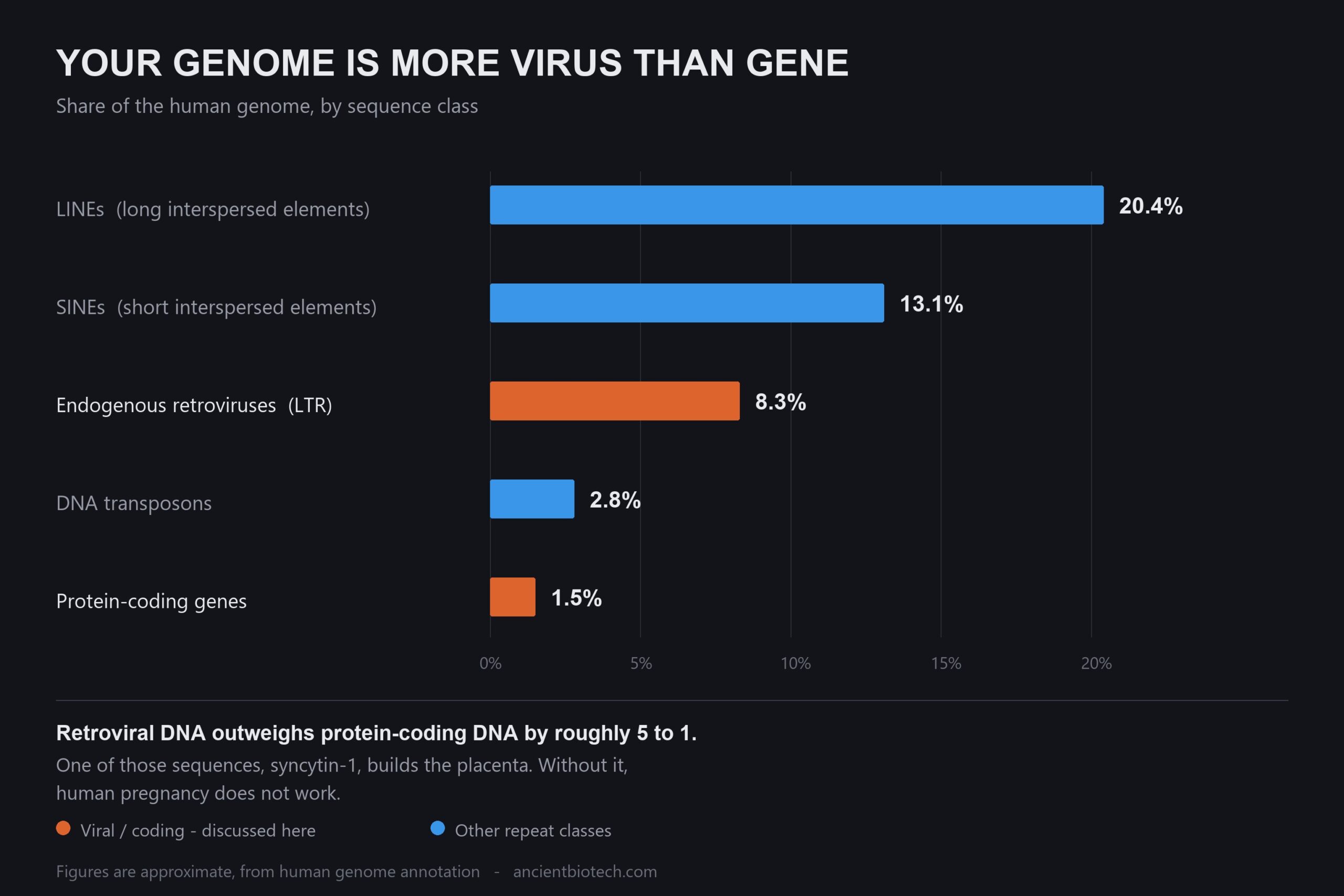
You would not exist without a virus.
That is not a metaphor, and it is the plainest thing viral DNA does in the human genome. The protein that builds your placenta — the organ that fed you before you could eat, and that stopped your mother’s immune system from destroying you as foreign tissue — is encoded by a gene that came from a retrovirus that infected an ancestral mammal tens of millions of years ago.
The gene is called syncytin-1. Its formal designation, ERVW-1, contains the admission: Endogenous Retrovirus, family W.
Delete it and mammalian pregnancy fails.
What the Human Genome Is Actually Made Of
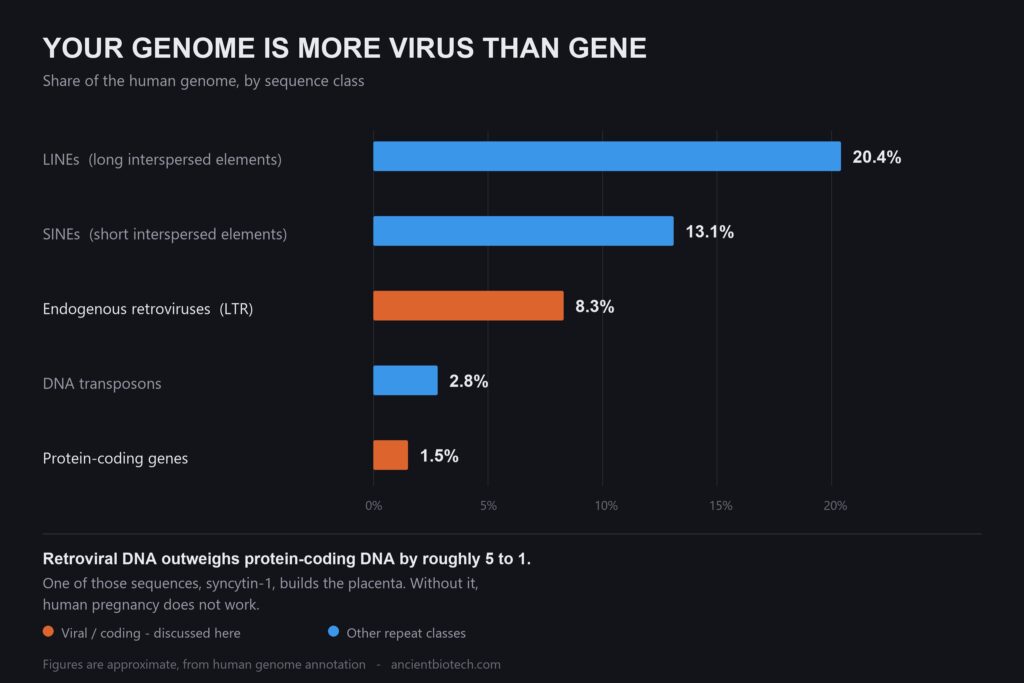
Most people carry a mental picture of the genome as a book of genes. It is not, and the actual proportions are startling.
- Protein-coding genes: about 1.5%. The part that actually specifies proteins is a rounding error.
- Endogenous retroviruses: roughly 8%. Sequences of viral origin, embedded in the chromosome.
- Transposable elements overall: close to half. LINEs, SINEs, DNA transposons — mobile or formerly mobile sequence.
Retroviral DNA in your cells outweighs the DNA that codes for your proteins by roughly five to one.
For most of the twentieth century this was dismissed as junk — molecular parasitism, genomic litter accumulated over deep time. That view has not survived contact with the evidence.
Syncytin: The Virus That Builds the Placenta
Here is how the placenta works, and why the origin of the mechanism is so strange.
For a foetus to receive nutrients, the placenta must form a syncytium — a layer in which individual cells fuse together into one continuous multinucleated sheet, with no cell walls to obstruct exchange. That fused barrier also shields the foetus from the maternal immune system, which would otherwise treat half-foreign tissue as an invader.
Cell fusion is a difficult trick. Very few things in biology can do it.
Retroviruses can. Fusing with a host membrane is precisely how an enveloped virus gets inside a cell, and the protein that performs it is the envelope protein.
Syncytin-1 is a retroviral envelope protein. It has been retained, domesticated, and put to work fusing the mother’s cells instead of infecting them. The machinery for breaching a membrane was repurposed into the machinery for building an organ.
And it happened more than once. Mice use a different syncytin, from a different viral insertion. So do rabbits, carnivores and some ruminants — each lineage independently capturing an envelope gene and converging on the same solution. Placental mammals, plural, solved pregnancy by domesticating viruses, repeatedly.
The Other Domesticated Invaders
Syncytin is the most striking case but not the only one.
Arc, a gene essential for memory consolidation and synaptic plasticity, descends from a retrotransposon gag gene. Remarkably, the Arc protein self-assembles into virus-like capsids and transfers RNA between neurons — behaving, structurally, like the virus it came from. Your memory uses viral packaging.
RAG1 and RAG2, the enzymes that generate antibody diversity by cutting and rearranging immune-system DNA, derive from an ancient transposon. The adaptive immune system — the thing that fights infection — was built from a mobile genetic element.
Bacteriophages — viruses that infect bacteria — are the most abundant biological entities on the planet, and enormous numbers live in your gut and on your mucosal surfaces, killing bacteria. They are part of how the microbiome is regulated.
The pattern is consistent enough to have a name: molecular domestication. A sequence arrives as an intruder and is retained, repurposed and made load-bearing.

Delivery Systems, Not Just Pathogens
Reframe what a virus fundamentally is and the biology looks different.
A virus is a package of genetic instructions with a mechanism for entering a cell and installing them. Strip away the disease and what remains is a delivery system — and a superbly engineered one.
This is not a rhetorical move. It is what modern medicine now does with them deliberately:
- Gene therapy uses modified adeno-associated virus to deliver working genes into patients. Approved treatments for spinal muscular atrophy and inherited retinal disease work this way.
- CAR-T cancer therapy uses a disabled lentivirus — derived from HIV — to reprogram a patient’s own T cells to attack their cancer.
- Viral vector vaccines deliver instructions rather than pathogens.
- Phage therapy deploys bacteriophages against antibiotic-resistant infections.
We did not invent these mechanisms. We found them, stripped out the harmful payload, and used the delivery architecture that was already there.
Horizontal Gene Transfer: Biology’s Other Inheritance
There is a second reason viruses matter beyond disease, and it changes the shape of the whole picture.
Inheritance is usually vertical — parent to child, down a lineage. But genes also move horizontally, between organisms and across species boundaries, and viruses are a principal vector.
In bacteria this is routine and consequential: antibiotic resistance spreads through populations horizontally, which is why resistance can appear in a species that never developed it. In eukaryotes it is rarer but documented, and syncytin is the proof that it can produce something essential.
So the tree of life is not purely a tree. It has cross-connections — sequences jumping between branches, carried by agents that exist to move genetic information from one place to another.
The Theological Problem
This is where the subject gets genuinely difficult, and it is worth stating the difficulty rather than smoothing it.
Genesis 1:31 has God surveying creation and calling it “very good.” Yet viruses cause smallpox, rabies, polio and Ebola. Two responses are available, and both have costs.
Response one: viruses were made good and later damaged. This reads Genesis 6:12 — “all flesh had corrupted his way upon the earth” — as a biological statement, applying beyond humanity, the same way the Nephilim account reads it. The original function was delivery and repair; pathogenicity is the corruption of a tool.
Its cost: it is not testable. Virology has no way to distinguish an “original” viral function from a derived one, and the claim cannot be checked against evidence.
Response two: “very good” means fit for purpose, not free of harm. Viruses regulate populations, drive genetic variation, control bacteria and move information. In an ecological sense they are load-bearing — remove all viruses and marine ecosystems collapse, since phages lyse a substantial fraction of ocean bacteria daily and release the nutrients that drive the carbon cycle.
Its cost: it does not soften what a child dying of rabies means.
The observation that stands on its own, independent of which response you take, is narrower and harder to dismiss: the same class of agent that causes our worst diseases also built the organ every one of us was grown in. That is not a tidy fact for anyone’s framework.
Information, Not Chemistry
There is a thread connecting all of this, and it is the one worth holding onto.
A virus carries almost nothing. No metabolism, no ribosomes, no power supply, often no more than a few thousand letters of nucleic acid in a protein shell. It cannot reproduce, move purposefully, or do anything at all on its own.
What it has is instructions — and an entry mechanism.
That turns out to be sufficient to reshape the biology of every organism on the planet, including ours. The functional payload is not chemistry. It is information, plus a way to deliver it.
Which is the same observation this record keeps arriving at from other directions: inheritance running as hidden code through visible carriers, a genome degrading as errors accumulate, a bloodline as the thing worth attacking. In every case the decisive layer is not the material. It is the instruction set written into it.
Frequently Asked Questions
What percentage of human DNA is viral?
Roughly 8% of the human genome consists of endogenous retrovirus sequences. Protein-coding genes account for only about 1.5%, so retroviral DNA outweighs coding DNA by around five to one. Transposable elements overall make up close to half the genome.
What is syncytin?
A protein essential for forming the placental syncytiotrophoblast — the fused cell layer that transfers nutrients and shields the foetus from the maternal immune system. Syncytin-1 is encoded by ERVW-1, a gene captured from an ancient retrovirus. Its formal name identifies it as endogenous retroviral in origin.
Could humans reproduce without viral DNA?
Not as we do. Placental development depends on syncytin, a domesticated retroviral envelope protein. Different mammal lineages captured different syncytin genes independently, which indicates the solution was arrived at repeatedly.
Are all viruses harmful?
No. Bacteriophages in the gut kill bacteria and help regulate the microbiome, and many viral infections are asymptomatic. Several sequences of viral origin are essential to human biology, including those behind the placenta, memory consolidation and the adaptive immune system.
Are viruses used in medicine?
Yes. Modified adeno-associated virus delivers gene therapies for conditions including spinal muscular atrophy; disabled lentivirus derived from HIV is used to engineer CAR-T cells for cancer; and bacteriophage therapy is used against antibiotic-resistant infections.
What is horizontal gene transfer?
The movement of genetic material between organisms other than by descent from parent to offspring. Viruses are a major vector. It is how antibiotic resistance spreads rapidly through bacterial populations, and how syncytin entered the mammalian genome.
Why would God create viruses?
The question has no settled answer. One reading holds that viruses were created as delivery and regulatory systems and became pathogenic through the corruption described in Genesis 6:12. Another holds that “very good” means fit for purpose rather than free of harm, noting that viruses are ecologically load-bearing.
Conclusion: The Enemy in the Blueprint
We classify viruses as enemies because we meet them when they harm us. That is a reasonable way to sort a threat and a poor way to understand a mechanism.
The full picture is stranger. The agent we treat as the archetypal invader is written into 8% of our chromosomes, built the organ that grew us, packages our memories, and supplied the machinery of our immune system. Meanwhile, the sequence that actually codes for our proteins occupies less than two percent.
Somewhere in deep biological history, something that arrived as an intruder was kept, disarmed, and given a job — and the job it was given was making it possible for us to be born.
Whatever you conclude about how that happened, the situation itself is not what anyone expected to find when they opened the genome. We went looking for the book of life and found that most of it was written by something else.
Continue Reading
- Junk DNA: An Archive Nobody Curated — An onion has five times more DNA than you do. That single fact is the hardest question in genomics, and it is the one…
- Human Chromosome 2: The Fusion, and the 1,280 Who Carried It — You have 46 chromosomes. Every other great ape has 48. What sits at 2q13, the case against reading it as a fusion, and…
- The Shroud of Turin: A Negative Nobody Ordered — Dust vacuumed from the cloth in 1978 has now been sequenced, and the result was reported as evidence the Shroud came…