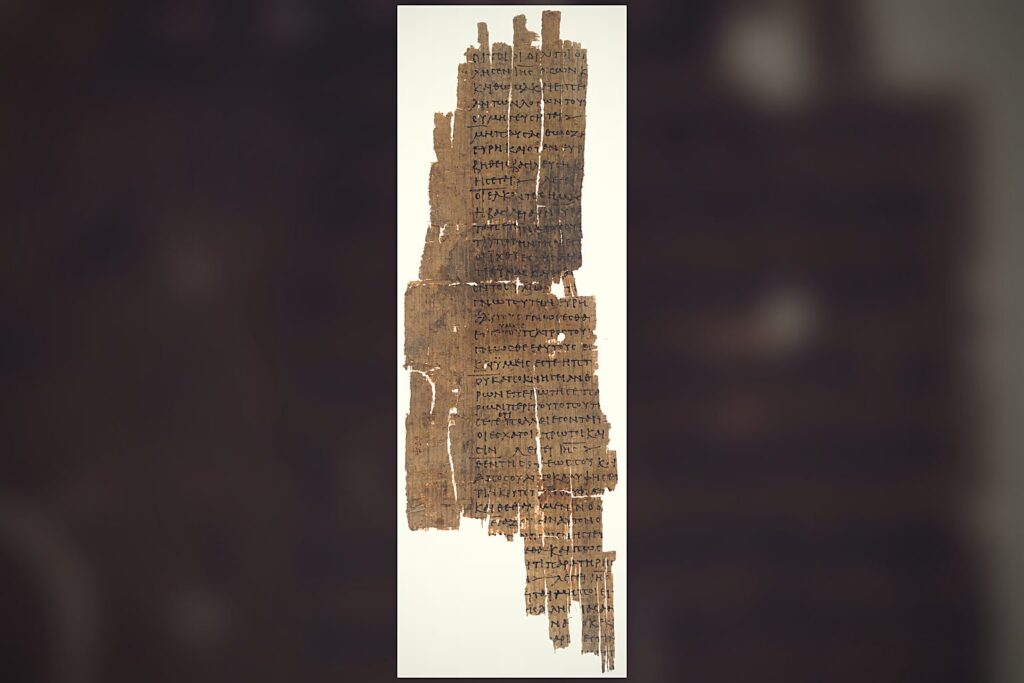
In 1897 two young Oxford archaeologists sifting an Egyptian rubbish mound at Oxyrhynchus pulled out a scrap of papyrus covered in Greek sayings attributed to Jesus. None of them were in any gospel. They published it, argued about it, and had no idea what it belonged to.
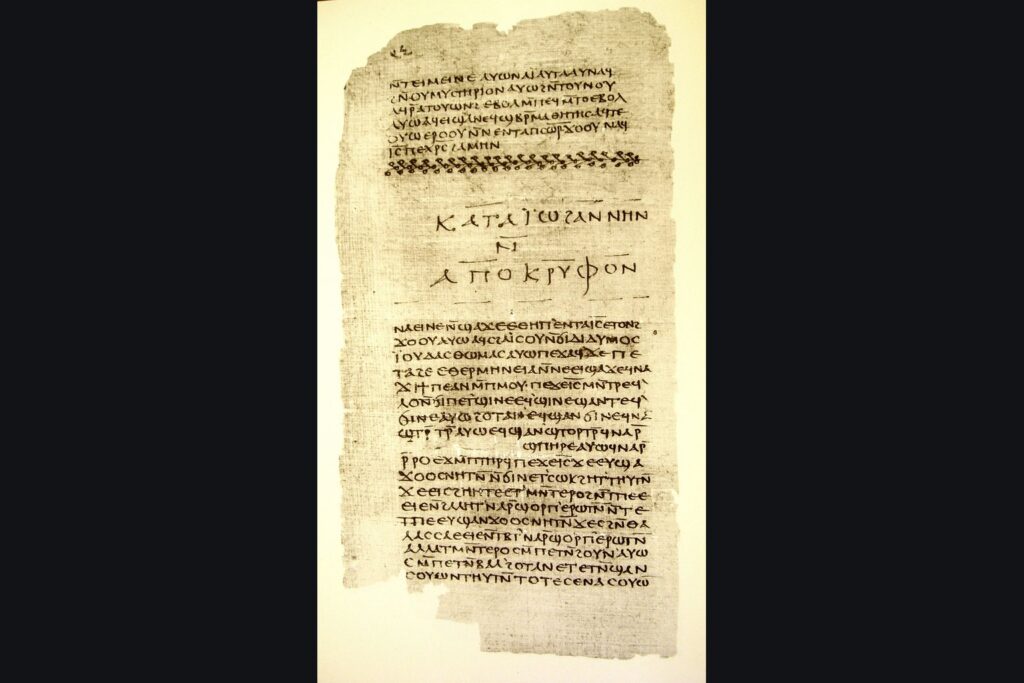
They were dead before anyone found out. In late 1945, near the town of Nag Hammadi four hundred kilometres upriver, farmers digging for fertiliser broke open a sealed jar containing thirteen leather-bound codices. Inside one of them, in Coptic, was a complete text beginning:
“These are the secret sayings which the living Jesus spoke and which Didymos Judas Thomas wrote down.”
The Oxyrhynchus scraps were fragments of it. The Gospel of Thomas had been sitting in the Oxford collection for nearly fifty years, unidentified.
What Is the Gospel of Thomas?
The Gospel of Thomas is a collection of 114 sayings attributed to Jesus, with almost no narrative around them. It survives complete in a Coptic manuscript of about AD 340 from Nag Hammadi, and in three earlier Greek fragments from Oxyrhynchus.
It is worth being precise about what “gospel” means here, because the word sets up the wrong expectation. There is no birth, no baptism, no miracle, no journey to Jerusalem, no arrest, no crucifixion, no resurrection. There is no plot at all. It is a sayings list: “Jesus said…”, 114 times, numbered by modern editors, in no obvious order.
What Does the Gospel of Thomas Say?
The organising promise is in the first line after the incipit, and everything follows from it:
“Whoever finds the interpretation of these sayings will not experience death.” (Thomas 1)
Salvation, in this text, comes from understanding — from working out what the sayings mean. That is a different engine from the canonical gospels, where what saves is an event that happened to somebody else.
The kingdom is treated the same way. It is not coming; it is here and unrecognised:
“The kingdom is inside of you, and it is outside of you. When you come to know yourselves, then you will become known.” (Thomas 3)
About half the sayings will feel familiar to anyone who has read Matthew, Mark or Luke.
The Sayings You Already Know
Thomas contains a mustard seed, a sower, a lost sheep, a hidden treasure, a rich fool, and a rejected cornerstone. Some run almost word for word with the synoptic versions; others are shorter, sharper, and stripped of the explanation the canonical gospels attach.
The most quoted example is Thomas 100, the coin question — and the difference is a single clause:
“Give Caesar what belongs to Caesar, give God what belongs to God, and give me what is mine.” (Thomas 100)
That third item is not in Mark, Matthew or Luke. Whether it is an addition, or an older version the others trimmed, is precisely the argument scholars have been having since 1959, and neither side has closed it.
The Sayings You Do Not Know
The other half is why the book gets its reputation.
“Split a piece of wood, and I am there. Lift up the stone, and you will find me there.” (Thomas 77)
“Blessed is the lion which becomes man when consumed by man; and cursed is the man whom the lion consumes.” (Thomas 7)
Saying 7 has resisted confident interpretation for seventy years. Saying 77 reads as a straightforward statement that the divine is distributed through the material world — which is either a beautiful line or a heresy, depending entirely on the century in which you read it.
And then there is the last one, Thomas 114, which is the reason a lot of readers put the book down:
“Simon Peter said to them: Let Mary leave us, for women are not worthy of life. Jesus said: I myself shall lead her, in order to make her male, so that she too may become a living spirit resembling you males.” (Thomas 114)
It is usually read today as a late addition — it sits awkwardly after 113, which had already closed the collection with a conclusion about the kingdom. It is also the saying most often quoted out of context in both directions: as proof the text is misogynist, and as proof the early church suppressed a feminist gospel. It is neither. It is one strange verse at the end of a strange book.
Is the Gospel of Thomas Gnostic?
This is the question the text is most often mislabelled on, and the honest answer is: partly, and probably not originally.
The case for Gnostic is circumstantial and mostly geographical. It was found in a library that is largely Gnostic. It speaks of secret knowledge, of the elect, of a light within, and it shows no interest in the crucifixion — all of which fits the profile.
The case against is textual. Thomas has none of the machinery that defines Gnosticism proper: no demiurge, no fallen Sophia, no elaborate hierarchy of aeons, no creation myth in which the material world is the work of a lesser and hostile god. Those features are everywhere in its neighbours in the same codex and absent here.
The current position of most specialists is that Thomas belongs to an early strand of mystical, wisdom-oriented Christianity that later Gnostics found congenial and preserved — which is not the same as saying they wrote it. Being bound in a heretical library does not make a book heretical, any more than being shelved beside a novel makes a book fiction.
When Was It Written?
Here the site’s usual rule applies: say plainly where the evidence runs out.
The manuscripts are firm. The Coptic codex is roughly AD 340. The Greek fragments — Papyrus Oxyrhynchus 1, 654 and 655 — are third century, around AD 200-250, with the composition of that Greek text usually placed near AD 140.
The original is not firm at all. Proposals run from about AD 50 to about AD 250, and the spread is not a sign of sloppy scholarship; it is a sign that the evidence genuinely underdetermines the answer.
| Position | Argument | Weakness |
|---|---|---|
| Early, c. AD 50-80 | Sayings lack the interpretive framing the synoptics add, which looks primitive; no passion narrative to harmonise | Simplicity can be editing rather than antiquity |
| Middle, c. AD 100-140 | Fits the Greek fragments and the sayings-collection genre of that period | Requires explaining the synoptic-looking material as independent |
| Late, c. AD 175-250 | Some sayings appear to know Matthew and Luke in their finished form, and specifically their Syriac harmonisation | Would make the Greek fragments nearly contemporary with composition |
The most defensible summary is that a core of sayings may be very early, and the collection as we have it is second century. Anyone who tells you Thomas is definitively older than the canonical gospels is reporting a preference, not a finding.
How It Ended Up Outside the Canon
Not because of a vote, and not because of the Council of Nicaea, which discussed the divinity of Christ and did not rule on the canon at all. That claim is worth a separate look.
Thomas failed the criteria that were actually in use, and it failed them on structural grounds rather than political ones.
- No passion and no resurrection. The earliest Christian preaching is built on the death and rising of Jesus. A text that omits both is not a competing account of the same thing; it is a different genre.
- No apostolic pedigree the churches accepted. Attribution to “Didymos Judas Thomas” was known and disputed early.
- Not read in the liturgy. Canon formed largely by tracking which books were already being read aloud in congregations across many regions. Thomas was not one of them outside Syria.
Origen and Eusebius both knew of a Gospel of Thomas and both put it outside. That is a judgment made two to three centuries before any imperial council and recorded openly.
Checking the Popular Claims
It was not in the Dead Sea Scrolls. The scrolls are Jewish, from Qumran, sealed before AD 70, and contain no Christian texts of any kind. Thomas came from Nag Hammadi, a different site, a different century and a different religion. The Qumran material is often merged with Nag Hammadi in popular accounts and they have nothing to do with each other.
It was not banned or burned. It fell out of use. Copies survived in Egypt because Egypt is dry, which is why almost every early Christian papyrus we have comes from there — including the only manuscript of the Gospel of Mary.
It does not contain a secret teaching the church removed. Whatever the incipit means by “secret sayings”, the content is on the page and has been publicly available in dozens of translations since 1959. Nothing in it is withheld.
It is not evidence that Jesus was married. That claim attaches to a different fragment entirely — the so-called Gospel of Jesus’ Wife, which was promoted in 2012 and shown to be a modern forgery by 2016. Thomas says nothing about a marriage.
Frequently Asked Questions
What does the Gospel of Thomas say?
It records 114 sayings attributed to Jesus with almost no narrative. About half parallel sayings in Matthew, Mark and Luke; the rest are unique, and several are deliberately cryptic. Its central claim is that whoever correctly interprets the sayings will not experience death.
Is the Gospel of Thomas in the Bible?
No. It is not in any Christian canon. Early writers including Origen and Eusebius listed it among disputed or rejected books, well before any imperial council met.
Is the Gospel of Thomas real?
It is a genuine ancient text, not a modern invention. A complete Coptic copy was found at Nag Hammadi in 1945 and Greek fragments had already been dug up at Oxyrhynchus from 1897. Authenticity as an ancient document is not the same as historical reliability about Jesus.
Is the Gospel of Thomas Gnostic?
It was found in a Gnostic library and uses the language of hidden knowledge, but it lacks the defining Gnostic features — no demiurge, no fallen Sophia, no aeons. Most specialists now treat it as an early mystical wisdom text that Gnostics later preserved.
Was the Gospel of Thomas in the Dead Sea Scrolls?
No. The Dead Sea Scrolls are Jewish texts from Qumran sealed before AD 70 and include no Christian writings. Thomas comes from Nag Hammadi in Egypt, discovered in 1945.
When was the Gospel of Thomas written?
The surviving Coptic manuscript dates to about AD 340 and the Greek fragments to around AD 200-250. The original is disputed, with serious proposals ranging from AD 50 to AD 250; a second-century date for the collection is the most common position.
Does the Gospel of Thomas say Jesus is God?
Not in the way the canonical gospels do. It presents Jesus as a living revealer of hidden wisdom rather than as a sacrificial figure, and saying 13 has Jesus refuse comparison altogether. It contains no incarnation theology.
Why was the Gospel of Thomas rejected?
Because it has no passion or resurrection narrative, was not read in worship across the churches, and its apostolic attribution was doubted. Those were the working criteria, and they were applied in the second and third centuries, not at Nicaea.
Conclusion: Fifty Years in a Drawer
The most instructive thing about the Gospel of Thomas is not what it says. It is that the fragments sat in Oxford from 1897 to 1945 while scholars argued about what they were — and that the answer arrived only because two Egyptian farmers went looking for fertiliser.
What emerged is neither the suppressed true gospel of popular retelling nor the heretical forgery of the older polemic. It is a second-century sayings collection with an early core, preserved by people whose theology it does not quite share, in the one climate on earth that keeps papyrus intact.
Read as what it is, it is the closest thing we have to hearing how one early Christian community remembered the teacher without the story.
Continue Reading
- The Gospel of Mary: Ten Missing Pages and One Argument — Bought in Cairo in 1896, published in 1955 after a burst water pipe and two world wars. What the surviving text says…
- The Lost Books of the Bible: Who Left What Out — The lists are real. Most of the books are real. The argument is over one word: banned. What the categories actually…
- Books Mentioned in the Bible but Not Included: The Dead Links — Around twenty books are named in scripture as its own sources, cited more than forty times, and not one has ever been…