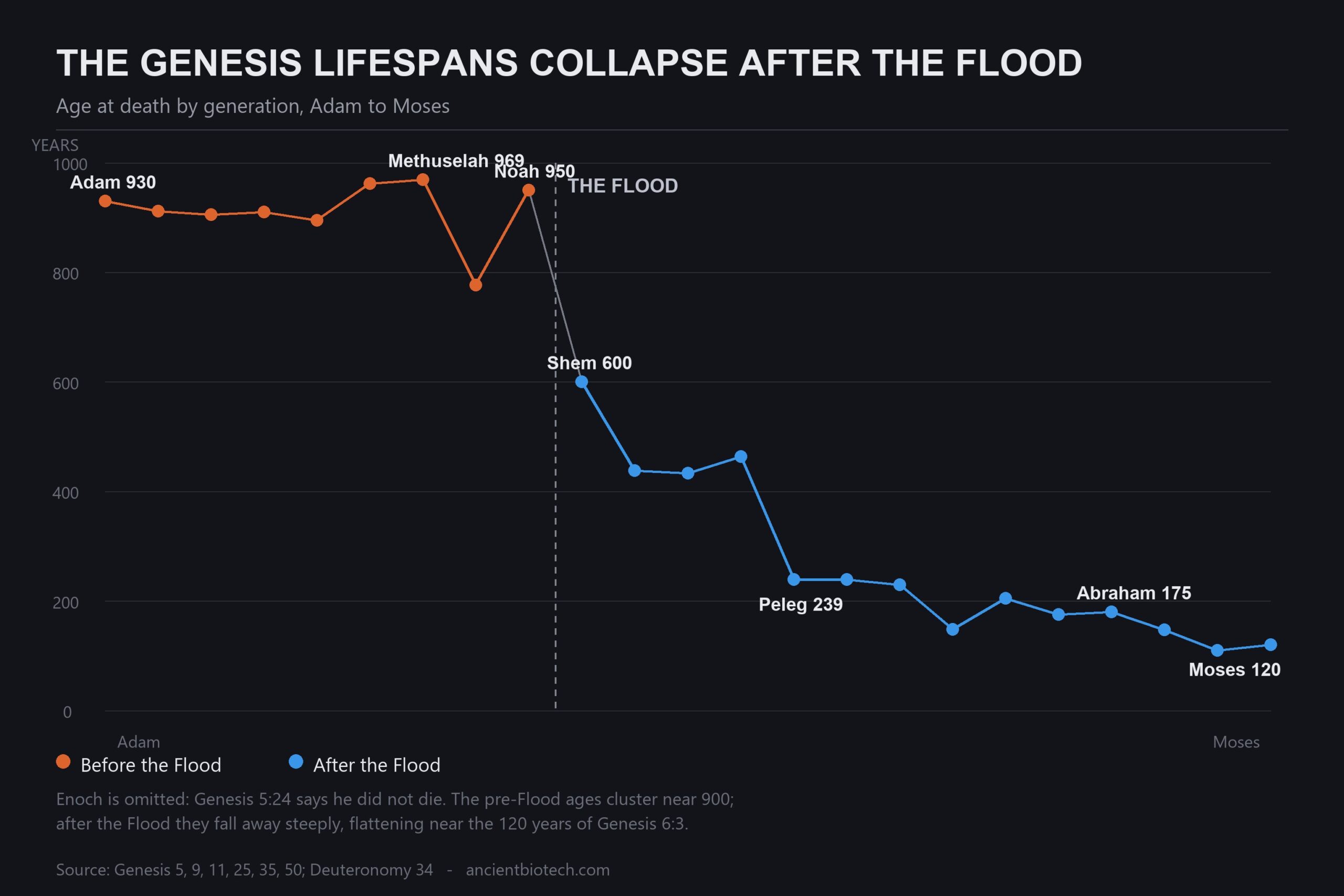
People are said to live 900 years in the Bible, and the usual reply is that the numbers are invented. Plot the ages in Genesis on a graph, though, and something unexpected happens. You do not get noise. You do not get a scatter of arbitrary large numbers, which is what invented figures usually look like.
You get a curve.
Nine generations before the Flood cluster tightly around 900 years. Then the line falls off a cliff and decays smoothly toward 120, flattening out near the figure the Bible itself names as a limit.
That shape is the most interesting thing about the whole question, and it is almost never discussed — because the argument usually stops at “nobody lives to 969.”
What the Numbers Actually Are
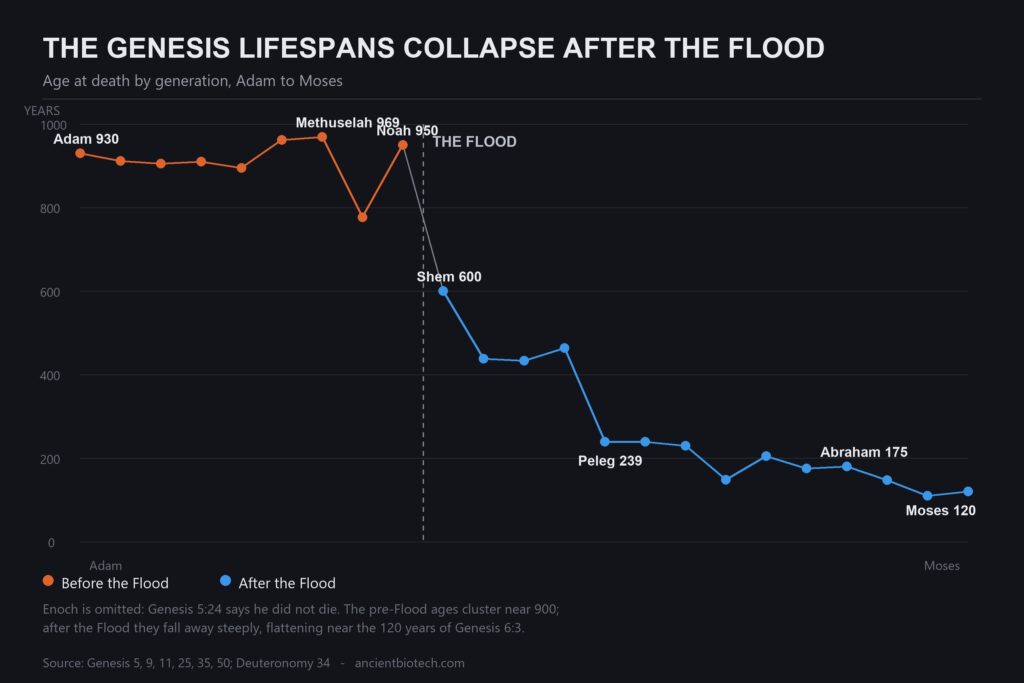
Before the Flood (Genesis 5): Adam 930, Seth 912, Enosh 905, Kenan 910, Mahalalel 895, Jared 962, Methuselah 969, Lamech 777, Noah 950. Enoch is the exception — 365 years, and he did not die.
After the Flood (Genesis 11, 25, 35, 50): Shem 600, Arphaxad 438, Shelah 433, Eber 464, Peleg 239, Reu 239, Serug 230, Nahor 148, Terah 205, Abraham 175, Isaac 180, Jacob 147, Joseph 110. Moses reaches 120.
The pre-Flood figures are remarkably consistent — a spread of under 200 years across nine generations. Then, within a handful of generations, the values drop by 80%.
And they do not drop linearly. They decay the way a quantity decays when it is governed by a rate rather than a subtraction — steeply at first, then flattening as it approaches a floor.
The Floor Is Stated in the Text
Before the Flood, Genesis records a specific announcement:
“And the LORD said, My spirit shall not always strive with man, for that he also is flesh: yet his days shall be an hundred and twenty years.” (Genesis 6:3)
A number is given in advance: 120 years.
Whatever else one makes of the passage, the data conforms to it. Moses dies at 120 (Deuteronomy 34:7). And the modern figure is striking: the longest verified human lifespan on record is Jeanne Calment at 122, and demographers who study extreme longevity generally place the practical ceiling for our species somewhere around 115 to 125 years.
The floor named in Genesis 6:3 and the ceiling measured by modern demography are the same number.
What Happened to the Vapour Canopy Theory
For decades the popular explanation was a vapour canopy: a layer of water suspended above the atmosphere before the Flood, producing a global greenhouse, doubled air pressure, and a radiation shield. It is still repeated widely.
It has to be set aside, and the reason is physics.
Model the canopy and it cooks the planet. Even a modest water layer — enough to contribute meaningfully to the Flood — traps so much infrared radiation that surface temperatures rise far beyond anything survivable. Larger canopies produce surface temperatures in the hundreds of degrees. The greenhouse effect that makes the theory attractive is exactly what destroys it.
This is not a sceptic’s objection. Answers in Genesis and the Institute for Creation Research have both abandoned the canopy model, and creationist physicists including Larry Vardiman published the calculations that killed it. Anyone still presenting it as the explanation is working from material that its own original proponents retired decades ago.
And the 35% Oxygen Claim
The companion claim — that air bubbles in ancient amber prove an atmosphere of 35% oxygen — needs the same correction.
There is a real result underneath it. Atmospheric oxygen genuinely was much higher at one point in Earth’s history: during the Carboniferous, around 300 million years ago, models such as Robert Berner’s GEOCARBSULF put O₂ near 30-35%. That is why Meganeura, a dragonfly with a 70 cm (28 in) wingspan, could fly — insect respiration is diffusion-limited, and denser oxygen supports a larger body.
But two things are wrong with the way it is used:
- The date is off by orders of magnitude. The Carboniferous is nowhere near the period Genesis 5 describes, on any chronology.
- The amber measurements are contested. Gas trapped in amber exchanges with the surrounding environment over geological time, and the original analyses have been challenged on exactly that basis. They are not a clean atmospheric sample.
Hyperbaric oxygen therapy is real and does accelerate healing — that part is sound. But there is no evidence humans ever lived in a naturally hyperbaric atmosphere, and the ancient high-oxygen episode belongs to the insects, not to us.
The Explanation That Actually Fits the Curve
Set the canopy aside and look at the shape of the data again, because the shape is the evidence.
A steep drop followed by a long flattening approach to a floor is the signature of accumulating damage in a system with finite repair capacity.
The proposed mechanism is genetic entropy — the idea, developed most prominently by the geneticist John Sanford, that mildly deleterious mutations accumulate in a population faster than selection can remove them. The logic:
- Every human carries new mutations not present in either parent — current estimates run to roughly 50 to 100 per generation.
- The overwhelming majority are not fatal. They are slightly harmful, individually invisible.
- Natural selection is efficient at removing severe defects and very poor at removing small ones, because a mutation that reduces fitness by a fraction of a percent is effectively invisible to it.
- So the small ones accumulate, generation on generation, degrading the genome’s overall integrity.
On this model, the founding population began with minimal genetic load and the load built up rapidly — producing exactly a steep initial decline that flattens as the most damaging combinations are selected out and the system settles at a new equilibrium.
The honest caveat: genetic entropy is not a mainstream position. Most population geneticists argue that selection, recombination and synergistic epistasis handle mutational load adequately, and that Sanford’s models understate their effect. It is a contested hypothesis, not a settled finding.
But it deserves mention here for a specific reason: it is the only proposed mechanism that predicts the right curve shape. The canopy theory predicts a step change — one environment, then another. The data does not show a step. It shows a decay.
The Bottleneck Nobody Mentions
There is a second mechanism built into the narrative, and it needs no exotic physics at all.
The Flood account describes eight people repopulating the earth — Noah, his wife, three sons and their wives. That is a population bottleneck of extreme severity, and it has a well-understood genetic consequence.
A small founding population means unavoidable consanguinity for many generations. Close relatives share recessive alleles, so harmful recessives that would normally stay hidden get paired up and expressed. This is inbreeding depression, and reduced lifespan is one of its textbook effects.
Notably, the Mosaic law prohibiting close-kin marriage (Leviticus 18) arrives centuries later — around the point in the timeline where the lifespans have already flattened out and the practice would have become genuinely dangerous rather than unavoidable.
Whatever one concludes about the numbers, the narrative contains a bottleneck, and bottlenecks do this.
The Sumerian Parallel
Here is a fact that cuts both ways, and both ways are interesting.
The Sumerian King List, a Mesopotamian document independent of the Bible, records the reigns of kings before and after a great flood. The antediluvian reigns are enormous: Alulim 28,800 years, Alalgar 36,000, and so on — eight kings totalling nearly a quarter of a million years.
Then the flood comes. And the reigns collapse — first to hundreds of years, then to ordinary human spans.
The same structure. The same discontinuity. The same event as the hinge.
There are two ways to read this:
The sceptical reading: long antediluvian lifespans were a standard Mesopotamian literary convention for marking primordial time, and Genesis 5 is participating in that convention. Note that the biblical numbers are far more modest — hundreds, not tens of thousands — which would be consistent with a deliberately restrained version of a shared genre.
The corroborative reading: two independent traditions, in different languages, preserve a memory of the same discontinuity — a period of extreme longevity, terminated by a flood, after which lifespans became ordinary.
The parallel is real either way, and any honest treatment has to put both readings on the table.
What About the Numbers Being Symbolic?
A final possibility deserves a hearing: that the figures encode something other than years.
Some scholars note that Mesopotamian mathematics was sexagesimal (base 60) and that several biblical ages factor neatly in base 60 terms. Others have proposed that the numbers preserve honour, clan duration, or dynastic length rather than individual lifespans.
The difficulty is that Genesis 5 uses the numbers consistently and arithmetically. It gives an age at fatherhood, then remaining years, then a total — and the arithmetic works every time. That is the behaviour of figures intended as quantities, not as symbols. Symbolic numbers do not usually submit to addition.
Frequently Asked Questions
Did people really live 900 years in the Bible?
Genesis 5 records ages between 895 and 969 for nine pre-Flood patriarchs, with Methuselah the longest at 969. Whether these are literal years, a shared ancient literary convention, or figures encoding something else is debated. The internal arithmetic of Genesis 5 is consistent, which is an argument for their being intended as quantities.
Why did lifespans decrease after the Flood?
The text does not explain it. The ages fall steeply from Shem’s 600 to Abraham’s 175 and flatten near 120. Proposed explanations include accumulating genetic load, the severe population bottleneck of eight survivors and the inbreeding that follows, and environmental change.
Is the vapour canopy theory true?
No. Modelling shows that a water canopy substantial enough to matter would trap so much heat that the surface would become uninhabitable. Creationist organisations including Answers in Genesis and the Institute for Creation Research abandoned the model decades ago.
Was ancient oxygen really 35%?
Atmospheric oxygen did reach roughly 30-35% during the Carboniferous around 300 million years ago, which is why giant insects could fly. That period is unrelated to the biblical patriarchs, and the amber bubble measurements often cited are contested because trapped gas exchanges with its surroundings over time.
Who lived the longest in the Bible?
Methuselah, at 969 years (Genesis 5:27). Jared is second at 962 and Noah third at 950.
What is genetic entropy?
A hypothesis, associated with geneticist John Sanford, that mildly deleterious mutations accumulate faster than natural selection can remove them, degrading genome integrity over generations. It is contested by most population geneticists but is the only proposed mechanism that predicts the decay curve shape seen in the Genesis figures.
What does Genesis 6:3 mean by 120 years?
It records God setting a limit on human days. Moses dies at exactly 120, and the longest verified modern lifespan is 122 — with demographers placing the practical species ceiling around 115 to 125.
Do other ancient records mention long lifespans?
Yes. The Sumerian King List gives antediluvian kings reigns of tens of thousands of years, followed by a dramatic collapse after a flood. The structure parallels Genesis closely, though the biblical figures are far smaller.
Conclusion: The Shape Is the Argument
Whether the ages in Genesis are literal is a question this article cannot settle, and anyone who tells you otherwise is selling something.
But the usual debate misses what is actually unusual about the data. Invented numbers, in ancient literature, tend to be large and arbitrary — the Sumerian King List’s 28,800-year reigns are exactly that. Genesis does something different. It gives figures that are internally consistent, that submit to arithmetic, that cluster tightly before a stated event and then decay smoothly afterwards toward a limit the text announced in advance.
The canopy is gone. The 35% oxygen belongs to the dragonflies. What remains is a dataset with a shape — and the shape is the kind a real process leaves behind, not the kind a storyteller invents.
Genesis 6:3 named the floor at 120. Four thousand years later, with every advantage of modern medicine, the record stands at 122.
Continue Reading
- Human Chromosome 2: The Fusion, and the 1,280 Who Carried It — You have 46 chromosomes. Every other great ape has 48. What sits at 2q13, the case against reading it as a fusion, and…
- Junk DNA: An Archive Nobody Curated — An onion has five times more DNA than you do. That single fact is the hardest question in genomics, and it is the one…
- The Shroud of Turin: A Negative Nobody Ordered — Dust vacuumed from the cloth in 1978 has now been sequenced, and the result was reported as evidence the Shroud came…