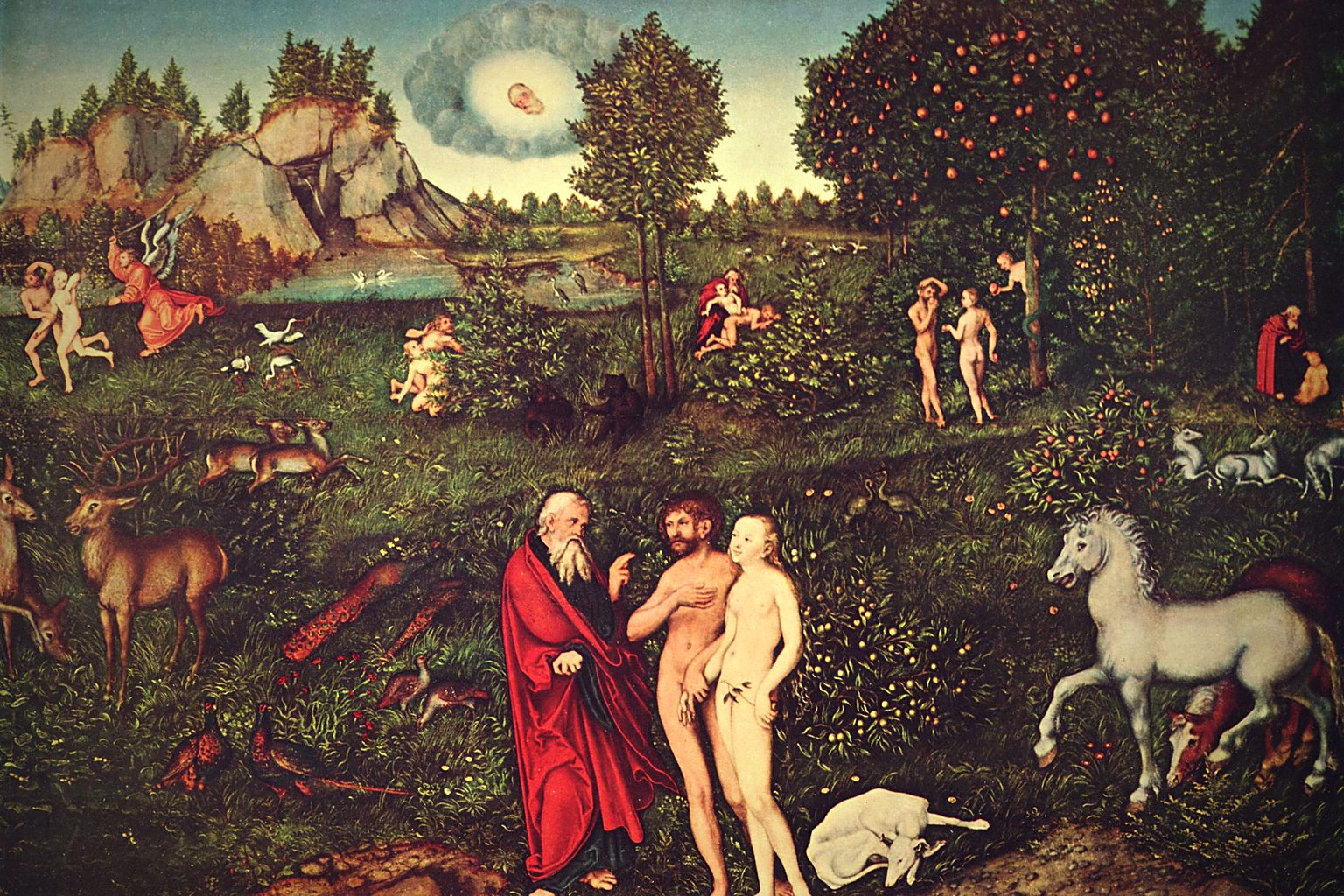
The biology of Adam and Eve begins in eleven words. Genesis 2:7 describes the assembly of a human being:
“And the LORD God formed man of the dust of the ground, and breathed into his nostrils the breath of life; and man became a living soul.”
Two operations. Formed — the physical structure, assembled from material already present. Breathed — something added afterward that the material did not supply.
The text is oddly insistent on that order. The body is built first, from ordinary matter, and it is not alive when it is finished. Something else has to arrive.
“Dust of the Ground” Is Chemically Accurate
The phrase sounds poetic. It is also, unexpectedly, correct.
By mass, the human body is oxygen, carbon, hydrogen, nitrogen, calcium and phosphorus, with trace quantities of potassium, sulphur, sodium, chlorine, magnesium and about fifteen others. Every one of those elements occurs in the earth’s crust and in ordinary soil. There is no element in you that is not also in the ground you walk on.
The Hebrew for man is adam (אָדָם). The Hebrew for ground is adamah (אֲדָמָה). The name is the material.
The Information Problem
Where the account gets genuinely interesting is not the chemistry but what is written into it.
Every one of your cells carries roughly 3.1 billion base pairs of DNA, written in a four-letter alphabet — adenine, cytosine, guanine, thymine. Stretched end to end, the DNA in a single cell is about two metres long. Across your entire body, the total exceeds the diameter of the solar system many times over.
But length is not the striking part. The striking part is that DNA is not primarily a chemical. It is a code.
That distinction matters more than it sounds. In a crystal, the structure determines the arrangement — the chemistry dictates the pattern, which is why every salt crystal is the same. In DNA, the sequence is not determined by the chemistry. Any base can follow any other. The backbone is indifferent to the order.
Which means the sequence carries information in the technical sense: it is one arrangement selected from an astronomically large number of chemically equivalent alternatives. And it is read — transcribed, translated through a coding table, and executed. There is a symbol set, a syntax, an error-correction system, and a translation mechanism.
The observation that information of this kind is characteristically the product of a mind is an old argument, and it is worth being honest about its status: it is a philosophical inference, not an experimental result. Mainstream biology holds that natural selection acting on variation accounts for the sequence without a designer. That debate is not settled by anything in this article.
But the description in the text is at least pointed. John 1:1 opens with “In the beginning was the Word” — Greek Logos, meaning word, reason, ordering principle. A universe that begins with a Logos and a biology that runs on a written code are using the same category.
Homochirality: The Detail Nobody Mentions
Here is a fact about your biology that is rarely discussed outside chemistry departments and is genuinely unresolved.
Most biological molecules are chiral — they exist in two mirror-image forms, like a left and right hand, chemically identical but not superimposable.
In your body:
- Every amino acid used in your proteins is left-handed.
- Every sugar in your DNA and RNA is right-handed.
Not mostly. Essentially all of them.
When amino acids are synthesised by ordinary chemistry in a laboratory, the result is a 50/50 mixture of both forms. There is no energetic preference; the two are equivalent. Yet life uses one and rejects the other, universally, in every organism ever examined.
This is called homochirality, and its origin is one of the genuinely open problems in origin-of-life research. Proposed explanations — circularly polarised light in star-forming regions, mineral surface selection, amplification of a tiny initial imbalance — exist, and none is established.
What is not in dispute is the consequence: a protein built from a mixture of left- and right-handed amino acids does not fold correctly and does not function. The selection had to be essentially complete from the beginning.
The Rib That Is Probably Not a Rib
The account of the woman’s formation contains a translation issue worth knowing about.
“And the LORD God caused a deep sleep to fall upon Adam… and he took one of his ribs, and closed up the flesh instead thereof.” (Genesis 2:21)
The Hebrew word is tsela (צֵלָע). It appears about forty times in the Hebrew Bible, and in almost every other instance it means side — the side of the tabernacle, the side of the ark, the side chambers of the temple. Genesis 2:21 is the only place it is translated “rib,” a rendering that entered English largely through the Latin costa.
If tsela means side, the account describes taking a portion of Adam’s side — tissue, not a single bone — which reads considerably more like a description of building from living material than the usual picture does.
And there is a real anatomical footnote here. The rib is one of the few human bones with genuine regenerative capacity, because of the periosteum — the membrane sheathing it. If a rib is removed but the periosteum is left intact, the bone can substantially regrow. Thoracic surgeons rely on this when harvesting rib for grafts. Genesis 2:21 notes that God “closed up the flesh instead thereof” — the tissue was closed over, which is precisely the condition under which regeneration occurs.

Mitochondrial Eve and Y-Chromosomal Adam
These terms come up constantly and are almost always misused, in both directions. Here is what they actually mean.
Mitochondrial Eve is the most recent woman from whom all living humans descend through an unbroken maternal line. Mitochondrial DNA passes only from mother to child, so it tracks one lineage cleanly.
Y-chromosomal Adam is the equivalent for the paternal line, tracked through the Y chromosome.
Both are real, both are established, and three things about them are routinely got wrong:
- They were not the only humans alive. Many thousands of other people lived at the same time and have living descendants — just not through an unbroken single-sex line. Lineages die out when a woman has no daughters or a man has no sons.
- They did not necessarily live at the same time. Estimates have varied and continue to be refined; some studies place them in overlapping ranges, others tens of thousands of years apart.
- The dates move. They are model-dependent, sensitive to assumed mutation rates and calibration.
So: these concepts do not confirm a literal Adam and Eve, and anyone citing them that way is overreaching. Equally, they do not refute one — they simply address a different question.
What they do establish is real and not trivial: every living human converges on a single maternal ancestor and a single paternal ancestor. Whatever else is true, the family tree narrows.
What “Perfect” Would Have Meant
The text does not say Adam was created immortal in an absolute sense. It says he had access:
“And now, lest he put forth his hand, and take also of the tree of life, and eat, and live for ever…” (Genesis 3:22)
The concern in that verse is access to a source, not an intrinsic property. Immortality is presented as something maintained by ongoing access, and the expulsion cuts off the supply. Genesis 3:24 has cherubim and a flaming sword posted specifically to block the route back.
That reframes “perfect” usefully. It is not a claim that the original biology could not fail. It is a claim that it was unblemished and supplied — and that the second condition was removed.
Whatever happened next, the ages recorded in Genesis 5 trace a curve declining from roughly 900 years toward the limit named in Genesis 6:3, which is the shape of a system losing integrity rather than one switched off.
Frequently Asked Questions
What was Adam made of?
Genesis 2:7 says God formed man from the dust of the ground. The human body consists of oxygen, carbon, hydrogen, nitrogen, calcium, phosphorus and trace elements — all of which occur in soil and the earth’s crust. The Hebrew name adam derives from adamah, ground.
Was Eve really made from a rib?
The Hebrew word tsela means “side” in nearly every other occurrence in the Hebrew Bible — the side of the tabernacle, the ark, the temple. Genesis 2:21 is the only place it is rendered “rib,” a translation that came through the Latin costa.
Can a human rib grow back?
Partially, yes. The rib is one of the few human bones with meaningful regenerative capacity because of the periosteum, the membrane surrounding it. If the periosteum is preserved, substantial regrowth can occur, and surgeons use this when harvesting rib grafts.
Does Mitochondrial Eve prove the biblical Eve?
No. Mitochondrial Eve is the most recent woman from whom all living people descend through an unbroken maternal line. She was not the only woman alive at the time, and the dating is model-dependent. The concept neither confirms nor refutes a literal Eve.
What is homochirality?
The fact that life uses only left-handed amino acids and only right-handed sugars, despite ordinary chemistry producing equal mixtures of both. Its origin remains an open problem in origin-of-life research, and proteins built from mixed forms do not fold or function.
How much information is in human DNA?
The human genome contains roughly 3.1 billion base pairs written in a four-letter alphabet. The DNA in one cell is about two metres long when uncoiled.
Was Adam created immortal?
Genesis 3:22 frames immortality as dependent on access to the tree of life rather than as an intrinsic property, and the expulsion in Genesis 3:24 specifically blocks the route back to it.
Conclusion: Two Operations
Genesis 2:7 keeps the two steps separate, and the separation is the claim.
The body is assembled from ordinary material — elements that are in the soil, chemistry that breaks no rules. On that, the text and the periodic table agree completely.
And then something is added that the material did not contain, and only at that point does the text say the man became a living soul.
Modern biology has filled in the first step in extraordinary detail: three billion letters, a translation table, error correction, a molecular handedness selected with a completeness nobody can yet explain. What it has not done — what it is not, in principle, equipped to do — is address the second.
The dust we can account for. The breath is still where the account left it.
Continue Reading
- Human Chromosome 2: The Fusion, and the 1,280 Who Carried It — You have 46 chromosomes. Every other great ape has 48. What sits at 2q13, the case against reading it as a fusion, and…
- The Garden of Eden: Two of the Four Rivers Are Missing — Genesis gives the garden an address. Two rivers are on every map, two match nothing. The drowned Persian Gulf valley…
- Junk DNA: An Archive Nobody Curated — An onion has five times more DNA than you do. That single fact is the hardest question in genomics, and it is the one…