Genesis 5 has a rhythm, and the rhythm is death.
The chapter lists the patriarchs of the first world one after another, and each entry closes with the same four words. Adam lived 930 years — and he died. Seth lived 912 years — and he died. Enosh, Kenan, Mahalalel, Jared. Lived, fathered, died. Lived, fathered, died. It reads like a ledger being closed, generation by generation.
Then the seventh entry breaks the pattern, and it breaks it completely.
“And Enoch walked with God: and he was not; for God took him.” (Genesis 5:24)
No death. No burial. No age at death. The ledger simply stops.
Who Was Enoch in the Bible?
Enoch was the seventh generation from Adam, the son of Jared and the great-grandfather of Noah. Genesis 5:21-24 records that he lived 365 years, “walked with God,” and then did not die — God took him. He is one of only two figures in the Hebrew Bible said to have left the earth alive, the other being the prophet Elijah.
He is also the traditional author of the Book of Enoch, an ancient text that the New Testament quotes directly but that most Bibles do not contain.
There Are Two Enochs — Don’t Confuse Them
This trips up almost everyone reading Genesis for the first time.
The first Enoch appears in Genesis 4:17. He is the son of Cain, and Cain names the first city after him. This Enoch does nothing else in Scripture.
The second Enoch — the one this article is about — appears in Genesis 5:18-24. He descends from Seth, Adam’s third son, and belongs to the righteous line that leads to Noah.
Same name, two different men, two different family lines, opposite legacies. One has a city named after him by a murderer. The other walks off the page alive.
The 365 Years: A Number That Isn’t Random
Every other patriarch in Genesis 5 lives to an enormous age. Jared, Enoch’s father, reaches 962. Methuselah, Enoch’s son, reaches 969 — the longest lifespan recorded in Scripture.
Enoch lives 365 years. By the standards of his own genealogy, he is taken young — barely a third of his father’s span.
The number itself is conspicuous. Three hundred and sixty-five is the count of days in a solar year, and the Book of Enoch is preoccupied with exactly that: solar calendars, the portals through which the sun rises and sets, the precise mechanics of celestial timekeeping. Whether the correspondence is deliberate or coincidental, ancient readers noticed it and did not think it was an accident.
What Does “Walked With God” Mean?
The Hebrew phrase is hithallek eth ha-Elohim, and the grammatical form matters. The verb is reflexive and iterative — it describes continuous, habitual, back-and-forth movement. Not a single act of obedience. A sustained manner of life.
The same phrase is used of only one other person before the Flood: Noah, in Genesis 6:9.
The New Testament adds a detail Genesis leaves out:
“By faith Enoch was translated that he should not see death; and was not found, because God had translated him: for before his translation he had this testimony, that he pleased God.” (Hebrews 11:5)
He was not found. That is the language of a search. People looked for him.
The word “translated” — Greek metatithemi — means to transfer, to change position, to move something from one place to another. It is a word about relocation, not death. Whatever happened to Enoch, the New Testament describes it as a change of address.
How Did Enoch Die?
He did not.
This is the direct answer to the question, and it is worth stating plainly because the phrasing of Genesis 5:24 is unusual enough that people assume it is a euphemism. It is not. Hebrews 11:5 removes the ambiguity: Enoch was translated so that he should not see death.
Only two people in the Hebrew Bible leave the world this way:
| Figure | Passage | Manner of departure |
|---|---|---|
| Enoch | Genesis 5:24 | “God took him” — no further detail given |
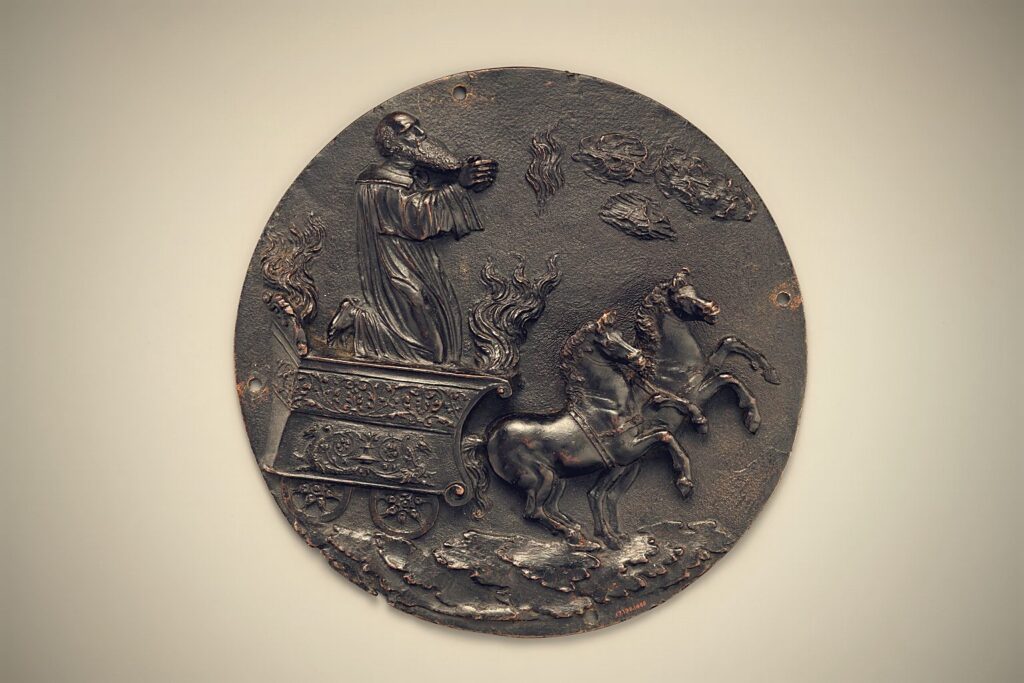
| Elijah | 2 Kings 2:11 | Taken up by a whirlwind, with a chariot and horses of fire |
Elijah’s departure is public and witnessed — Elisha watches it happen. Enoch’s is not described at all. He is simply present, and then not.
Is Enoch Still Alive?
This is where Scripture stops giving answers and interpretation takes over. Three positions exist:
He is alive in the presence of God. The plain reading of Hebrews 11:5. He never died, so he is still living, somewhere that is not here.
He is one of the two witnesses of Revelation 11. This is the most popular speculation. Revelation 11 describes two witnesses who prophesy, are killed, and rise after three and a half days. Since Hebrews 9:27 says it is appointed to men once to die, some argue Enoch and Elijah — the only two who never did — must return to complete that appointment. It is an elegant theory. It is also entirely inferential; Revelation never names them.
He died later, elsewhere. A minority reading, holding that “God took him” means an early natural death phrased gently. This sits badly with Hebrews 11:5, which specifically says he did not see death.
The honest position is the first, with the second flagged as speculation that the text does not confirm.
The Book of Enoch: Quoted in the Bible, Absent From It
Most people are surprised that a Book of Enoch exists. They are more surprised to learn the New Testament quotes it.
“And Enoch also, the seventh from Adam, prophesied of these, saying, Behold, the Lord cometh with ten thousands of his saints, to execute judgment upon all…” (Jude 1:14-15)
Jude is quoting 1 Enoch 1:9, almost word for word. He introduces the quotation as prophecy, and attributes it to Enoch by name and by generation.
So the situation is this: a text outside the canon is quoted as authoritative inside the canon. That does not make the whole book Scripture — Paul quotes pagan poets without canonising them — but it does mean the early church knew this literature and took parts of it seriously.
Some facts worth knowing about the book:
- It is not one book but a collection of at least five distinct works, composed roughly between the 3rd century BC and the 1st century AD — long after the historical Enoch would have lived. It is pseudepigraphal: written in his name, not by him.
- It is canonical in the Ethiopian Orthodox Tewahedo Church, which is the only reason the complete text survives. The full version exists in Ge’ez; Greek and Aramaic fragments survive elsewhere.
- Aramaic fragments were found among the Dead Sea Scrolls at Qumran, confirming the text was circulating in Judea before the New Testament was written.
The Watchers and the Forbidden Curriculum
The most influential section of the book is the Book of the Watchers, and it is an expansion of four verses in Genesis 6 that the Bible leaves almost unexplained.
Enoch names two hundred angels who descended on Mount Hermon, bound themselves by mutual oath, took human wives, and fathered the Nephilim. Their leader is named Semjaza; a second figure, Azazel, is blamed for the worst of it.
But the text’s real emphasis is not on the marriages. It is on the teaching.
The Watchers are charged with transferring knowledge that humanity was not meant to hold yet:
- Azazel taught the making of swords, knives, shields and breastplates — and the working of metals.
- He also taught the use of antimony, cosmetics, and the beautifying of the eyelids.
- Semjaza taught enchantments and the cutting of roots — pharmacology and sorcery.
- Baraqijal taught astrology; Kokabel, the constellations; Sariel, the courses of the moon.
Read as a list, it is a curriculum: metallurgy and weapons, chemistry and pharmacology, astronomy, and the manipulation of appearance. These are not trivial arts. They are the foundations of technology.
The charge is not that this knowledge is evil in itself. It is that it arrived out of order — handed to a civilisation that had not developed the restraint to hold it. The result, in Enoch’s telling, was a world that armed itself, drugged itself, and corrupted itself within a few generations.
The Ascent: What Enoch Claims to Have Seen
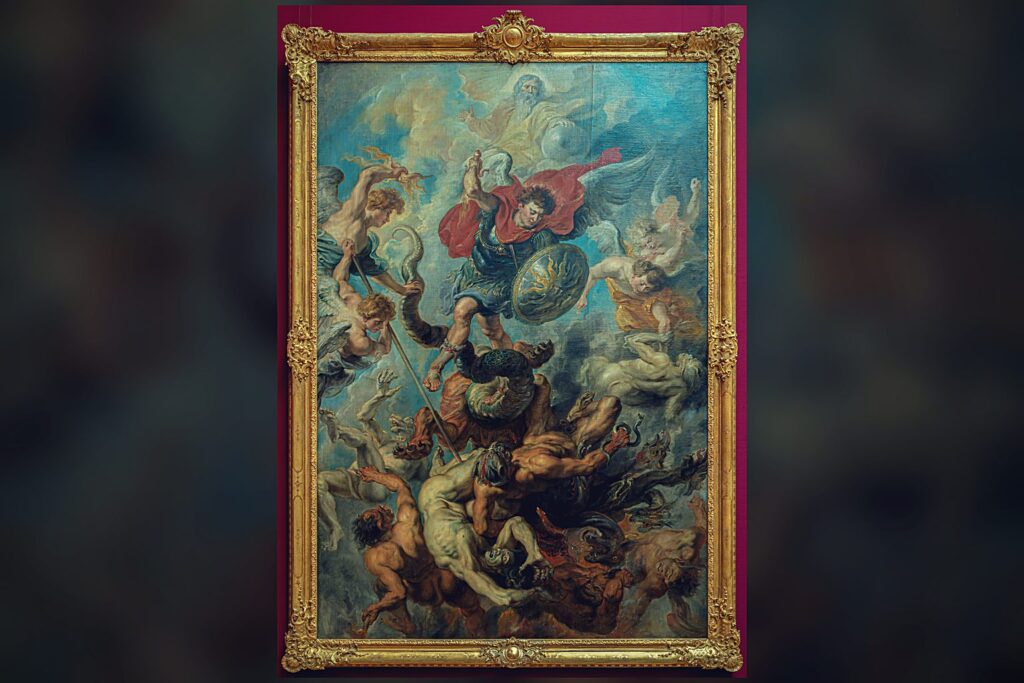
Unlike other prophets who receive visions in sleep, Enoch describes a physical journey. He is lifted from the earth and taken on a tour.
He is shown the storehouses of the winds, the lightning and the hail. He is shown the portals through which the sun and moon rise and set, and the strict laws that govern them. He is shown the ends of the earth, and a chaotic abyss where rebellious stars are imprisoned until judgement — a place he is told is a prison for angels, not for men.
The climax is the throne room. He describes approaching a wall of crystal surrounded by tongues of fire, entering a house that is simultaneously “hot as fire and cold as ice,” and seeing a lofty throne whose appearance is like frost, with wheels like the shining sun.
“None of the angels could enter and could behold His face by reason of the magnificence and glory, and no flesh could behold Him.”
And yet Enoch is permitted to approach. He falls on his face trembling; the voice calls him to stand. He is then given a job: he becomes a scribe, tasked with writing down the sentence on the Watchers and delivering it to them.
That is the detail that reframes his story. Enoch is not taken because he is a passive saint. He is taken because he is given a function — he is made the courier of a judgement, the one human authorised to carry a verdict to beings who outrank him.
Why Enoch Still Matters
Strip the story to its structure and three things stand out.
A boundary was crossed. Beings assigned to one domain entered another. That is the same transgression described in the original rebellion, repeated at a lower level with worse consequences for humanity.
Knowledge arrived early. The corruption in Enoch’s account is not primarily sexual — it is informational. A civilisation received capability it had not earned, and it used that capability exactly as you would expect.
One man was exempted. In a world described as saturated with violence and forbidden knowledge, one person maintained a way of life so anomalous that the normal rules of biology were suspended for him.
That last point is the one Genesis actually emphasises. The extraordinary thing about Enoch is not that he was taken. It is that he was taken out of that world in particular — the world that was about to be erased by the Flood, the world where all flesh had corrupted its way. He walked through the most corrupted environment in human history and came out the other side without dying.
Frequently Asked Questions
Who was Enoch in the Bible?
Enoch was the seventh generation from Adam, son of Jared and great-grandfather of Noah. Genesis 5:21-24 says he lived 365 years, walked with God, and was taken by God without dying. He is traditionally credited with the Book of Enoch.
How did Enoch die?
He did not. Genesis 5:24 says “God took him,” and Hebrews 11:5 states explicitly that Enoch was translated so that he should not see death. He is one of only two biblical figures who left the world alive, the other being Elijah.
Is Enoch still alive?
The plain reading of Hebrews 11:5 is that he never died and is therefore still living in God’s presence. A popular but unconfirmed theory identifies Enoch and Elijah as the two witnesses of Revelation 11, who die and rise at the end of the age. Revelation never names them.
Was Enoch a prophet?
Jude 1:14-15 calls him a prophet and quotes a prophecy attributed to him, identifying him as “the seventh from Adam.” The quotation matches 1 Enoch 1:9 almost exactly.
Why is the Book of Enoch not in the Bible?
It was excluded from the Jewish and most Christian canons, largely because it was recognised as pseudepigraphal — written in Enoch’s name centuries after he lived, between roughly the 3rd century BC and the 1st century AD. It remains canonical in the Ethiopian Orthodox Tewahedo Church, which is why the complete text survives.
How old was Enoch when God took him?
365 years, according to Genesis 5:23 — remarkably young within his own genealogy, where his father Jared lived 962 years and his son Methuselah lived 969.
What did the Watchers teach humanity?
According to 1 Enoch, they taught metalworking and the making of weapons, the use of antimony and cosmetics, enchantments and the cutting of roots, astrology, the constellations, and the courses of the moon. The charge is that this knowledge was delivered before humanity was fit to hold it.
Are there two different Enochs in the Bible?
Yes. Genesis 4:17 names an Enoch who is the son of Cain, after whom the first city is named. Genesis 5:18-24 names a different Enoch in the line of Seth — the one who walked with God and was taken. They are separate people in separate genealogies.
Conclusion: The Ledger That Stopped
Genesis 5 is a chapter about mortality. Every entry ends the same way, and the repetition is the point — it is establishing that death is the rule now, that the sentence passed in Eden is being carried out generation by generation, without exception.
And then there is an exception.
Enoch lived in an age very much like a mirror of our own: rising technical capability, collapsing restraint, knowledge arriving faster than the wisdom to hold it. That was the world he walked through, and the text’s claim is that walking through it a particular way produced an outcome the rest of the chapter rules out for everybody else.
The ledger closes on everyone else. On the seventh entry, it simply stops — and whoever was keeping the record had nothing further to write down.
Continue Reading
- The Book of Enoch Giants: The Lost Book That Names Them — They were enormous and they ate people — that is the part everyone knows. The part nobody knows is that a second book…
- The Nephilim: What Genesis 6 Actually Describes — Four verses describe something happening, and five verses later the planet is scheduled for erasure. Who the sons of…
- The Book of Jubilees: Fifteen Copies and the Wrong Calendar — Qumran held more copies of Jubilees than of Kings. What the book says, the 364-day calendar it was willing to split a…