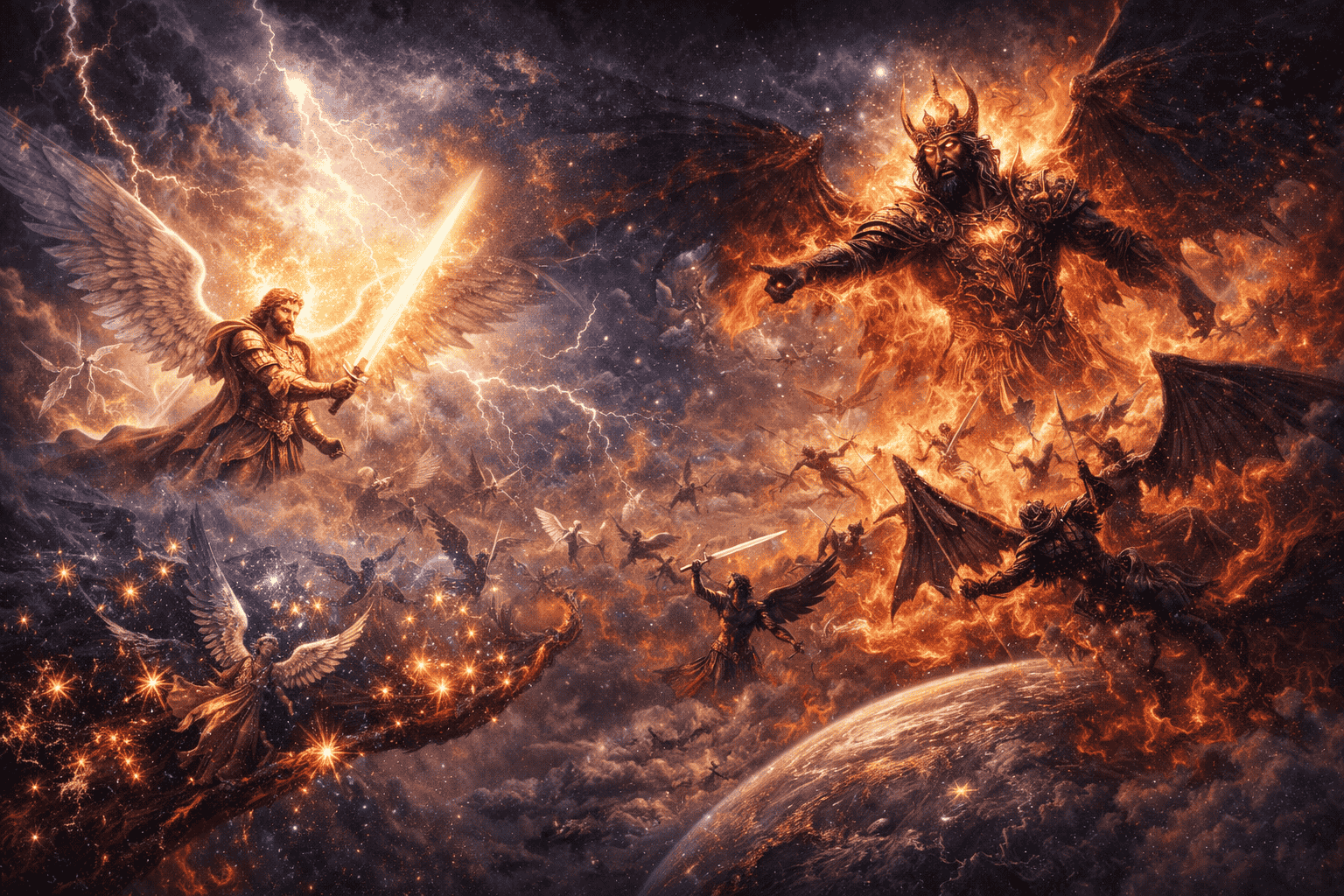
Before human history began, before the first sunrise over the Garden of Eden, there was peace. But that peace was shattered by a catastrophe that few of us truly understand.
We often think of the “War in Heaven” as a religious myth or a painting in a museum. But the ancient texts describe it as a literal, historical event—a cosmic civil war that tore the spiritual realm apart.
This was not a battle over land or resources. It was a battle for the throne of existence.
The Golden Being
To understand the war, we must look at the one who started it. The Bible describes him not as a monster with horns, but as a being of supreme beauty. In the book of Ezekiel (28:12-15), he is called the “seal of perfection,” full of wisdom and perfect in beauty. He was the “anointed cherub,” likely the highest-ranking angel in the celestial hierarchy, standing closest to the Creator.
But something shifted. The text says, “Your heart became proud on account of your beauty.”
It wasn’t a flaw in his creation; it was a choice. He looked at his own brightness and desired the worship that belonged only to his Creator. As Isaiah 14 records, his ambition was absolute: “I will ascend above the tops of the clouds; I will make myself like the Most High.”
The Great Betrayal (The Third Part)
He did not act alone. A rebellion of this magnitude requires persuasion.
The Book of Revelation (12:4) reveals a terrifying detail: “His tail swept a third of the stars out of the sky and flung them to the earth.”
In biblical symbolism, “stars” often represent angels. This means the rebellion was massive. It wasn’t just a few disgruntled spirits; 33% of the entire angelic host chose to follow him. This suggests a massive campaign of deception. He likely promised them power, freedom, or a new order—promises that would eventually lead to their doom.
Michael vs. The Dragon
The conflict reached a breaking point. Revelation 12:7 describes the moment simply but powerfully:
“Then war broke out in heaven. Michael and his angels fought against the dragon, and the dragon and his angels fought back.”
On one side stood the rebellion. On the other stood Michael. His very name is a challenge to the rebellion’s leader. “Michael” translates from Hebrew as “Who is like God?”
While the rebel cried out “I will be like the Most High,” Michael’s existence was the answer: No one is like God.
The rebel forces, despite their power and number, could not hold their ground. The spiritual atmosphere could no longer sustain their corruption.
The Exile to Earth
They lost. But they were not destroyed—not yet.
“The great dragon was hurled down—that ancient serpent called the devil, or Satan, who leads the whole world astray. He was hurled to the earth, and his angels with him.” (Revelation 12:9)
This is the most critical point for us. The war didn’t end; it just changed location. The fallen entities were cast out of the highest heaven and confined to the earthly realm.
This explains the state of our world. We are living in the territory where the exiles landed. The chaos, violence, and deception we see in human history are echoes of that original rebellion. The adversary, having lost the battle for Heaven, has turned his attention to the next best thing: humanity.
Conclusion
The War in Heaven reminds us that free will is dangerous, even for angels. It shows us that evil did not originate with man, but was brought here by a fallen nobility that refused to serve.
We are part of a story much older than we realize. The war that began in the stars is now being fought in the human heart.