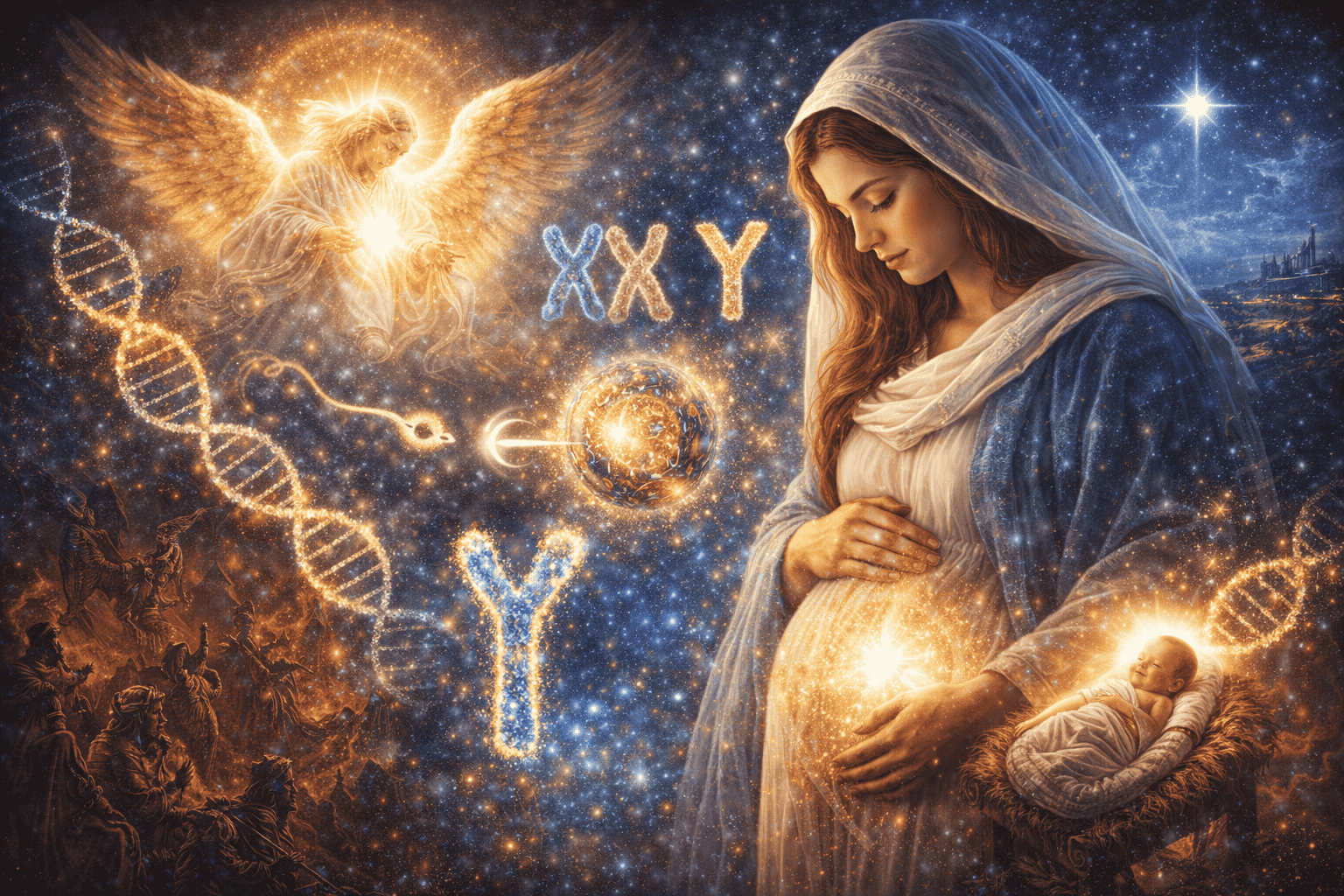
The Virgin Birth is the central miracle of the Christian faith. For centuries, skeptics have dismissed it as a myth, and theologians have debated its spiritual meaning. But rarely do we stop to analyze the biology of what actually happened in Bethlehem.
If we look at the Incarnation through the lens of modern genetics, we are confronted with a scientific impossibility that points to a deliberate act of creation.
The Genetic Problem: XX vs. XY
To understand the magnitude of this miracle, we must go back to high school biology.
Every human being has 46 chromosomes in their cells—23 from the mother and 23 from the father. The sex of a child is determined by the 23rd pair:
- Females carry XX chromosomes.
- Males carry XY chromosomes.
A mother can only provide an X chromosome in her egg. She does not possess a Y chromosome. The Y chromosome—which determines maleness—must always come from the father.
Here is the scientific dilemma: Mary was a woman. Her genetic code was XX. Jesus was a male. His genetic code was XY.
If Mary was a virgin—meaning no human father was involved—where did the Y chromosome come from?
The “Seed of the Woman”
The Bible hints at this biological anomaly in the very first prophecy found in Scripture. In Genesis 3:15, God speaks to the Serpent:
“And I will put enmity between thee and the woman, and between thy seed and her seed…”
Biologically speaking, women do not have “seed.” Men have seed (sperm); women have eggs. This unique phrase—“her seed”—suggests that thousands of years before the event, the ancient text was predicting a biological exception: a child produced solely from the woman, yet fully male.
The Divine Intervention
When the Angel Gabriel appeared to Mary, she asked the logical biological question: “How will this be, since I am a virgin?”
The Angel’s answer was: “The Holy Spirit will come on you, and the power of the Most High will overshadow you.” (Luke 1:35)
This “overshadowing” was not just a spiritual blessing; it was a physical, creative act. Since Mary could provide the X chromosome (and the 22 other chromosomes for humanity), the Holy Spirit had to provide the missing piece of the puzzle.
God, the Creator of the first man, performed a genetic miracle. He created a Y chromosome ex nihilo (out of nothing) and placed it within the egg of the virgin.
Why Was This Necessary?
Why go through all this trouble? Why couldn’t Jesus just have a human father like Joseph?
The answer lies in the blood. In biblical theology, the “sin nature” (the corruption of the human spirit and body) is passed down through the line of Adam—the father.
- Adam is the head of the fallen human race.
- Jesus is called the “Last Adam.”
If Jesus had a human father, He would have inherited the broken, corrupted lineage of Adam. He would have been born a sinner, unable to save anyone.
By bypassing the human father, God broke the chain of infection.
- From Mary, Jesus received His humanity, His flesh, and His physical connection to King David.
- From the Holy Spirit, He received His divine nature and a perfect, sinless bloodline, untainted by the fall of man.
The Perfect Man
This makes Jesus biologically unique in all of history. He is the only human being whose genetic structure was a combination of natural descent (Mary) and direct divine creation (The Y Chromosome).
Just as God formed the first Adam from the dust of the ground, He formed the “Last Adam” in the womb of a virgin. The Y chromosome that determined His gender was not inherited from a fallen man; it was written directly by the finger of God.
Conclusion
The Virgin Birth is not a fairytale. It is the solution to a genetic problem. To save a humanity whose blood was tainted by death, the Creator had to introduce new life into the system.
Science tells us a woman cannot produce a male child alone. The Bible agrees. That is why the birth of Christ is not just a natural anomaly—it is the evidence of an Architect stepping into His own building.