From a young age, mainstream culture teaches us that “giants” belong in fairy tales. We see them in cartoons, climbing beanstalks or hiding under bridges. Consequently, society conditions us to believe they are nothing more than the product of human imagination.
However, the Bible paints a very different picture.
In the ancient scriptures, giants were not myths; they were monsters. The text describes them as the result of a catastrophic violation of natural law that nearly wiped out the human race. Essentially, they acted as a biological weapon designed to destroy the very image of God.
The Forbidden Union
The story begins in Genesis 6, the chapter that describes the world before the Great Flood. Specifically, it opens with a scene that has baffled theologians for centuries:
“The sons of God saw the daughters of men that they were fair; and they took them wives of all which they chose.” (Genesis 6:2)
For a long time, the church tried to teach that these “sons of God” were simply normal men from a religious family line. Yet, the ancient Hebrew text uses the term Bene Ha’Elohim—a phrase used exclusively in the Old Testament to describe direct creations of God: Angels.
The narrative context implies something far darker than a marriage between tribes. From a biological perspective, the text describes a forbidden hybridization.
Celestial beings, who were never meant to mix with mortality, crossed the dimensional barrier. They took human wives. Consequently, the biological result of this union was a species that terrified the ancient world: The Nephilim.
The Watchers and the Oath on Mount Hermon
While Genesis gives us the summary, the Book of Enoch provides the details.
Note: The Book of Enoch is not part of the standard Biblical canon. However, the New Testament cites it (Jude 1:14), and early church fathers treated it as a vital historical record of the pre-flood world.
Enoch records that 200 fallen angels, known as The Watchers, descended onto the summit of Mount Hermon. They swore a binding oath to corrupt humanity. Their mission was not love; it was sabotage.
They introduced a genetic code that was never meant to exist on Earth. As a result, this union did not merely produce “tall humans.” It created a new, dominant species—physically superior, spiritually void, and inherently violent.
The Hunger of the Giants
What happens when you introduce a superior predator into an ecosystem? The predator eats the native population.
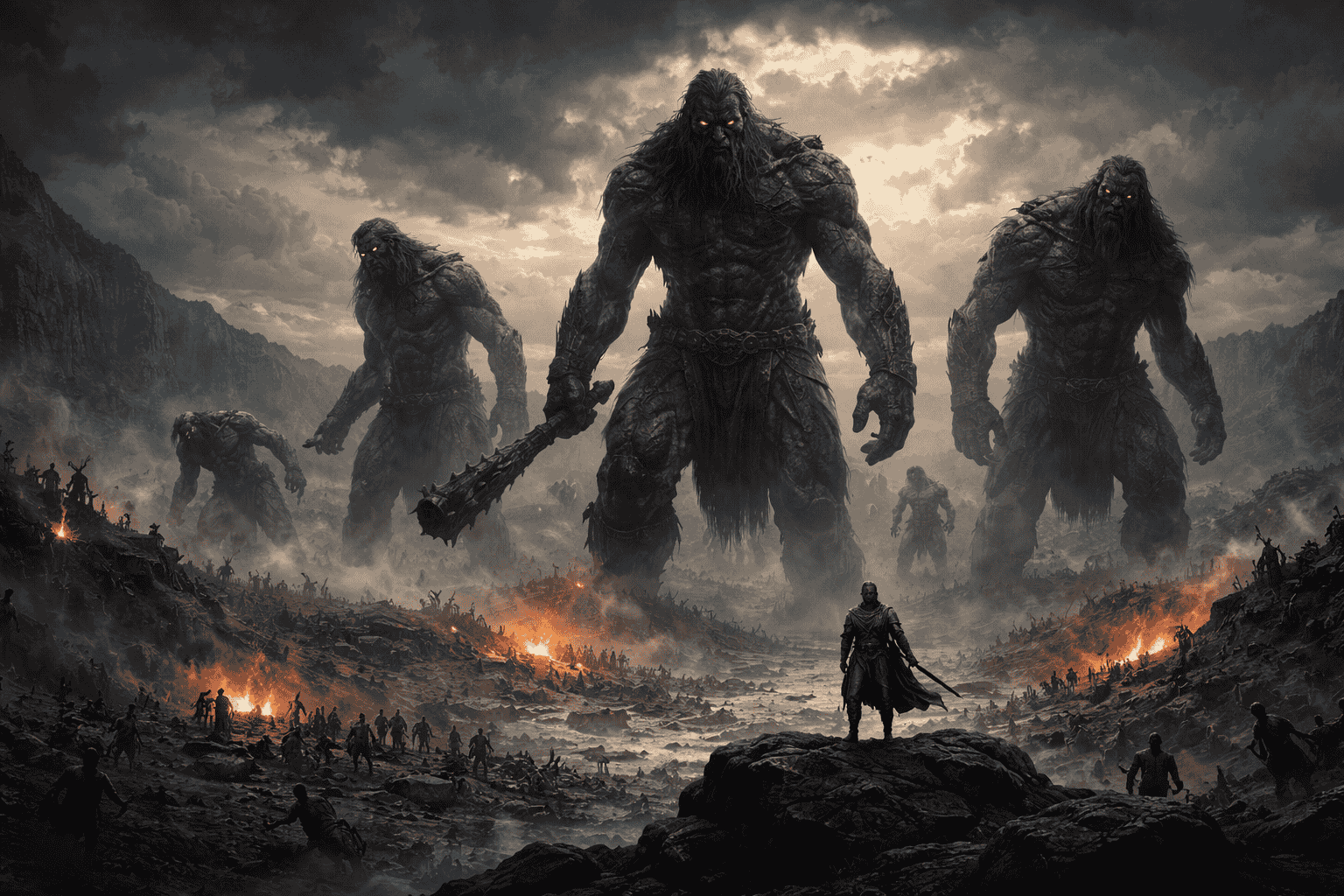
The Nephilim were not the “gentle giants” of fiction. They were apex predators. With immense size—described in some ancient extra-biblical texts as reaching colosal heights of over 30 feet—came an immense metabolic demand.
Enoch 7:3-5 describes the horrifying progression:
- First, they consumed all the agricultural produce (“the acquisitions of men”).
- Next, when the food ran out, they turned on the animals.
- Finally, when the land was stripped bare, “the giants turned against them and devoured mankind.”
The “violence” described in Genesis 6 was not just people fighting each other. It was a slaughter. These monsters hunted humanity to extinction because humans could not fight back. Scripture never depicts a giant as righteous or repenting; they are always engines of destruction.
The Flood as a Sterilization Protocol
This biological context explains the true necessity of the Great Flood.
Sunday schools often teach that God sent the Flood because He was angry that people were “mean” to each other. But the text suggests the motivation was the preservation of the species.
Genesis 6:9 says: “Noah was a just man and perfect in his generations.”
The Hebrew word for “perfect” here is Tamim. It is the same word used for a sacrificial lamb—meaning “without physical blemish.”
In this context, the only interpretation that fits the linguistic evidence is genetic purity. Significantly, Noah was one of the few remaining men whose DNA the Watcher bloodline had not corrupted.
God did not send the Flood out of cruelty. He sent it as a Sterilization Protocol. The Nephilim infestation had overrun the planet. If the Flood had not happened, the hybrid invaders would have devoured or genetically erased the human race. The Ark served as a rescue mission for the last remnants of true humanity.
The Cover-Up
If these beings were real, and if they were destroyed in a global cataclysm, where is the evidence?
In the 1800s and early 1900s, newspapers across America reported the excavation of giant skeletons—7, 8, even 10 feet tall—often found in the burial mounds of the Midwest. Yet, major scientific institutions routinely collected these bones, and the public never saw them again.
If these reports were mere fabrications or misidentified animal bones, why did institutions never publicly debunk or display them? Why the silence?
To admit the existence of the Nephilim is to validate the biblical narrative of history. Furthermore, it directly contradicts the assumptions of mainstream evolutionary anthropology.