Disclaimer: This article explores historical and scientific concepts regarding fasting. It is not medical advice. Fasting can be dangerous for certain individuals. Consult your doctor before attempting any fasting protocol.
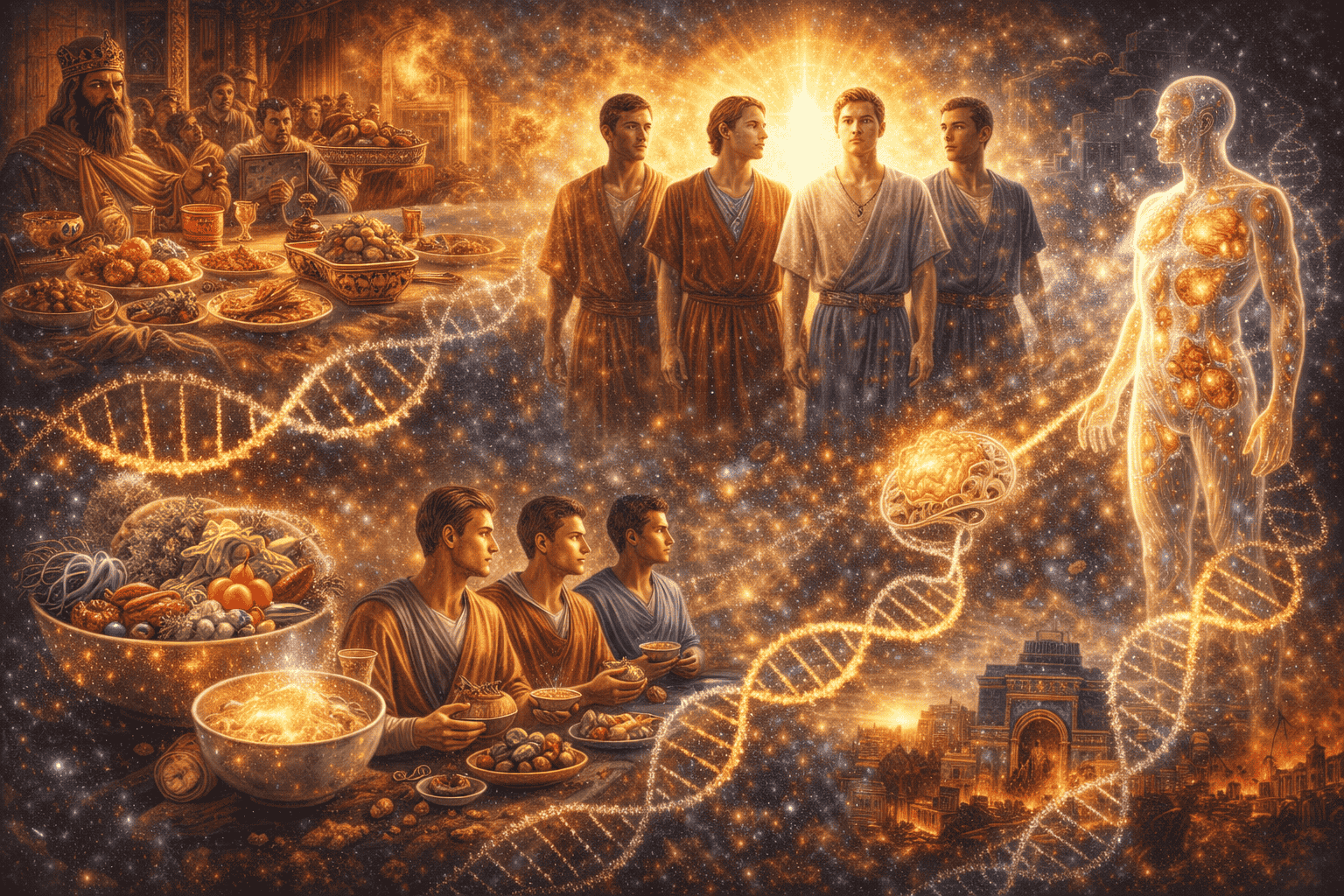
King Nebuchadnezzar offered four young men the ultimate privilege in ancient Babylon. He gave them a seat at the royal table. Servants brought them the finest meats and the richest wines. It was the diet of power. But the Bible says that Daniel made a different choice.
Daniel 1:8 states clearly: “But Daniel purposed in his heart that he would not defile himself with the portion of the king’s meat, nor with the wine which he drank.”
He refused the luxury. Instead, he proposed a scientific test to the master of the eunuchs.
He said in Daniel 1:12: “Prove thy servants, I beseech thee, ten days; and let them give us pulse to eat, and water to drink.”
The guards worried. They predicted the young men would waste away. They thought Daniel would grow weak compared to the other captives who ate the royal rations. But the results shocked everyone.
Daniel 1:15 records the verdict: “And at the end of ten days their countenances appeared fairer and fatter in flesh than all the children which did eat the portion of the king’s meat.”
They did not just survive; they thrived. For centuries, believers viewed this only as an act of obedience. But modern biology reveals something deeper. Daniel triggered a powerful biological mechanism.
The Science of “Self-Eating” (Autophagy)
We often consume rich, heavy foods like meats and sugars. This keeps our bodies in a constant state of digestion. Our cellular machinery stays “on.” It builds new tissue but rarely stops to clean up the mess. We clog our own biology.
But the body flips a switch when we restrict our intake. Scientists awarded the 2016 Nobel Prize in Medicine for the discovery of this process. It is called Autophagy.
The word literally means “self-eating.” Cells begin to look for fuel internally when they lack external food. They hunt down damaged proteins. They find broken cellular parts and accumulated toxins. The body acts as a furnace. It burns its own waste to generate new energy.
Daniel rejected the King’s heavy food. This allowed his body to enter this state of deep repair. Digestion burdened the other men. Meanwhile, Daniel’s cells scrubbed themselves clean. This produced the physical “fairness” that the scripture describes.
The Gut-Brain Connection
The experiment in Babylon involved more than physical appearance. It changed their minds.
The text confirms this in Daniel 1:17: “As for these four children, God gave them knowledge and skill in all learning and wisdom: and Daniel had understanding in all visions and dreams.”
Later, in verse 20, the King found them “ten times better” than all the magicians and astrologers in his realm.
A direct link connects the stomach and the brain. Modern science calls it the “gut-brain axis.” A diet heavy in processed meats and sugars creates inflammation. This inflammation travels to the brain. It causes “brain fog” and lethargy.
Fasting changes this flow. Blood leaves the heavy task of digestion. It flows to the brain instead. The mind clears. Ancient prophets understood this intuitively. They knew a secret: you must quiet the voice of the stomach to hear the voice of God.
Disciplining the Vessel
Many people misunderstand fasting. They see it as starvation. But the Bible defines it as discipline. Paul the Apostle wrote in 1 Corinthians 9:27: “But I keep under my body, and bring it into subjection.”
Constant feeding makes the spirit dull. We tie ourselves to the earth with heavy consumption. But we practice the discipline of Daniel to break these chains. We declare that we are not slaves to our appetites.
The Babylon Experiment teaches us a vital lesson. God designed the body with a miraculous ability to heal itself. But we must give it a chance to rest. We reject the “King’s delicacies.” We step away from the toxic abundance of the modern world. This unlocks mental clarity and spiritual purity. The vessel becomes ready to receive something greater than bread.