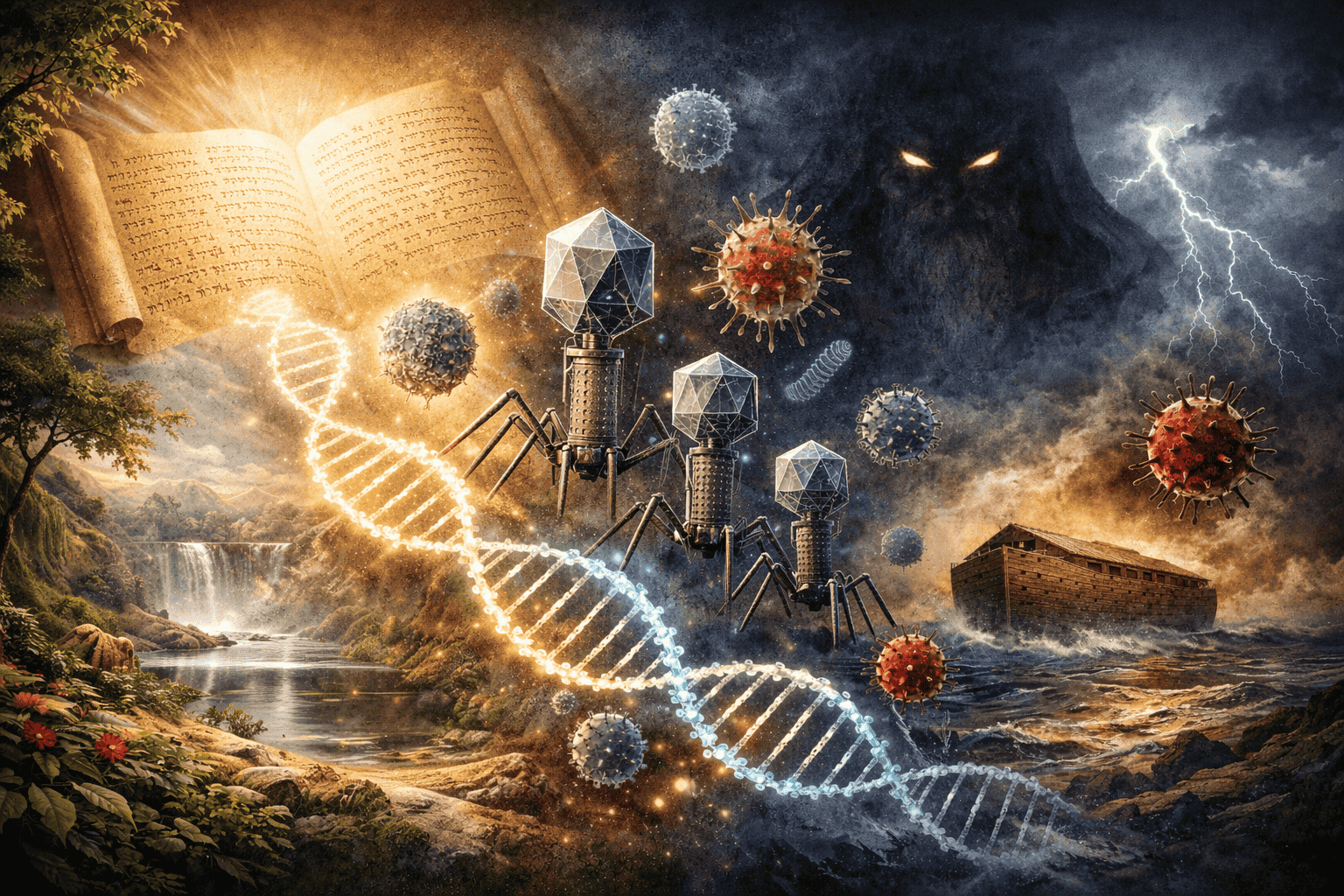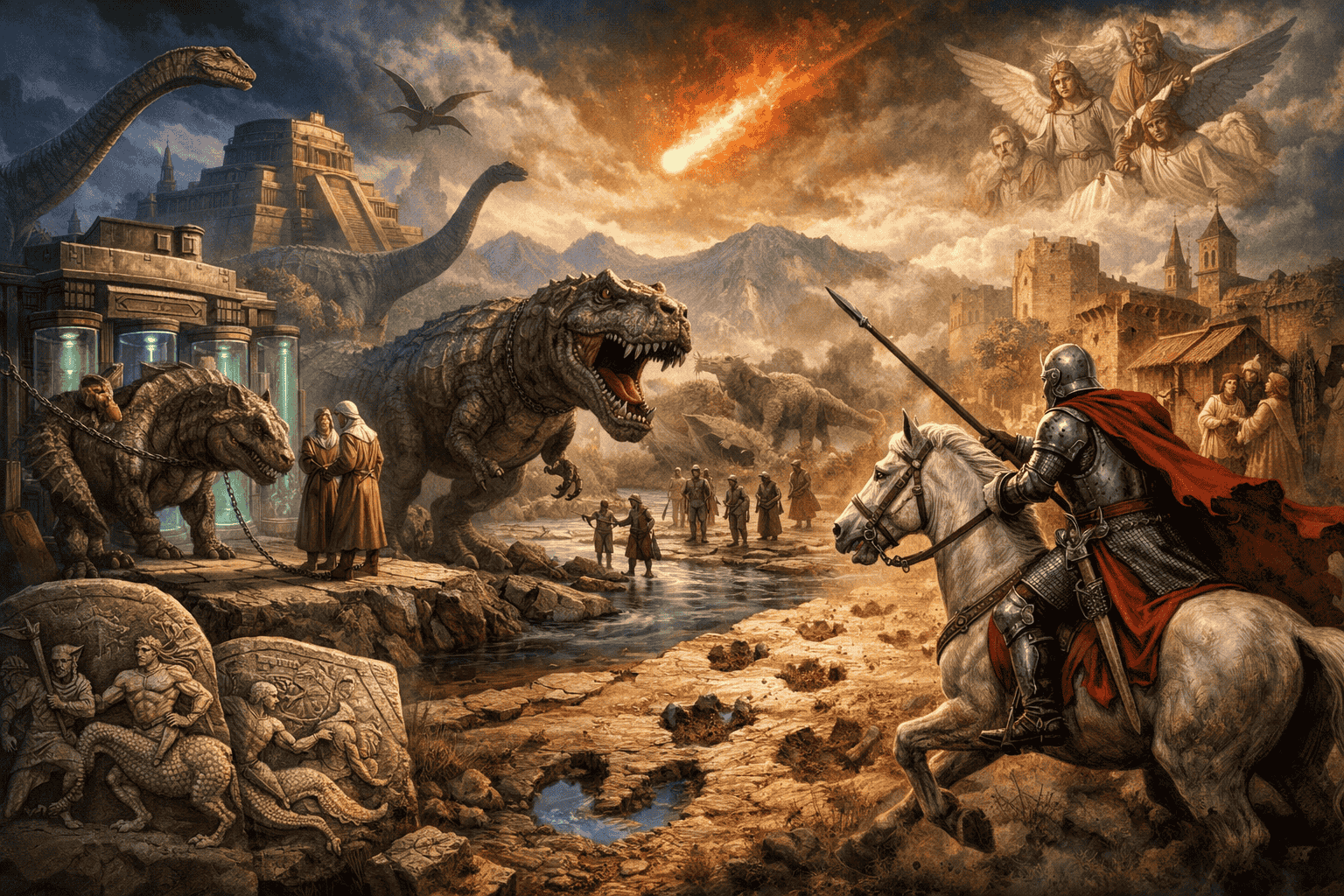
We are taught a specific timeline from the moment we enter school. Textbooks tell us that dinosaurs ruled the earth for millions of years and vanished in a cosmic cataclysm long before the first human opened his eyes. According to this official story, man and dinosaur are separated by an unbridgeable ocean of time.
But if that is true, why does human history whisper a different story? From the caves of Europe to the pottery of Peru, ancient cultures depict encounters with giant reptiles. They did not call them dinosaurs; they called them “dragons.”
Does the Bible support this view? And is it possible that the monsters we see in museums were not just wild animals, but the result of a dark, pre-flood biological experiment that turned nature into a weapon?
The Missing Word: Why “Dinosaur” Isn’t in the Bible
Skeptics often use a linguistic argument to disprove the Bible. They ask: “If dinosaurs lived with humans, why is the word ‘dinosaur’ never mentioned in Scripture?”
The answer is a matter of simple history. The word “dinosaur” (meaning terrible lizard) was invented by Sir Richard Owen in 1841. However, the King James Bible was translated in 1611—more than two centuries before the word existed. The translators could not use a term that had not yet been coined.
Instead, the Bible uses the ancient Hebrew word “Tannin.” In modern translations, this is rendered as “Dragon,” “Sea Monster,” or “Serpent.” The creatures were there; we just changed the label.
The Behemoth: The Cedar-Tailed Giant
The most compelling evidence for human-dinosaur coexistence is found in the Book of Job, one of the oldest texts in the biblical canon. In chapter 40, God is speaking directly to Job to humble him. He directs Job’s attention to a colossal beast that was currently walking the earth.
God says: “Look now at Behemoth, which I made along with you; he eats grass like an ox.” (Job 40:15)
God then describes the anatomy of this creature in specific detail:
- It possesses immense strength in its loins and belly muscles.
- It lives in the marshes and riverbeds.
- “He moves his tail like a cedar.” (Job 40:17)
Many modern Bible footnotes suggest this animal was a hippo or an elephant. But this interpretation fails biologically. A hippo has a small flap of skin for a tail. An elephant has a thin, rope-like tail. Neither of them resembles a “cedar”—the massive, thick tree of Lebanon.
There is only one animal in history that fits this description. The Sauropod (like a Brontosaurus or Diplodocus) possessed a massive, muscular tail that tapered like a tree trunk. God’s statement “which I made along with you” confirms that man and these giants stood on the earth at the same time.
The Anomaly in the Stone
We find evidence not just in the text, but in the rock itself. In the limestone bed of the Paluxy River near Glen Rose, Texas, archaeologists made a discovery that challenges the standard evolutionary timeline.
They found fossilized dinosaur tracks. But alongside them, they found footprints that looked impossibly human. Known as the “Taylor Trail,” these tracks suggest a scene where a human was walking in the same fresh mud as a dinosaur.
While mainstream science often dismisses these findings as erosion to protect the official timeline, the stones remain a stubborn witness to a forgotten history where the two species coexisted.
The Dark Theory: Created or Corrupted?
This leads us to a disturbing theological question. God created animals on the sixth day and called them “good.” But the fossil record shows dinosaurs with six-inch serrated teeth designed to crush bone and tear flesh. We see the T-Rex and the Raptors—machines of death.
Did God create them as monsters? Or did something happen to change them?
The Bible gives us a clue in Genesis 6:12, just before the Flood:
“And God looked upon the earth, and, behold, it was corrupt; for all flesh had corrupted his way upon the earth.”
Notice the phrase “all flesh.” It does not say “all mankind.” It suggests that the biological corruption of that era extended to the animal kingdom.
Ancient Genetic Engineering
To understand what happened, we must look at the historical texts that the biblical authors were familiar with. The Book of Jasher is mentioned in the Bible (Joshua 10:13), and while it is not scripture, it serves as a vital historical record.
Jasher 4:18 records a chilling detail about the pre-flood generation:
“And the sons of men in those days took from the cattle of the earth, the beasts of the field and the fowls of the air, and taught the mixture of animals of one species with the other.”
The Book of Enoch similarly states that the fallen ones “sinned against birds, and beasts, and reptiles, and fish.”
This describes hybridization. It sounds like ancient genetic engineering. Satan cannot create life; he can only twist what God has created. It is highly probable that the “dragons” of legend were biological chimeras—animals taken from God’s original design and genetically enhanced for size, aggression, and warfare.
Reptiles as Weapons of War
Imagine a pre-flood world filled with violence, governed by the Nephilim and advanced forbidden knowledge. In such a world, nations would seek to create the ultimate biological weaponry.
- The Triceratops functions like an armored tank, with shielding that seems excessive for a simple grazer.
- The Ankylosaurus carries a heavy bone club on its tail, capable of shattering legs.
- The Tyrannosaurus Rex is the ultimate biological weapon—massive, armored, and unstoppable.
These creatures may have been the “war machines” of the ancient world, bred by a civilization that had rejected the natural order. This explains why the Flood was a necessity. It was not just a judgment on sin; it was a sterilization event to wipe out the “corrupted flesh” that had overrun the planet.
The Survivors and the Knights
Did they all die in the Flood? The Bible says Noah took two of every living sort onto the Ark. This likely included young, small versions of these great reptiles (perhaps the ones that were still genetically pure).
This means dinosaurs survived the Flood. But the new world was different. The atmospheric pressure had dropped, the oxygen levels were lower, and food was scarce. The giants could not thrive as they once did. They became rare.
However, humanity still encountered them.
- The Babylonians depicted the Sirrush on the Ishtar Gate—a creature that looks exactly like a dinosaur.
- The Chinese listed the Dragon as a real animal in their zodiac, right alongside the dog and the horse.
- European folklore is filled with stories of knights slaying dragons.
Consider the legend of St. George. He became famous for killing a “dragon” that was terrorizing a town near a lake. We treat this as a fairytale today. But if we strip away the magic, the description often matches a medium-sized theropod (like a Baryonyx).
A knight on horseback, armed with a long lance and armor, would be the perfect match for a surviving, post-flood dinosaur. These men were not fighting myths. They were exterminators. They hunted these dangerous animals to extinction to protect their villages, just as modern humans hunted wolves and lions.
The bones we dig up today are not millions of years old. They are the remnants of a lost ecosystem—creatures that were created by God, corrupted by man, preserved in the Ark, and finally hunted into the mist of legend. We do not need to invent a new history; we only need to read the one we have forgotten.