Tag: Evolution

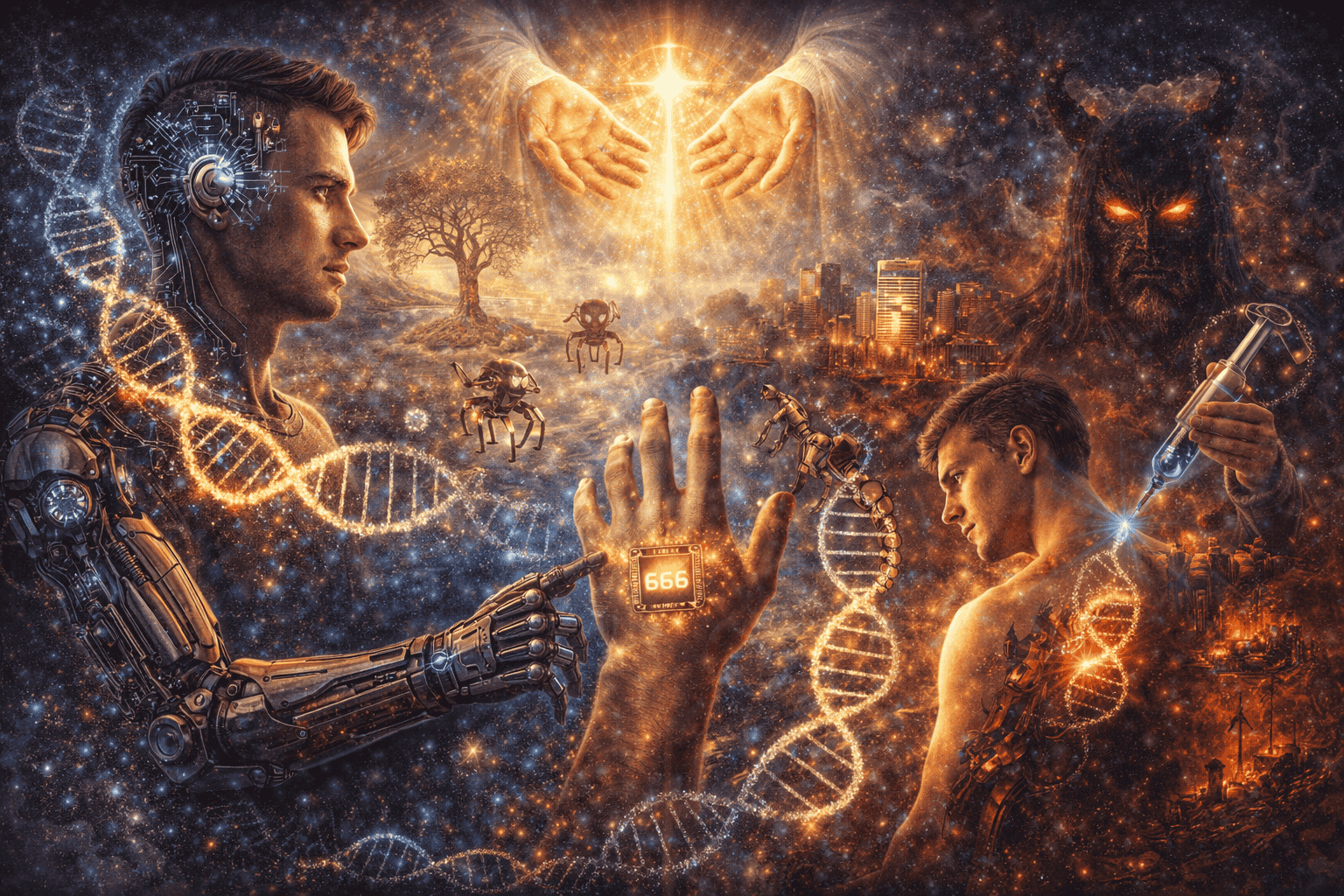
  • The Forbidden Upgrade: Why the Mark of the Beast Might Be Biological

    the Mark of the Beast

    For thousands of years, to be human meant something specific. It meant to be born of flesh and blood, to breathe the air of this earth, and to possess a spirit given by the Creator. We were defined by our limitations. We aged, we bled, and we eventually returned to the dust. But we are now living in the generation that intends to erase those boundaries forever.

    A new philosophy is rising, one that whispers the same promise made in the Garden of Eden: “You shall be as gods.”

    They call it Transhumanism. The idea is simple and seductive: humanity is not a finished creation, but a raw material waiting to be molded. Through the merging of biology and synthetic technology, scientists now propose that we can conquer death, eliminate disease, and expand the mind beyond all natural limits. But in this rush to become something greater, we are failing to ask the most terrifying question of all: If we change what we are, do we remain the beings God created?

    The Temple of the Body

    The ancient scriptures tell us that the human body is a temple. In Genesis, God formed man from the clay and breathed life into him, creating a being in His own image. This “Image of God” is not just a poetic phrase; it is a spiritual blueprint. It defines us as a unique creation, separate from the animals and separate from the angels.

    Medicine has always been about healing that temple. When a bone is broken, we set it. When the heart fails, we repair it. But the new movement is not interested in healing. It is interested in replacement. The goal is to weave synthetic threads into the brain and replace organic limbs with superior artificial ones, until the line between the person and the machine disappears.

    If the seat of human consciousness—the brain—is permanently fused with a digital hive mind, who is truly in control? If our thoughts are augmented by artificial signals, do we still possess the free will to choose between good and evil? A soul that is constantly fed information by a machine may lose the ability to hear the quiet voice of the Spirit.

    The Unforgivable Change

    This brings a chilling clarity to the prophecies found in the Book of Revelation. For centuries, theologians have debated the nature of the “Mark of the Beast.” Why would taking this Mark result in immediate, irreversible separation from God?

    God is merciful. He forgives the worst of sins. Why is this specific act the point of no return?

    The answer may lie in the blood. Redemption is promised to the sons and daughters of Adam. The Savior is called the “Kinsman Redeemer”—He took on human flesh to save humans. But if a person fundamentally alters their biology to become a hybrid of flesh and technology, they may be stepping out of the human race entirely.

    If the Mark involves a biological alteration—a promise of eternal life without God, a modification of the DNA to make us “superior”—then the recipient is no longer fully human. They have become a new creature, one made by the hands of men, not God. They have voluntarily removed themselves from the lineage of Adam and, therefore, from the covenant of salvation.

    Repeating the Ancient Sin

    We have walked this path before. The oldest traditions speak of a time before the Great Flood when the natural order was violated. The “Watchers” mingled with humanity, corrupting the bloodline and creating hybrid offspring known as the Nephilim. They sought to upgrade humanity with forbidden knowledge and superior genetics.

    The result was a corruption so deep that the earth had to be washed clean. The Flood was not just a judgment on wickedness; it was a preservation of the human definition. Noah was saved because he was “perfect in his generations”—his bloodline remained pure, untouched by the hybridization that had consumed the world.

    The Final Deception

    We are standing at the threshold of the same decision. The offer will not look like a threat. It will look like a miracle. It will offer the blind sight through implants; it will offer the paralyzed the ability to walk through exoskeletons; and eventually, it will offer the healthy the chance to never die.

    But the price of this immortality may be the loss of the soul. The danger is not that we will be conquered by monsters, but that we will willingly surrender our humanity for an upgrade. In our quest to become gods, we risk becoming something that Heaven no longer recognizes.
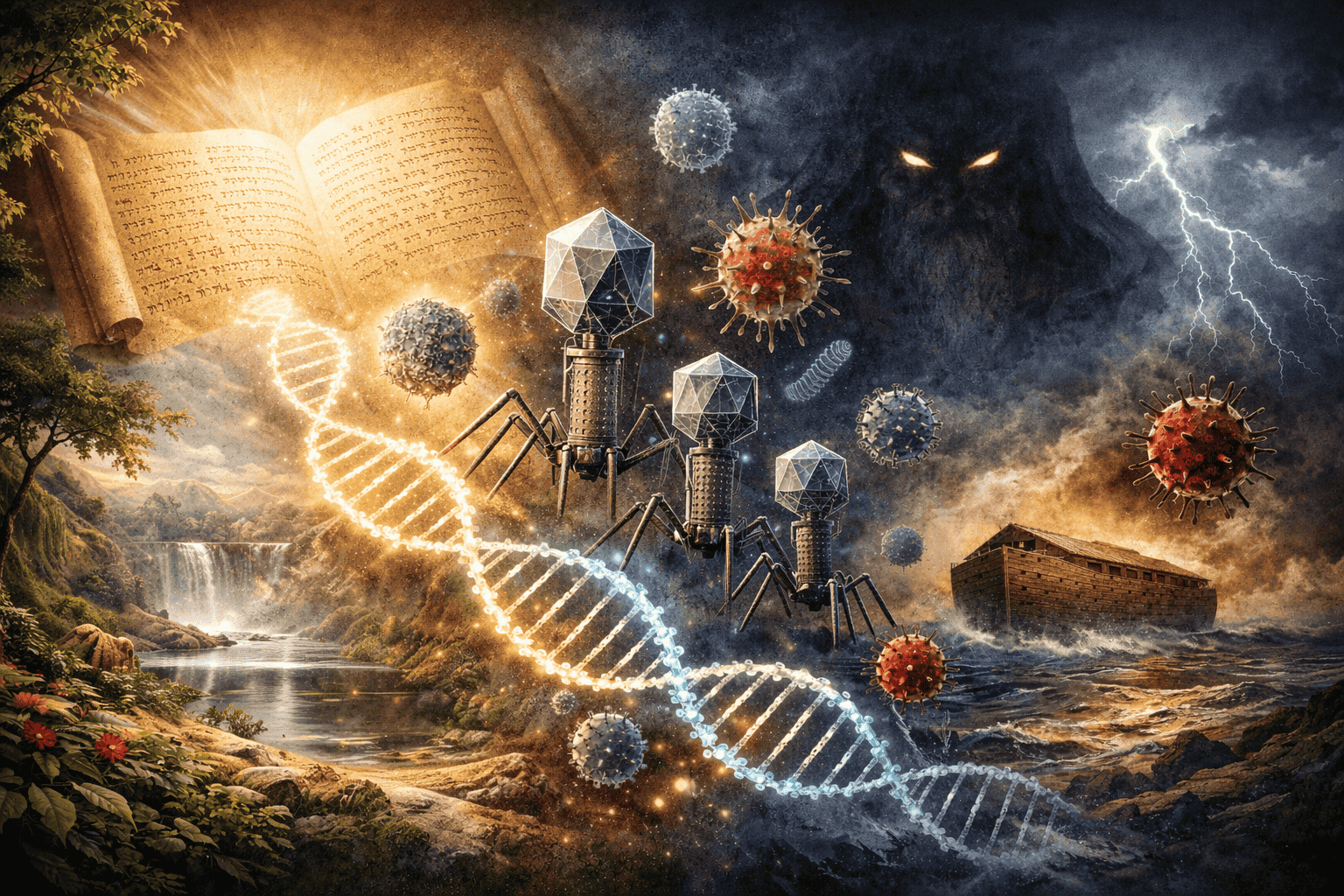
  • Viruses, Instruction, and Corruption: A Biblical Meditation

    Viruses Instruction and Corruption

    What a Virus Is
    Biology places viruses in an uneasy position. They are not alive in the way animals or plants are alive, yet they are not simply dead matter. They have no metabolism, no independent reproduction, and no capacity for growth. What defines them is information.

    At its core, a virus acts as a microscopic package of instructions. It drifts until it encounters a living cell capable of reading those instructions and carrying them out. Once inside, the cell does not resist the message. Instead, it follows it.

    For this reason, a virus functions less like a creature and more like a delivery system—an entity whose primary role is to insert information into life.

    Viruses as More Than Accidents
    Most explanations describe viruses as accidents of nature or meaningless byproducts of evolution. However, deeper biological research complicates that picture. Many viruses, especially bacteriophages, display structures that resemble engineered systems rather than random organic forms. Their geometry, efficiency, and precision stand out.

    Such features invite a speculative but serious question. What if viruses did not begin as purposeless entities? What if they did not originally oppose life?

    This question does not assert historical fact. It offers an interpretive lens.

    Instruction, Logos, and Living Code
    The Gospel of John opens with the claim that in the beginning was the Word. The term Logos points toward reason, order, and intelligible structure. Within the biblical imagination, creation unfolds through meaning.

    DNA reflects this idea at the biological level. It operates as coded instruction rather than random material. That code directs how life forms, repairs itself, and persists across generations.

    Viruses interact directly with this system. Rather than attacking tissue alone, they enter the language of life itself and modify instruction.

    If creation rests on ordered information, then mechanisms that deliver information into living systems do not automatically contradict that order.

    Beneficial Viruses and Hidden Functions
    Scientific research increasingly shows that many viruses play constructive roles. Some regulate bacterial populations and help stabilize ecosystems, including the human microbiome. Others exist within human DNA and contribute to ordinary biological processes such as reproduction. In some cases, viral presence even strengthens immune responses.

    These observations challenge the assumption that viruses exist only to cause harm. Instead, they often function as regulators and modifiers within life.

    From a biblical perspective, this allows for the possibility that viruses once operated in alignment with life, supporting resilience or adaptation rather than destruction.

    The World Before the Flood
    Genesis describes a pre-Flood world that differs radically from the present one. Human lifespans extended for centuries, and generations overlapped in ways unknown today. Such conditions would have allowed knowledge to accumulate over unusually long timescales.

    At the same time, Scripture states that corruption reached “all flesh.” While readers often interpret this phrase morally, the language also allows for a broader reading—one that includes the condition of life itself.

    If a civilization developed advanced understanding of life, genetics would offer the most direct point of intervention. To change the body at its foundation would require a mechanism capable of entering cells and altering instruction.

    Such a mechanism would closely resemble a virus.

    Tools, Corruption, and Misuse
    Biblical theology consistently presents evil as corruptive rather than creative. It twists what already exists instead of producing something entirely new.

    Within this framework, tools designed to serve life can become destructive when corruption distorts their use. A mechanism that supports healing may trigger uncontrolled growth. A system that strengthens defense may cause collapse. Adaptation may give way to degeneration.

    This process does not require intention in the present. Persistence alone is enough when guidance disappears.

    The Flood and the Survival of Mechanisms
    The Flood represents a decisive interruption. Whatever knowledge, balance, or governance characterized the pre-Flood world vanished. Cities, texts, and institutions did not survive.

    Microscopic systems, however, require no preservation. A biological mechanism designed to operate inside cells can endure without oversight.

    Such a system continues to function, though no longer wisely.

    Modern Echoes and Artificial Viruses
    In the modern world, humanity again uses viruses as instruments. Scientists engineer them as carriers for genetic therapies and medical treatments. At the same time, history records the development of artificial and weaponized viruses.

    Biblical narratives repeatedly warn that knowledge without wisdom leads to collapse. The story of the Flood marks a boundary that humanity once crossed.

    Seen through this lens, viruses resemble remnants of a deeper history—powerful mechanisms that outlived their original context and now move through life without alignment to their first purpose.

    A Question Rather Than a Claim
    This reflection does not argue for lost civilizations as historical fact. Instead, it traces a pattern found in Scripture: creation ordered through instruction, corruption of that order, and the survival of mechanisms beyond their intended bounds.

    Within that pattern, viruses appear not merely as biological threats, but as reminders of how deeply life depends on information—and how dangerous information becomes when separated from wisdom.