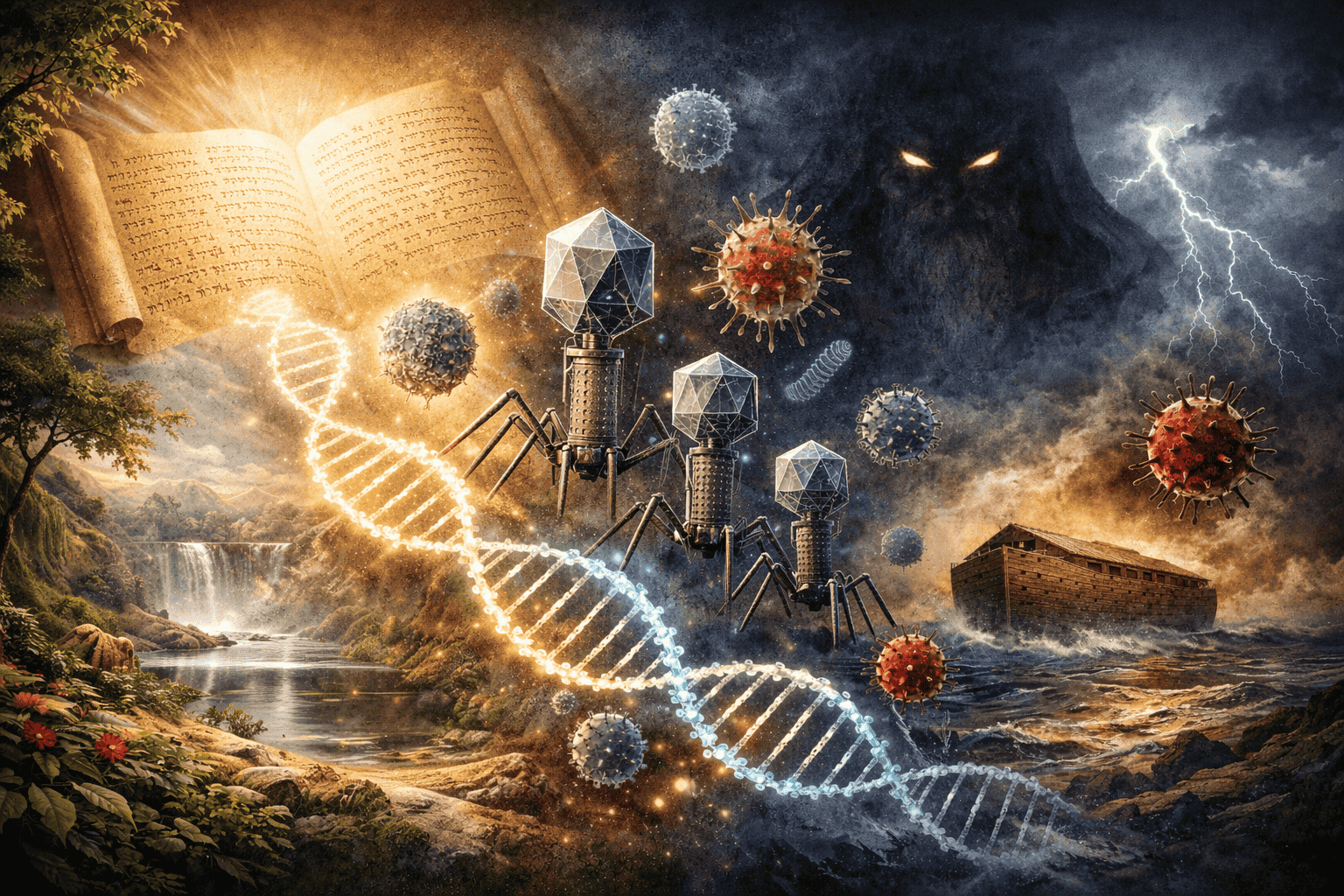
We often view viruses as enemies. We see them as mistakes of nature that exist only to kill. However, this view contradicts the nature of God. The Bible tells us that in the beginning, God looked at everything He made and called it “very good.”
Therefore, viruses must have had a holy purpose originally.
Biology reveals a shocking truth. These microscopic entities were likely designed by the Creator as tools to sustain and improve life. However, like all powerful tools, they fell into the hands of an enemy who turned them into weapons.
God’s Original Tool for Life
Science has discovered something incredible hidden in our DNA. Essential parts of our human biology come from viral instructions.
The most powerful example is the Placenta.
For a mother to carry a child, her body must build a placenta. This organ connects the baby to the mother. Crucially, it prevents the mother’s immune system from attacking the baby. Scientists found that the protein responsible for this, called Syncytin, is not of human origin. It is a viral code.
God apparently used a virus (a retrovirus) to insert this capability into mammals. Without this specific “viral instruction,” human birth would be impossible.
Furthermore, trillions of viruses called Bacteriophages live inside us right now. They do not hurt us. Instead, they hunt down dangerous bacteria. They act as God’s microscopic guardians, protecting our health.
Clearly, the Creator designed these entities as delivery systems. They were meant to update our bodies, share beneficial traits, and protect life.
The Thief Who Cannot Create
If viruses were designed for good, why do they kill us now?
We must understand the nature of Satan. The Bible shows that he cannot create life. Only God is the Creator. Therefore, Satan can only corrupt what already exists. He is a hacker who steals a functional program and rewrites it to destroy the system.
At some point in history—likely during the Fall of Man—the enemy hijacked these biological tools. He took the mechanisms designed to give life (like the placenta virus) and twisted them.
Instead of delivering strength, the corrupted viruses began to deliver death. Instead of repairing the cell, they began to tear it apart. The tool became a weapon.
The Ancient Bio-Engineering
This corruption reached its peak in the days of Noah. Genesis 6 tells us that “all flesh” had corrupted its way upon the earth.
Pre-flood civilizations, influenced by fallen spiritual beings, likely understood the power of these viral tools. Since they could not create new species from scratch, they used viruses to mix existing ones.
They likely used viral vectors to transfer genes between different animals. This created the “chimeras” of ancient legend. They sought to modify the human body to be stronger, taller, and immortal, independent of God.
The result was a biological nightmare. The earth was filled with genetic abominations.
The Flood as a Sterilization Event
This explains the necessity of the Great Flood. God did not send the waters merely because people were lying or stealing. He sent the Flood because the biology of the planet was contaminated.
The Flood was a global sterilization. It washed away the genetically modified monstrosities. It reset the code of life back to Noah, whose bloodline remained pure.
As in the Days of Noah
However, Jesus gave us a specific warning about the end of the world. He said in Matthew 24:37: “But as the days of Noah were, so shall also the coming of the Son of Man be.”
Today, we have returned to the days of Noah.
Modern scientists have rediscovered the technology of the ancients. We once again use viruses as tools in laboratories. We call them “viral vectors.” We use them to edit DNA and modify living organisms. We are creating “chimeras” in labs again. We are even enhancing viruses to make them more potent (Gain of Function).
Humanity has once again taken the pen from God’s hand. We are trying to rewrite the code of life ourselves.
The Final Reset
History is a circle. We are standing at the same precipice as the generation of Noah. We are tampering with the building blocks of creation.
The return of this forbidden technology is a major prophetic sign. It signals that the “time of the Gentiles” is coming to a close. The world is ripening for the final judgment.
The Second Coming of Christ will be the ultimate “System Restore.” He will not just save our souls; He will redeem our bodies. He will wipe away the corruption, the disease, and the death that the enemy inserted into our code. He will restore the biology of the world to the perfection of Eden, where no virus causes harm, and no cell knows death.