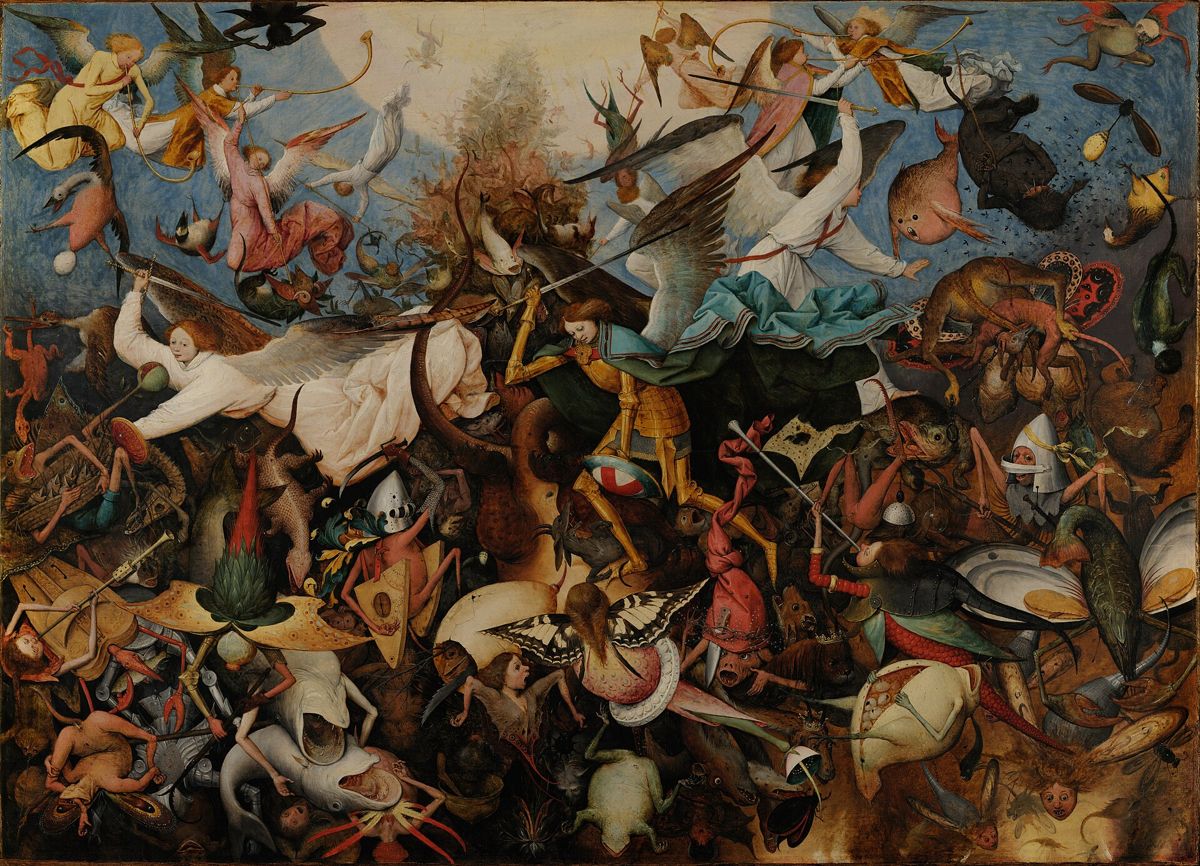
The Book of Enoch names twenty leaders of the fallen angels, the Watchers, in 1 Enoch 6:7. Their chief is Shemihazah. After him come Arteqoph, Remashel, Kokabel, Armumahel, Ramel, Daniel, Ziqel, Baraqel, Asael, Hermani, Matarel, Ananel, Setawel, Samshiel, Sahriel, Tummiel, Turiel, Yamiel and Yehadiel. Chapter 8 says what nine of them taught, from weapons and cosmetics to the signs of the sun and moon. The other 180 of the two hundred are never named.
That is the short answer, and most pages stop there. The longer answer is more interesting, because the list you get depends on which manuscript your translator was reading. In the most widely reprinted English version, several of these names look different. One of them turns into Azazel.
Put the names next to what each angel taught, and a pattern appears. It says a good deal about how the list was made.
Where the List Comes From
Genesis gives four verses to the “sons of God” who took human wives (Genesis 6:1–4) and names none of them. The names come from the Book of the Watchers, chapters 1–36 of 1 Enoch and one of the oldest parts of the book attributed to Enoch, the man who never died.
In 1 Enoch 6 the setup is a conspiracy. The Watchers see the daughters of men and want them. Their leader, Shemihazah, hesitates: he fears that he alone will be held guilty of a great sin. So all of them swear an oath and bind one another with a curse, two hundred angels on the peak of Mount Hermon “in the days of Jared.” The text says the mountain was named for that curse, a pun on the Semitic root ḥrm, “to ban, to devote to destruction.”
Then comes the roster:
“And these are the names of their chiefs: Shemihazah—this one was their leader; Arteqoph, second to him; Remashel, third to him; Kokabel, fourth to him … Yehadiel, twentieth to him. These are their chiefs of tens.” (1 Enoch 6:7–8, Nickelsburg–VanderKam translation)
Chiefs of tens. Twenty officers, each over ten, gives exactly two hundred. It is an organisation chart, not a membership list.
The 20 Watcher Leaders and What They Taught
The table gives the names as they appear in the Hermeneia translation by George Nickelsburg and James VanderKam, which follows the Aramaic wherever the Qumran fragments survive. Next to them are the Ethiopic forms from R. H. Charles’s 1912 translation, the version most free online copies reproduce. The teachings come from 1 Enoch 8:1–3. A dash means chapter 8 gives that angel no specific subject.
| # | Name (Aramaic-based, Nickelsburg–VanderKam) | Ethiopic form (Charles 1912) | Probable root of the name | What he taught (1 Enoch 8) |
|---|---|---|---|---|
| 1 | Shemihazah (the leader) | Sêmîazâz / Semjâzâ | Uncertain | Spells and the cutting of roots |
| 2 | Arteqoph | Arâkîba (6:7); Araqiêl (8:3) | Begins with ʾarʿā, “earth” | The signs of the earth |
| 3 | Remashel | Râmêêl | Uncertain | — |
| 4 | Kokabel | Kôkabîêl | kôkab, “star” | The signs of the stars (Charles: “the constellations”) |
| 5 | <Armumahel> | Tâmîêl | Uncertain (reconstructed) | — |
| 6 | Ramel | Râmîêl | Possibly raʿam, “thunder” | — |
| 7 | Daniel | Dânêl | “God has judged” | — |
| 8 | Ziqel | Êzêqêêl | zîq, “spark, shooting star” | The signs of the shooting stars (Charles: “the knowledge of the clouds”) |
| 9 | Baraqel | Barâqîjâl | baraq, “lightning” | The signs of the lightning flashes (Charles: “astrology”) |
| 10 | Asael | Asâêl (6:7); Azâzêl (8:1) | Probably “God has made” | Weapons and armour, metalworking, gold and silver jewellery, antimony and eye paint, precious stones, dyes |
| 11 | Hermani | Armârôs | Possibly linked to Hermon | Sorcery for loosing spells, magic and skill (Charles: “the resolving of enchantments”) |
| 12 | Matarel | Batârêl | maṭar, “rain” | — |
| 13 | Ananel | Anânêl | ʿanan, “cloud” | — |
| 14 | Setawel | Zaqîêl | Possibly sitwā, “winter” | — |
| 15 | Samshiel (Shamsiel in 8:3) | Samsâpêêl (6:7); Shamsiêl (8:3) | shemesh, “sun” | The signs of the sun |
| 16 | Sahriel | Satarêl (6:7); Sariêl (8:3) | sahar, “moon” | The signs of the moon (Charles: “the course of the moon”) |
| 17 | <Tummiel> | — (not in Charles’s list) | Uncertain (reconstructed) | — |
| 18 | Turiel | Tûrêl | ṭûr, “mountain, rock” | — |
| 19 | Yamiel | Jômjâêl | yôm, “day” (or yam, “sea”) | — |
| 20 | Yehadiel | Sariêl (slot 19 in Charles) | Uncertain | — |
Two things stand out. First, only nine of the twenty get a speciality. According to 1 Enoch 7:1, all of them taught their wives “sorcery and charms” and “the cutting of roots and plants.” Chapter 8 then picks out the specialists.
Second, compare the names with the subjects. Baraqel (baraq is lightning) teaches the signs of the lightning flashes. Kokabel (kôkab, star) teaches the signs of the stars. Shamsiel (shemesh, sun) teaches the sun, and Sahriel (sahar, moon) the moon. Ziqel, from a word for a spark or shooting star, teaches the shooting stars. Arteqoph, whose name begins with the Aramaic word for earth, teaches the signs of the earth.
The angels are named after their subjects. Hold on to that; it comes back below.
Asael or Azazel?
The tenth name matters most, and it changes most. In the Aramaic fragments and in Nickelsburg’s translation he is Asael. In Charles’s translation from the Ethiopic he is Asâêl in the 6:7 list, then Azâzêl in chapter 8, in 9:6 and in chapter 10.
Azazel is a name with a biblical address. On the Day of Atonement, Leviticus 16 has two goats chosen by lot, “one lot for the LORD and the other lot for Azazel.” The second goat is sent alive “into the wilderness to Azazel,” carrying the people’s sins (Leviticus 16:8–10). Leviticus never says who or what Azazel is.
1 Enoch 10 reads like an answer. God tells Raphael to bind Asael hand and foot, open a pit in the wilderness at Doudael (Charles: Dûdâêl) and throw him in. He is to be covered with jagged stones and darkness until the judgement. Then comes the line: “over him write all the sins” (10:8; Charles has “to him ascribe all sin”).
So he is exiled to the wilderness with every sin written over him. Was Asael’s punishment modelled on the scapegoat ritual? Or did later copyists merge the two names because the stories fit? Scholars still argue about it. The text as it stands makes the link either way.
The shift from Asael to Azazel is also a warning. When a name in this list looks unfamiliar, the real question is usually which manuscript it came through, not which angel it was.
The Second List: 1 Enoch 69
The Book of Enoch names the fallen angels twice. The second roster is in 1 Enoch 69, part of the Book of Parables (chapters 37–71). That is the one major section of 1 Enoch not found among the Dead Sea Scrolls, and it is generally dated later than the Book of the Watchers.
It opens by repeating the chiefs, but the names are badly damaged. Charles counts twenty-one, marks six of them as corrupt, and has Azazel appear twice, tenth and twenty-first. Then the chapter switches to a different group, the chiefs who did specific damage:
- Yeqon (Jeqôn) led “all the sons of God” astray and brought them down to the earth through the daughters of men (69:4).
- Asbeel (Asbeêl) gave the holy sons of God “evil counsel” (69:5).
- Gadreel (Gâdreêl) showed humans “all the blows of death” and led Eve astray. He also handed over the shield, the coat of mail, the sword and “all the weapons of death” (69:6).
- Penemue (Pênêmûe) taught “the bitter and the sweet” and the secrets of wisdom, and “instructed mankind in writing with ink and paper” (69:8–9).
- Kasdeya (Kâsdejâ) showed humans “all the wicked smitings of spirits and demons,” including harm to the embryo in the womb and the bite of the serpent (69:12).
A further figure, Kasbeel, is named “the chief of the oath” (69:13), and then the chapter moves on to cosmology.
Notice what has moved. In chapter 8 weapons belong to Asael; in chapter 69 they belong to Gadreel. And Penemue’s offence, writing, is treated as a disaster: “men were not created for such a purpose, to give confirmation to their good faith with pen and ink” (69:10, Charles).
Why the Names Differ Between Translations
No complete manuscript of 1 Enoch survives in its original language. The names reach us through three channels:
- Aramaic. These are fragments from Qumran Cave 4, published by J. T. Milik in 1976. 4Q201 (4QEnocha) covers 1 Enoch 6:4–8:1 and 8:3–9:3. 4Q202 (4QEnochb) covers 6:7–8:1 and 8:2–9:4, and 4Q204 also preserves part of 6:7. Judging by the handwriting, the oldest Book of the Watchers fragments date to around 200–150 BC.
- Greek. The sixth-century Codex Panopolitanus from Akhmim in Egypt was published in 1892. The Byzantine chronicler George Syncellus also quotes 6:1–9:4.
- Ge’ez (Ethiopic). This is the only complete text. It survived because 1 Enoch is scripture in the Ethiopian Orthodox Tewahedo Church. Charles made his 1912 translation from his own edition of the Ethiopic and printed the Greek fragments alongside it.
Charles worked before the Aramaic was published; Nickelsburg and VanderKam worked after. Their note on 6:7 is blunt: the names “are often corrupted in the Gk and Eth” and “are largely attested in the Aram.” Nickelsburg sets out the reconstruction in his Hermeneia commentary (1 Enoch 1, p. 175).
The corruptions follow familiar copying patterns:
- Matarel becomes Batarel, probably a confusion of M and B.
- Hermani becomes Armaros in Charles’s Ethiopic.
- Ziqel becomes Ezeqeel, and his subject shifts from “shooting stars” to “the knowledge of the clouds.”
- Arteqoph is Arakiba in 6:7 but Araqiel in 8:3, apparently two Ethiopic forms of one angel.
- Samshiel is Samsapeel in 6:7 and Shamsiel in 8:3; Sahriel becomes Sariel in 8:3.
- Baraqel teaches “the signs of the lightning flashes” in Nickelsburg and “astrology” in Charles.
Nickelsburg prints two names, Armumahel and Tummiel, in angle brackets, which marks them as editorial reconstructions rather than secure readings. Charles’s list has only nineteen names.
So any page that gives you a confident list of “the 20 fallen angels,” with one spelling each, has picked a single manuscript tradition, usually without saying which.
Two Ways to Read the Roster
The literary reading. On the mainstream scholarly view, the list is a composition, and the names give it away. Angels called Lightning of God, Star of God, Sun of God and Moon of God, each teaching exactly that subject, are labels rather than reports. The story explains where evil and dangerous knowledge came from: weapons, seduction, sorcery, divination from the sky. It pins all of it on heavenly rebels, and the oath on Hermon makes the whole group equally guilty. Read this way, the roster is a theological argument laid out as an organisation chart.
The knowledge-transfer reading. The other reading takes the curriculum at face value and looks at what is on it. Metallurgy. Weapons manufacture. Cosmetics and dyes, which are chemistry. Root-cutting, which is pharmacology. Astronomy, weather, the reading of the earth. Writing. Every item is a real technology. The text does not object that humans learned the wrong things. It objects that they learned them too early, from the wrong source, all at once. That is why the Watchers’ teaching sits so close to the giants in the Book of Enoch: both are the same failure, power delivered before anyone could handle it.
The literary reading finds the weak spot in the second one: a list whose names match their subjects this neatly looks built, not witnessed. The second reading’s strength is that the first does not explain why this particular set of skills was chosen as the dangerous one. The text does not settle it.
Either way, these are not the rebels of Revelation 12. The war in heaven is a different story with a different leader, and later tradition merged the two.
What the List Does Not Say
It does not name all two hundred. No manuscript of 1 Enoch contains two hundred names. Any such list you find online has been assembled from later sources or made up.
It does not include the famous names. Lucifer, Beelzebub and Samael appear in neither list. They come from other texts and later traditions.
It does not make the Watchers into roaming demons. In 1 Enoch the Watchers are bound, under the earth or in the wilderness, until the judgement. The evil spirits that roam the earth are something else: in 1 Enoch 15:8–9 they are the spirits that come out of the giants’ bodies.
The Names Are the Argument
The twenty names in 1 Enoch 6:7 are one of the few places where an ancient text gives you the rebels by name and rank. They survived through Aramaic scraps, Greek copies and a single complete Ethiopic tradition, and each channel bent the spelling.
What survives intact is the idea. The leaders are named after what they knew, and what they knew is what the story is afraid of.
Sources
- George W. E. Nickelsburg and James C. VanderKam, 1 Enoch: The Hermeneia Translation (Fortress Press, 2012) — fortresspress.com; publisher’s sample of chapters 1–36, including 6:7 and 8:1–3 — ms.augsburgfortress.org (PDF)
- George W. E. Nickelsburg, 1 Enoch 1: A Commentary on the Book of 1 Enoch, Chapters 1–36; 81–108, Hermeneia (Fortress Press, 2001); discussion of the names on p. 175 — fortresspress.com
- R. H. Charles, The Book of Enoch, or 1 Enoch (Oxford: Clarendon Press, 1912) — archive.org
- Charles 1912, chapter 6 (the list of names) — sacred-texts.com/bib/boe/boe009.htm
- Charles 1912, chapter 8 (the teachings) — sacred-texts.com/bib/boe/boe011.htm
- Charles 1912, chapter 10 (Azazel bound) — sacred-texts.com/bib/boe/boe013.htm
- Charles 1912, chapter 15 (the giants’ spirits) — sacred-texts.com/bib/boe/boe018.htm
- Charles 1912, chapter 69 (the second list) — sacred-texts.com/bib/boe/boe072.htm
- J. T. Milik, The Books of Enoch: Aramaic Fragments of Qumrân Cave 4 (Oxford: Clarendon Press, 1976) — archive.org
- 4Q201 (4QEnocha), Leon Levy Dead Sea Scrolls Digital Library — deadseascrolls.org.il
- 4Q202 (4QEnochb), Leon Levy Dead Sea Scrolls Digital Library — deadseascrolls.org.il
- Book of Enoch: manuscripts, the Qumran fragments, the Greek witnesses — en.wikipedia.org/wiki/Book_of_Enoch
- Genesis 6:1–4 (NRSVUE) — biblegateway.com
- Leviticus 16:8–10 (NRSVUE) — biblegateway.com
Frequently Asked Questions
What are the names of the fallen angels in the Book of Enoch?
1 Enoch 6:7 names twenty leaders of the two hundred Watchers: Shemihazah, Arteqoph, Remashel, Kokabel, Armumahel, Ramel, Daniel, Ziqel, Baraqel, Asael, Hermani, Matarel, Ananel, Setawel, Samshiel, Sahriel, Tummiel, Turiel, Yamiel and Yehadiel. These spellings follow the Aramaic, as in the Nickelsburg–VanderKam translation. The older Charles translation, made from the Ethiopic, has different forms for several of them (Semjaza, Armaros, Batarel, Ezeqeel) and only nineteen names.
Who was the leader of the Watchers?
Shemihazah, spelled Semjaza or Semyaza in older translations. 1 Enoch 6 has him fear that he alone will pay for the sin, which is why all two hundred swear a joint oath on Mount Hermon. In 1 Enoch 8 he teaches spells and root-cutting. Asael (Azazel), the tenth on the list, is blamed more heavily for the corruption of the earth.
Are all 200 fallen angels named in the Book of Enoch?
No. 1 Enoch names twenty “chiefs of tens”, each over ten angels, which accounts for the two hundred. The other 180 are never named, and no manuscript contains a list of two hundred names. Chapter 69 adds a second, partly corrupted list and five named chiefs: Yeqon, Asbeel, Gadreel, Penemue and Kasdeya.
Is Azazel the same as Asael?
In 1 Enoch, yes. The Aramaic fragments and the 6:7 list have Asael, while the Ethiopic text calls him Azazel in chapters 8 to 10. That name links him to the scapegoat sent “to Azazel” in Leviticus 16, and 1 Enoch 10 has Raphael bind him in a desert pit and write all sin over him. Whether the two figures were connected from the start or merged during copying is still debated.
What did the fallen angels teach humans in the Book of Enoch?
According to 1 Enoch 8, Asael taught weapons, metalworking, jewellery, cosmetics, precious stones and dyes. Shemihazah taught spells and root-cutting, and Hermani the loosing of spells. Baraqel, Kokabel, Ziqel, Arteqoph, Shamsiel and Sahriel taught the signs of lightning, stars, shooting stars, earth, sun and moon. 1 Enoch 69 adds Gadreel (weapons of death), Penemue (writing with ink and paper) and Kasdeya (harmful “smitings” of spirits and demons).
Continue Reading
- Books Mentioned in the Bible but Not Included: The Dead Links — Around twenty books are named in scripture as its own sources, cited more than forty times, and not one has ever been…
- What Do Angels Look Like? Men More Often Than Wings — Abraham fed three of them and took them for travellers. Daniel saw one and lost his strength. The Bible describes…
- Waking Up at 3 AM: The Spiritual Meaning and the Science — Millions wake at the same hour and find two answers that barely speak to each other: a spiritual tradition that prizes…